Reviewed · CRAFT WORKSHOPS
Tokyo: Japanese Calligraphy Lesson with Skilled Instructor
The best part of this one-hour Asakusa class is that you do not simply watch a demonstration. You choose a Japanese word, learn what it means, practice it again and again, then put your finished work on a fan, decorative board, or hanging scroll. Instructor Shusuke brings more than 10 years of calligraphy experience and explains the language in English.
In This Article
- Key points to know before booking
- Why this Asakusa calligraphy class feels personal
- Choosing a word with meaning
- The 20-sheet practice session
- Creating an uchiwa, shikishi, or kakemono
- A patient teacher with useful language skills
- The room, location, and timing in Asakusa
- What the $45 price buys you
- Who will enjoy this experience most
- Booking details that matter
- Should you book this calligraphy lesson?
- FAQ
- Where does the calligraphy class take place?
- How long does the activity last?
- How many people can join?
- What languages does the instructor speak?
- What can I take home?
- Can I cancel or pay later?
I like the small limit of four people, which keeps the lesson calm and gives you room to ask questions. I also like the 20 sheets of hanshi paper. That is enough practice to understand how brush pressure and stroke order affect the final character. The main consideration is that the exact rental room is sent after booking, and the whole class lasts only an hour, so you will need to settle on your word fairly quickly.
Key points to know before booking
- Choose a meaningful Japanese word: Sample works come with English explanations, so you can pick a character for its meaning, not just its shape.
- Practice on 20 sheets: About half the class is set aside for repeated practice and personal advice.
- Take home original artwork: Pick an uchiwa fan, shikishi board, or kakemono hanging scroll for your final piece.
- Learn with Shusuke: He is a certified third dan calligrapher with more than 10 years of teaching experience.
- Expect a very small class: The limit is four participants, with English and Japanese instruction.
- Plan for an Asakusa rental room: The room may have tatami flooring or a Western-style table and chairs.
Why this Asakusa calligraphy class feels personal
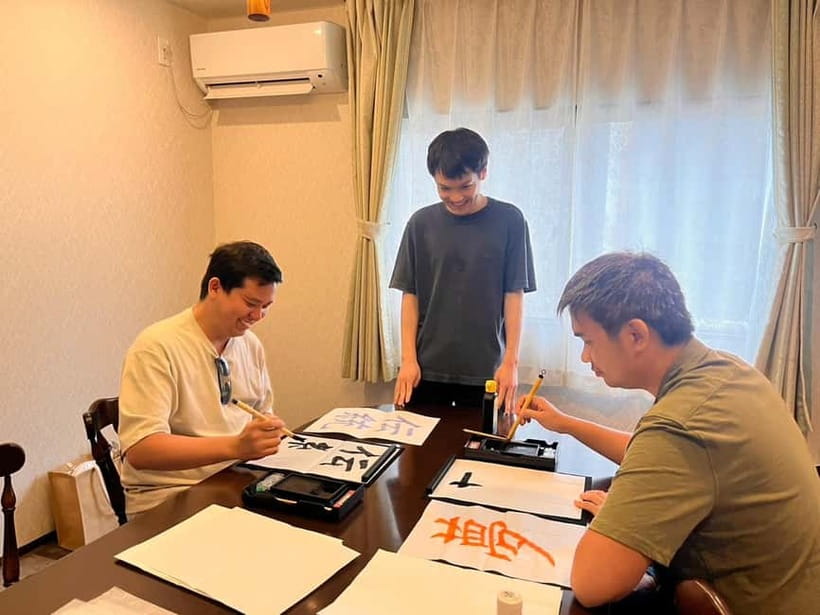
Japanese calligraphy can look intimidating at first. A single black character may appear simple, but its balance depends on brush angle, ink control, pressure, speed, and the order of each stroke. This class gives you a friendly way into that art without asking you to arrive with any Japanese-language skill.
You begin by looking through examples of words and phrases. Shusuke explains their meanings in English and helps you choose one that feels right. That step matters. You are not copying a random decorative symbol from a menu. You are selecting a word you can take home with a clear sense of what it represents.
The activity uses Japanese terms such as kanji, the character-based writing system often used for words with Chinese origins. You may also hear about the three forms of Japanese calligraphy, an aspect one participant found useful for understanding how the writing systems differ. The information is kept practical, tied to the brush work in front of you.
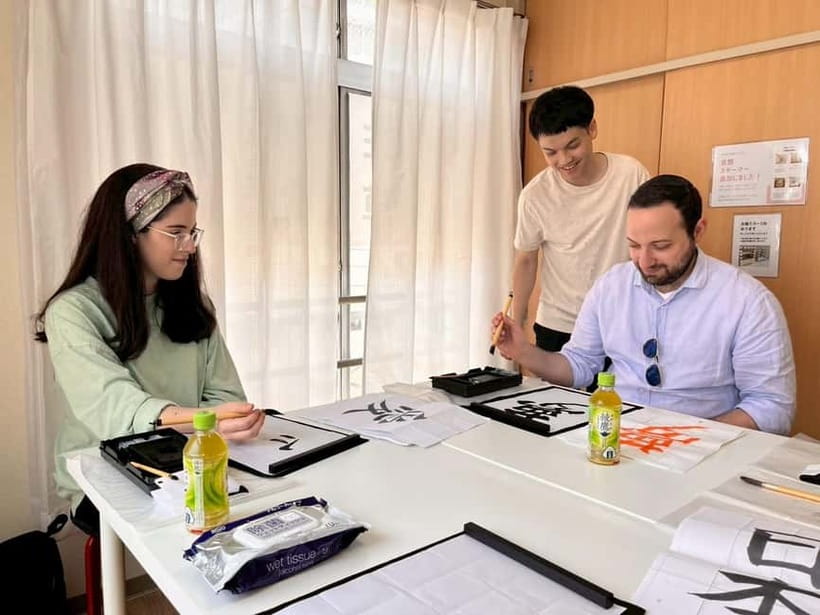
The setting is deliberately small. With no more than four people, you get more attention than you would in a large workshop. You can ask Shusuke to correct a stroke, explain a word, or suggest how to arrange your finished character on the souvenir. The class has been praised for its calm feel and private-room setting, which makes it a good break from Tokyo’s crowded streets.
A few more Tokyo tours and experiences worth a look

Choosing a word with meaning
The choice of word is the first decision that shapes the whole experience. Sample calligraphy pieces are available, and each word comes with an English explanation. You can select a single kanji or a short phrase based on an idea that matters to you.
This is where the instructor’s language skills help. Shusuke speaks native Japanese and advanced English, so you can ask about meaning and use instead of relying on a literal dictionary translation. That is especially useful because Japanese characters can carry several related meanings, and a word that looks attractive may not express what you intend.
I recommend choosing a word connected to your trip, your family, or a quality you want to remember. The supplied information does not give a fixed list of choices, so you should expect to select from the samples available in the room rather than request any possible phrase in advance.
Do not rush this part, but keep an eye on the clock. The class lasts one hour, and roughly 30 minutes are planned for practice. A short choice is likely to work better than a long sentence, since you need enough time to write it properly and transfer it to the final item.
The 20-sheet practice session
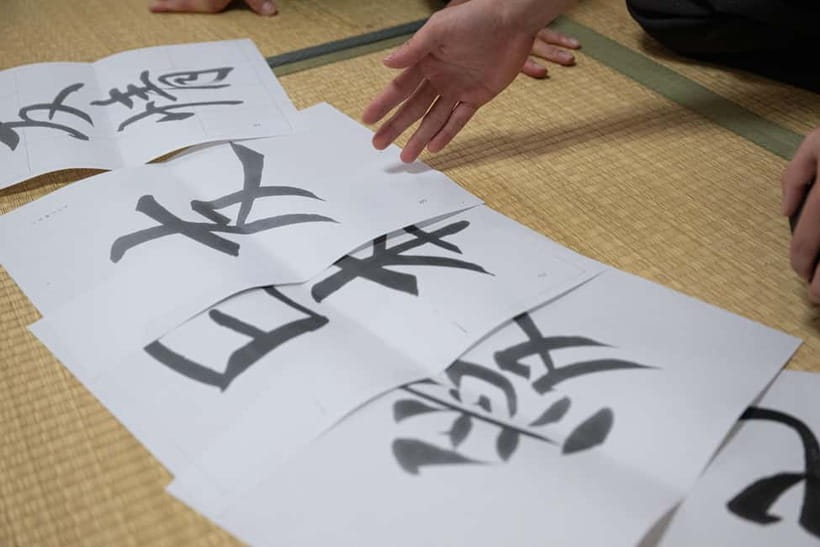
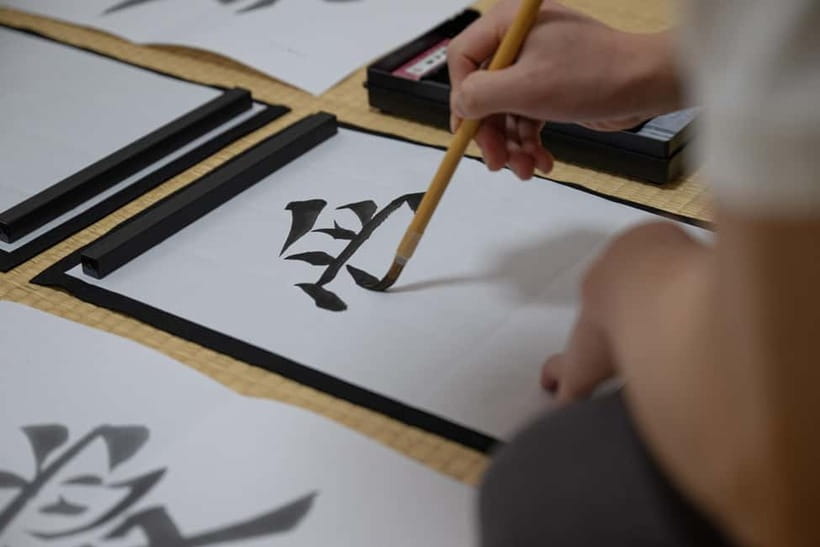
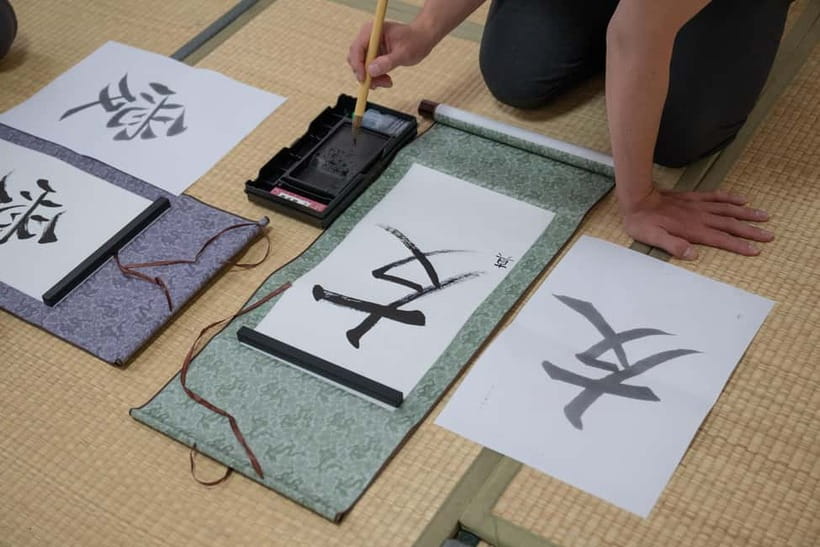
After choosing your word, you work on hanshi, the thin paper used for calligraphy practice. Each participant receives 20 sheets. That generous paper allowance is one of the strongest practical features of the class because your first attempt is unlikely to be your best.
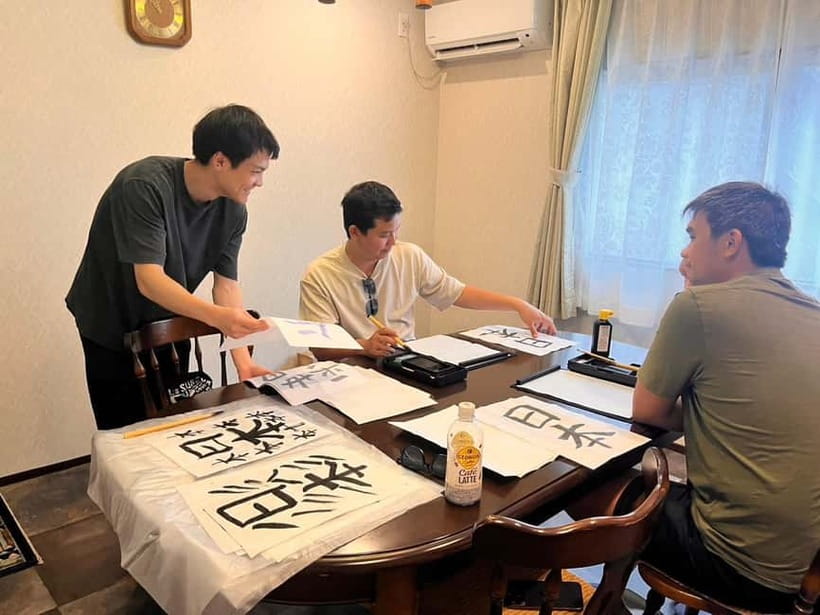
Calligraphy is learned through repetition. You may begin by holding the brush too tightly or pressing too hard. On the next sheet, you might slow down a stroke or leave more space between two parts of a character. Shusuke can watch these changes and give you specific advice instead of letting you repeat the same mistake.
The practice period lasts about half an hour. You work at your own pace, with step-by-step guidance and personal tips. This does not mean you will produce professional calligraphy in 30 minutes. It does mean you will understand more about the process and have several attempts from which to choose.
The paper also gives you a useful safety net. You can experiment without worrying that one imperfect line has ruined the souvenir. If you are new to brush work, I would treat the practice sheets as part of the experience, not as disposable material. They show how your writing changes from the first attempt to the one you finally decide to keep.
Creating an uchiwa, shikishi, or kakemono
Once you are happy with your word, you transfer it to the souvenir of your choice. The options are different in size and character, so your selection affects how the finished work will look and travel home.
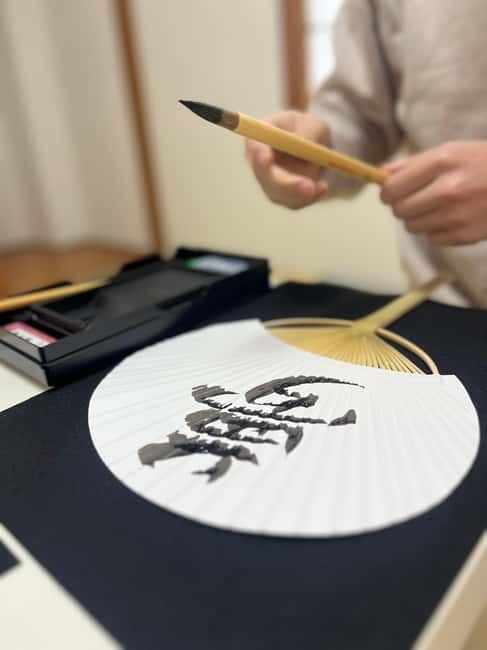
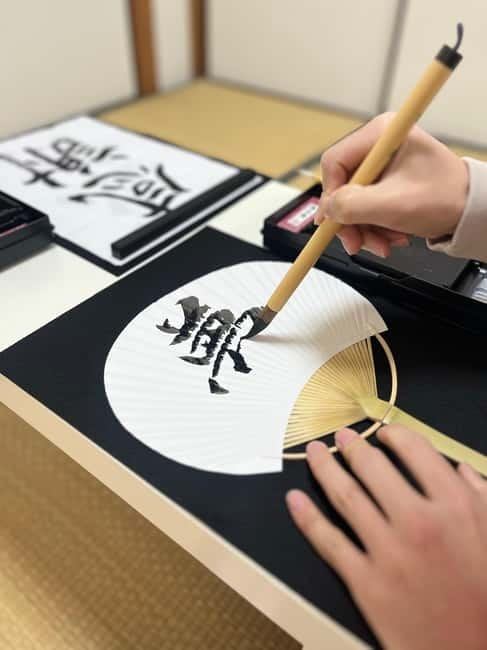
An uchiwa is a traditional Japanese fan. It is a light, distinctly Japanese object that can be displayed or used, and its shape gives your writing a more informal feel. A shikishi is a decorative board designed for artwork or calligraphy. It offers a firm surface and is easy to frame or place on a shelf.
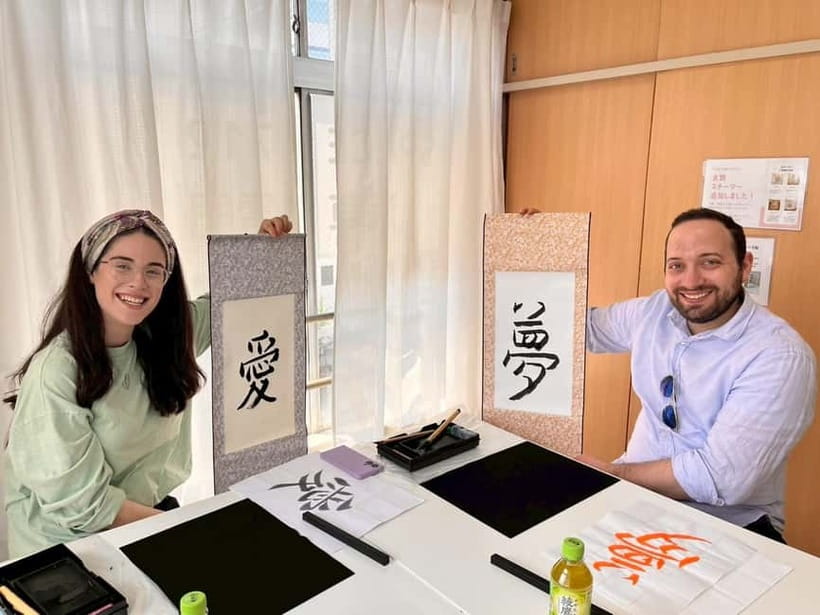
A kakemono is a hanging scroll. It gives the finished character a more formal appearance and makes a particularly memorable keepsake. One participant specifically received a scroll and wrote a kanji character on it, so this option is worth considering if you want something that feels closely tied to traditional display.
The activity does not say that every item is available at every session, so you should confirm the available choice when you arrive. The important point is that you are making the final souvenir yourself. It is not a printed product with your name added later.
A patient teacher with useful language skills
Shusuke is certified in Japanese calligraphy at third dan level through the Japan Educational Calligraphy Federation. He has taught for more than 10 years and speaks Japanese and English, with beginner Korean as an additional language.
For you, the teaching experience matters more than the certificate alone. A skilled calligrapher knows how to perform a character, but an experienced teacher also knows how to break that movement into steps a beginner can follow. The class includes demonstrations, hands-on guidance, and corrections as you practice.
The personal side of the instruction is also useful. Shusuke has traveled in more than 20 countries, studied abroad in the Philippines and Canada, and traveled widely in Japan. You can ask him for ideas about places to visit beyond the class, though the main focus remains calligraphy.
The strongest praise connected to the instructor centers on his calm manner, clear explanations, communication, and willingness to help with questions. That combination suits beginners who may feel nervous about producing something in front of a trained artist. The experience is structured, but it is not described as a stiff or formal lesson.
A few more Tokyo tours and experiences worth a look
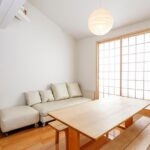

The room, location, and timing in Asakusa
The class takes place in one of several rental rooms in Asakusa. You receive the exact address and meeting point by email after reserving. Depending on availability, the room may be Japanese style with tatami flooring or Western style with a table and chairs.
That detail is worth noting when you plan your day. Do not head to a single assumed studio address before receiving the confirmation message. One participant found the meeting point easy to locate and communication clear, but you should still read the email carefully and allow enough time to find the assigned room.
Asakusa is a sensible part of Tokyo for this activity because it is associated with traditional culture and sightseeing. The supplied details do not promise a tour of the neighborhood, so treat the class as a one-hour scheduled activity rather than a walking tour. You can place it before or after your own Asakusa plans.
The group limit is four. That makes the class workable for solo visitors, couples, families, or a small group of friends. A group of four can share the activity while still receiving individual correction. If you prefer a quiet setting to a large craft workshop, this format is a strong match.
What the $45 price buys you
At $45 per person, the value comes from the combination of instruction, materials, and a finished object. You receive access to the word samples, English explanations, guided practice, 20 sheets of hanshi paper, your choice of souvenir, and a commemorative photo.
The class is not simply a short demonstration followed by a souvenir purchase. About half the hour is devoted to your own practice, and the final piece is made from your handwriting. That makes the price easier to justify for people who want an activity rather than another item from a shop.
The one-hour length also keeps the cost and time commitment manageable. You can fit it into a full Tokyo day without giving up an entire afternoon. The tradeoff is that you will not receive a long lesson in Japanese calligraphy history or an advanced course in brush technique. You are paying for a focused introduction and a personal keepsake.
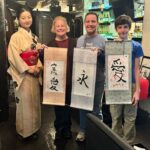
The included photo adds a nice finishing touch. It records you with the artwork you made, rather than leaving you with only a wrapped souvenir. If you are comparing this class with a larger craft session, the small group and individual advice are the main reasons to choose it.
Who will enjoy this experience most
I would recommend this class to first-time visitors who want a hands-on link to Japanese culture. It works well for couples looking for a shared keepsake, families with older children who can handle careful brush work, and solo visitors who enjoy learning through making.
It also suits anyone who has an interest in Japanese characters but cannot read Japanese. The English explanations give you a reason for choosing your word, while the instructor’s guidance keeps the writing approachable.
You should be comfortable with a little trial and error. The goal is not perfect professional calligraphy. Your finished character will show your own hand, and that is part of its value. If you only want a flawless piece made by an expert, a calligraphy shop or custom commission may suit you better.
The class may be less appealing if you want a long cultural lecture, a broad sightseeing program, or a large selection of activities in one booking. This is a quiet craft lesson with one clear focus.
Booking details that matter
The experience costs $45 per person and lasts one hour. Instruction is available in English and Japanese, and participation is limited to four people.
You can reserve now and pay later, which helps if your Tokyo schedule is still changing. Free cancellation is available up to 24 hours in advance for a full refund. Starting times depend on availability, so check the schedule before building the rest of your day around the class.
Because the room address is sent after booking, keep an eye on your email. The activity provider is Experience Calligraphy Tokyo, and the instructor’s name is Shusuke. Those details are useful when checking your confirmation and finding the right rental room in Asakusa.
Should you book this calligraphy lesson?
Book it if you want a calm, personal activity that leaves you with something you made yourself. The small group, English explanations, 20 practice sheets, and choice of fan, board, or scroll give the hour real substance.
I would especially choose it for a first calligraphy experience, a rainy-day plan, or a quiet pause between Asakusa sightseeing stops. Skip it if you want a longer workshop or a polished artwork produced entirely by a professional. For most beginners, the chance to understand a word, practice it patiently, and carry home your own kanji makes this a good-value Tokyo experience.
FAQ
Where does the calligraphy class take place?
The class uses a rental room in Asakusa. The exact location and meeting point are sent by email after you reserve. The room may be Japanese style with tatami or Western style with a table and chairs.
How long does the activity last?
The activity lasts one hour. Starting times depend on availability.
How many people can join?
The class is limited to four participants, making it a small-group activity.
What languages does the instructor speak?
Instruction is available in English and Japanese. Shusuke speaks native Japanese and advanced English.
What can I take home?
You can create your chosen word or phrase on one souvenir item: an uchiwa fan, shikishi decorative board, or kakemono hanging scroll.
Can I cancel or pay later?
You can cancel up to 24 hours in advance for a full refund. You can also reserve now and pay later, so no payment is required at the time of booking.
More Workshops & Classes in Tokyo
More Craft Workshops in Tokyo

More tours in Tokyo we've reviewed












Craft Workshops, compared.
 ★ 4.8Chopstick Making Workshop in GinzaFrom $251 hour
 ★ 5.0Kintsugi Experience: Art of Golden Joinery in TokyoFrom $59
Tokyo: Shinjuku Chopstick Making ClassFrom $121 hour
 ★ 5.0Private Craft Your Own Ring Handmade Experience in Asakusa, TokyoFrom $21
 ★ 5.0Authentic Pure Gold Kintsugi Workshop with Master Taku in TokyoFrom $142
 ★ 5.0Tokyo: Calligraphy on Kanji Fan & Scroll with DrinkFrom $531h 20m