
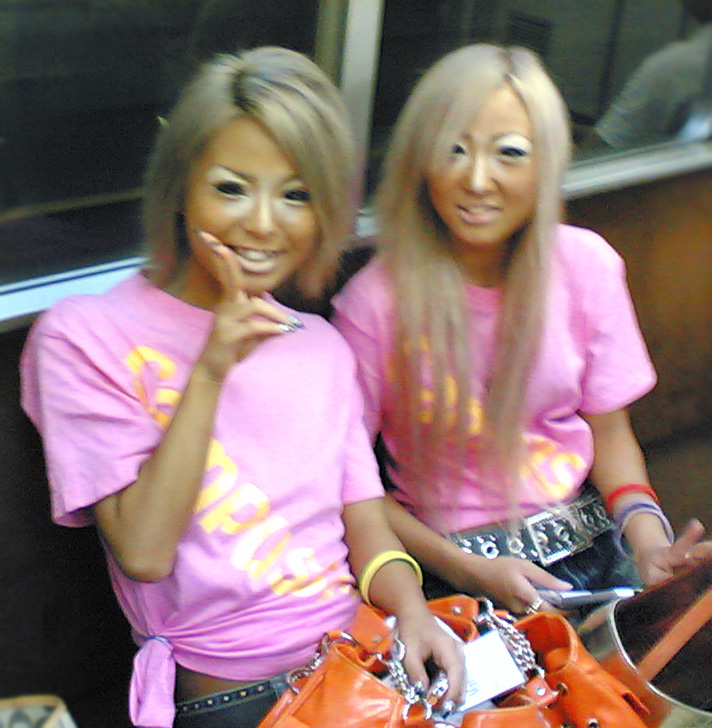
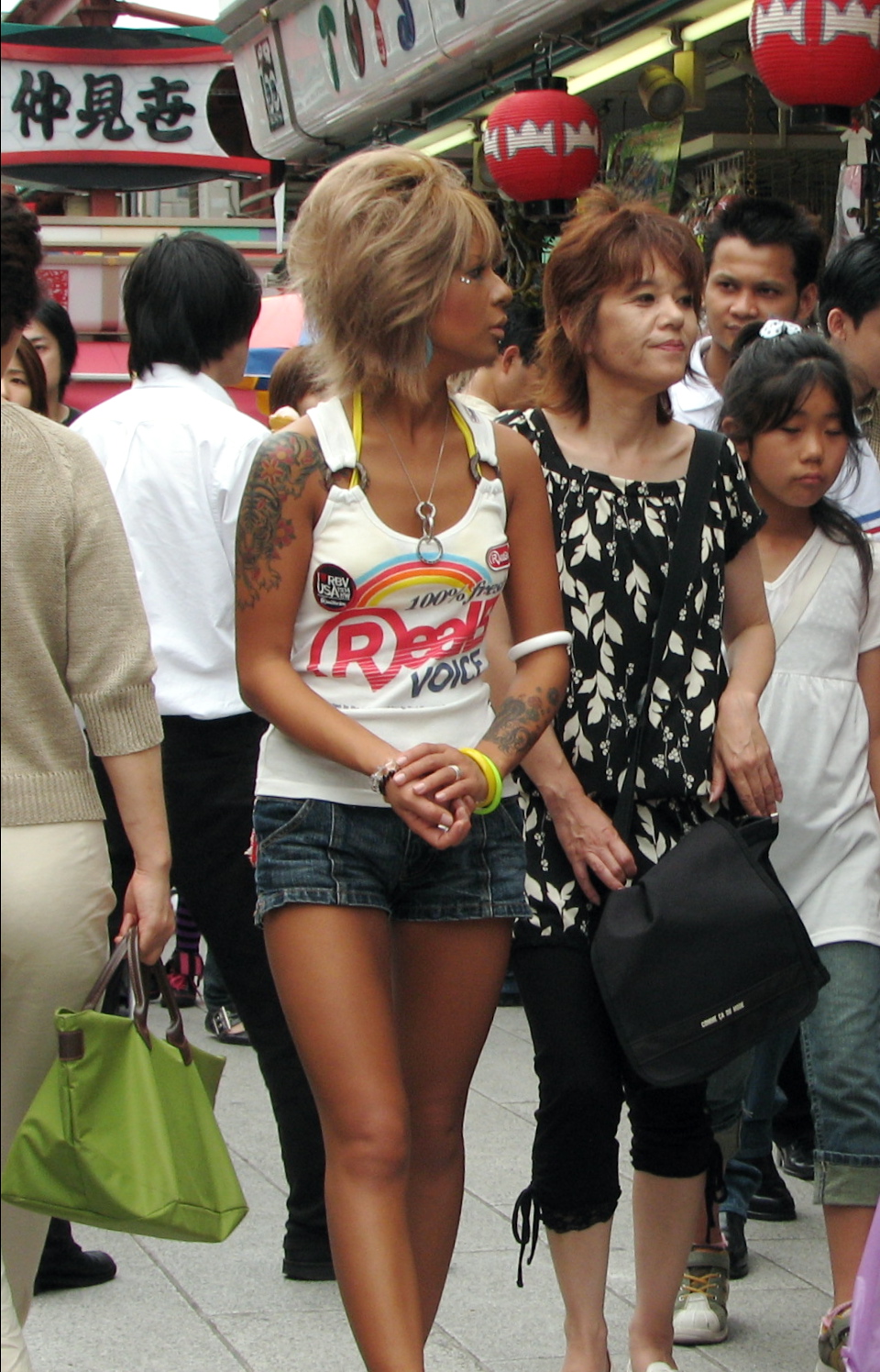
Between roughly 1996 and 2005, a specific teenage girl would roll off the Yamanote Line at Shibuya Station, walk into Shibuya 109, and emerge two hours later with skin tanned almost to brown, bleached white hair, black and white eyeliner that made her eyes look raccoon-like, platform boots the height of small books, and a miniskirt over a tie-dyed sarong. She was a ganguro gal, she was deliberately breaking every Japanese beauty norm, and for about a decade she was the most photographed street-fashion phenomenon in Tokyo.
In This Article
- Quick facts at a glance
- What was ganguro, exactly?
- Where did ganguro come from?
- What was Shibuya 109’s role?
- Who were the extreme variants: Yamanba and Manba?
- Why did ganguro die?
- 1. The bihaku counter-trend
- 2. The “sweet” style takeover
- 3. The 2008 financial crisis
- Is there anywhere you can still see ganguro in Tokyo?
- What replaced ganguro in Shibuya?
- How does ganguro connect to the broader Japanese subculture story?
- What about ganguro’s international influence?
- Is ganguro problematic?
- Should you care about ganguro now?
Then the trend ended. By 2010 the style had basically disappeared from Shibuya. By 2017, Fragments Magazine ran a feature on Erimokkori — “the last ganguro gal” — interviewing her about why she was still committed to the look ten years after everyone else had moved on. Today you can go months in Tokyo without seeing a single ganguro outfit.
This guide covers what ganguro actually was, why it mattered, where it lived, why it died, what replaced it, and whether you can still see any traces of it today.
Quick facts at a glance
- Name: Ganguro (ガングロ) — literally “very black”, referring to the deep tan
- Active years: Mid-1990s emergence, 1999–2005 peak, mostly gone by late 2000s
- Birthplace: Shibuya, Tokyo — specifically Shibuya 109 mall and the streets around it
- Core look: Extreme tan, bleached hair, black-and-white eyeliner, false eyelashes, platform shoes, bright miniskirts
- Extreme subsets: Yamanba (“mountain witch”), Manba — even more exaggerated versions
- What killed it: Bihaku (“light skin”) beauty trend of the late 2000s plus the 2008 financial crisis
- Can you still see it? Almost never. A few nostalgia events per year. One or two holdout gyaru cafes.
What was ganguro, exactly?
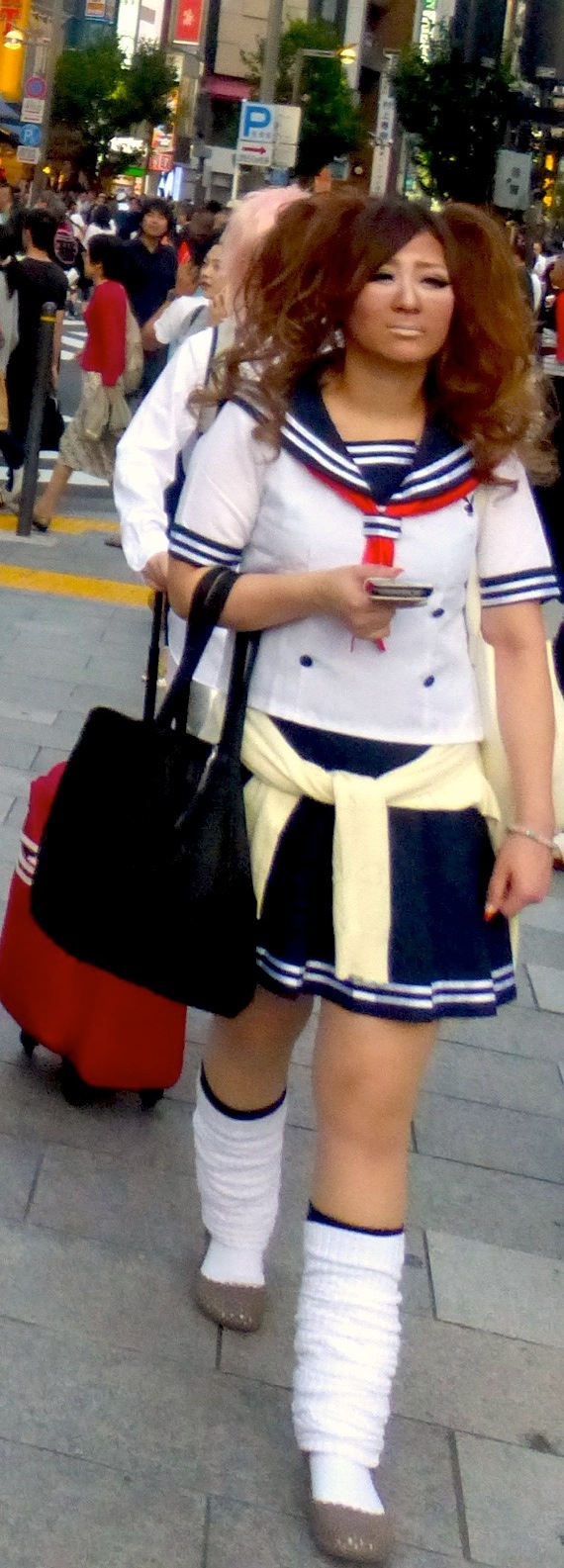
Ganguro was a subset of the broader “gal” (ギャル, gyaru) fashion movement that started in Japan in the late 1980s. Gal style itself was a reaction against the conservative, traditional Japanese beauty standard — pale skin, straight black hair, muted makeup, modest clothing. Gal style inverted every single one of those.
Within the gal subculture, ganguro specifically pushed the inversion to its furthest logical extreme. Everything was cranked up:
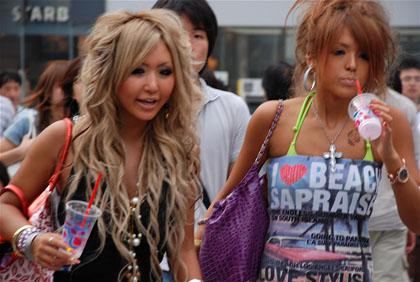
- Skin: Tanned to the deepest brown the wearer could achieve — often with tanning beds, spray tans, or extended beach visits. The name itself (“very black”) was about the skin.
- Hair: Bleached almost white, sometimes with streaks of dyed colour. Naturally jet-black Japanese hair, aggressively stripped.
- Eye makeup: Heavy black eyeliner paired with white eyeshadow or white eyeliner under the eye — the signature raccoon-effect. False eyelashes stacked on top.
- Lips: Light or frosted, deliberately undersized against the dark skin.
- Clothing: Short miniskirts, tie-dyed sarongs, bright colours, hibiscus print, beachy/Hawaiian-influenced prints. Platform shoes were mandatory — often with 15-20 cm soles.
- Accessories: Piles of plastic bracelets, rings, necklaces, hair flowers, and cell phones encrusted with stickers, crystals, and charms.
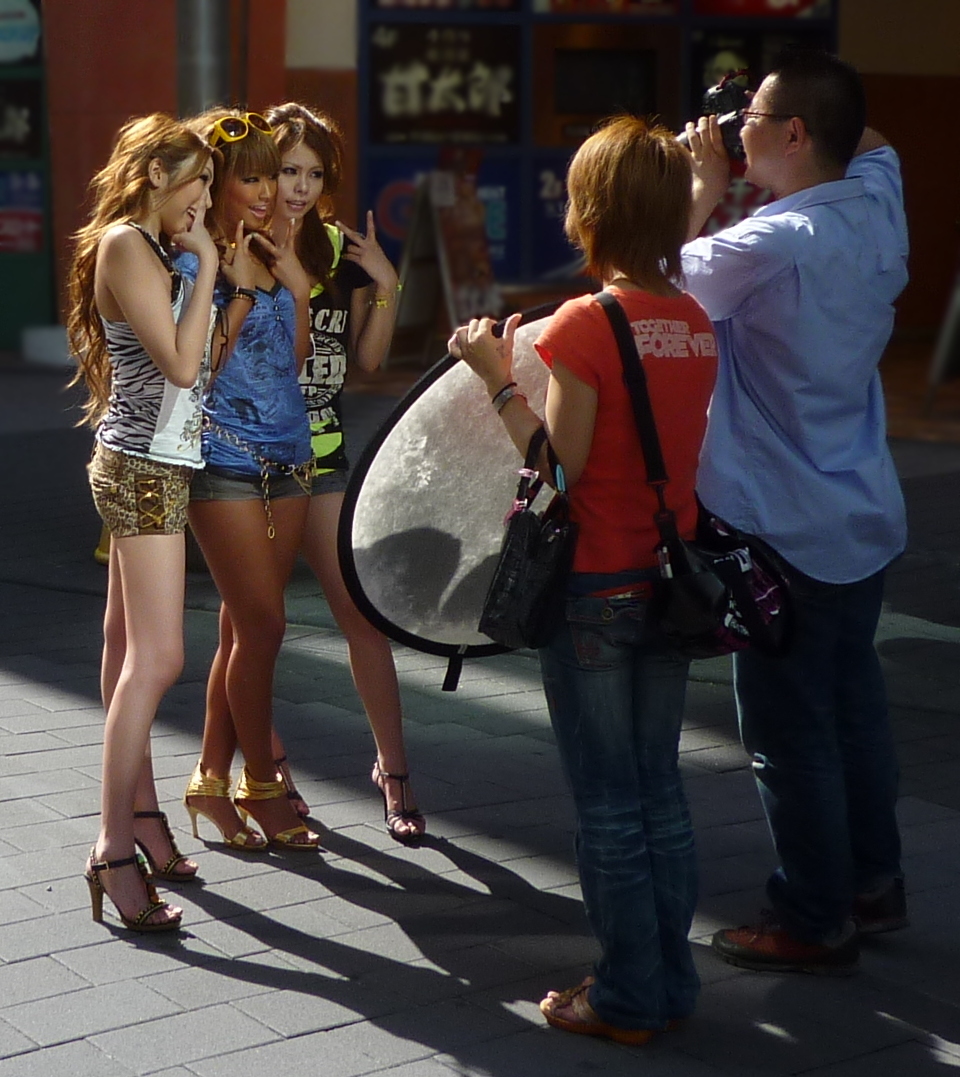
Put the whole look together on a 16-year-old girl standing outside Shibuya 109 in 2002, and you had the single most recognizable Japanese street-fashion silhouette of the era.
Where did ganguro come from?
The short version: Shibuya in the mid-1990s, among teenage girls rebelling against parental and societal beauty expectations.
The longer version involves a specific economic and cultural moment. Japan’s post-bubble 1990s were genuinely grim for most adults — the “lost decade” of economic stagnation, mass layoffs, and collapsing salaryman certainties. But for middle-class teenagers, a period when their parents were losing career footing created an unusual amount of unsupervised freedom. Allowances were still coming in. Parents were distracted. Shibuya on a Saturday afternoon became the default meeting place for tens of thousands of teenage girls with money, time, and not much supervision.
Out of that environment, several fashion experiments ran in parallel: the kogal (schoolgirl-uniform-as-fashion) look, the shibu-kaji style, the kawaii explosion, and the gal/gyaru spectrum that included ganguro at its darkest-skinned extreme. What made ganguro distinct from the other gal variants was its explicit commitment to breaking Japanese beauty norms. “White is beautiful” (美白, bihaku) was the dominant commercial beauty message. Ganguro said: fine, then we’ll be as dark as possible. Every element of the look was the inverse of what a Japanese magazine spread was selling that year.
What was Shibuya 109’s role?
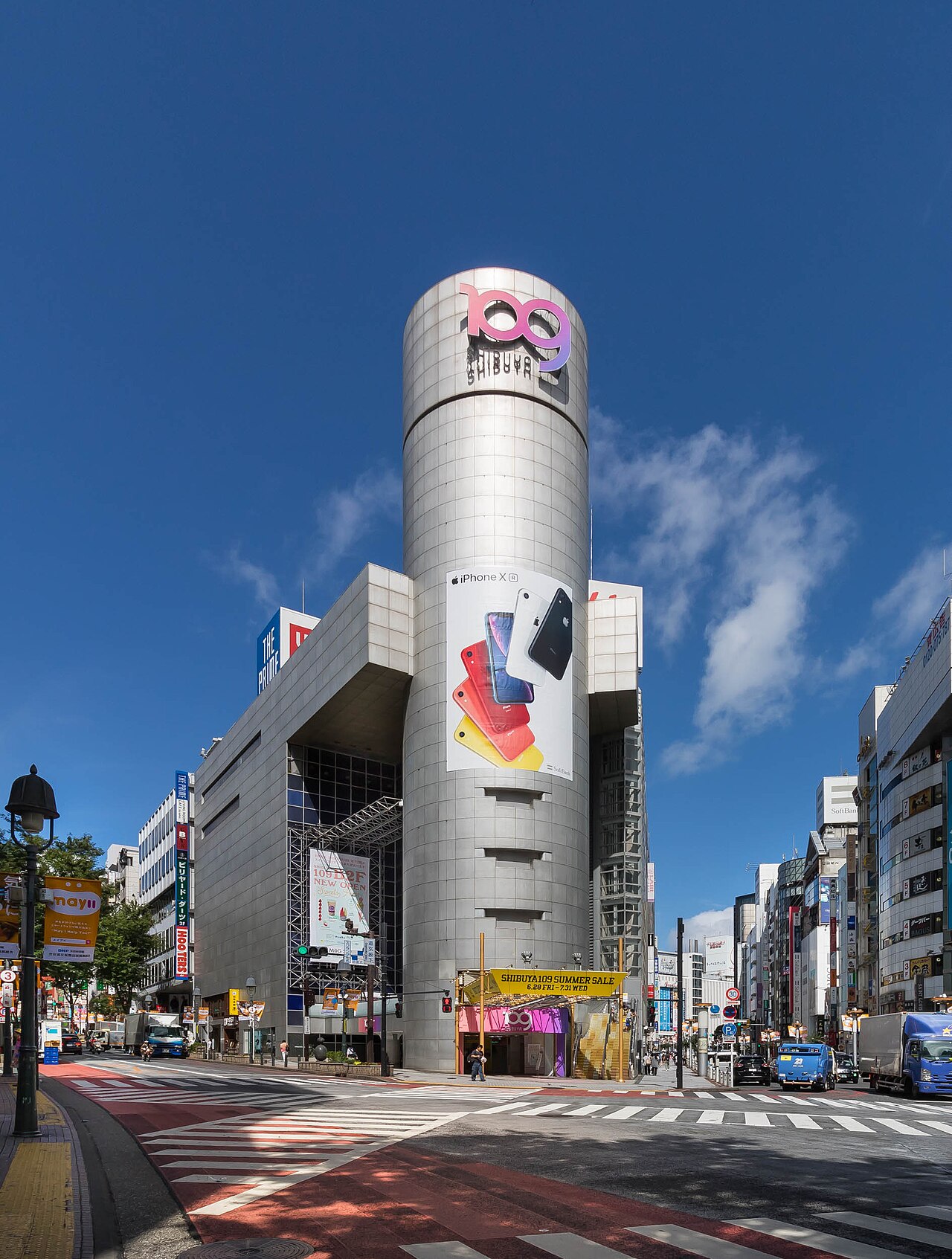
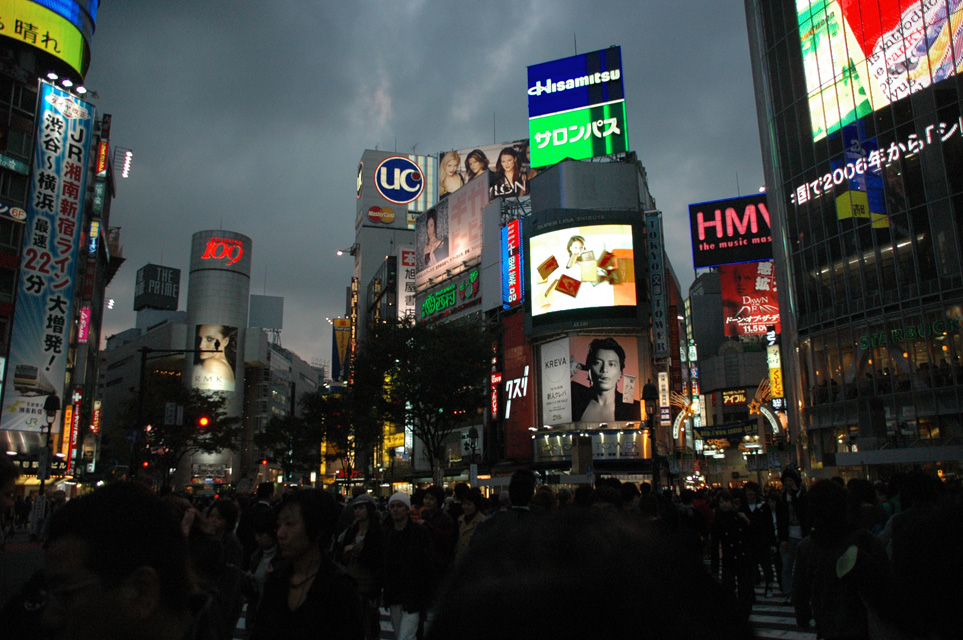
Ground zero. Shibuya 109 is the circular ten-story mall directly across from Shibuya Station — you can see it in every establishing shot of Shibuya. From the early 1990s through the late 2000s it was the epicentre of gal fashion commerce. The lower floors of 109 sold exactly the kind of platform sandals, tie-dye sarongs, and crystal-encrusted accessories that ganguro girls wore. You could walk in with a normal outfit and walk out fully kitted. Many girls did.
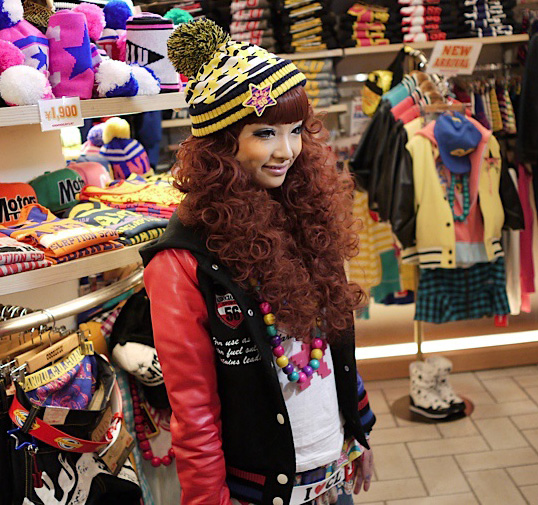
The mall’s shop staff themselves were part of the attraction. 109’s shop assistants — known as karisuma tenin (“charisma clerks”) — were hired specifically for their extreme looks and their social-media following. They were the visual reference point for teenage shoppers who wanted to learn the look. In a pre-Instagram era, the shop staff was your style tutorial.
Who were the extreme variants: Yamanba and Manba?
Yamanba (山姻 or 山嬰婝, literally “mountain witch”) and the even more extreme Manba were the most exaggerated versions of ganguro. If standard ganguro had a deep tan, yamanba had the deepest commercially available tan plus white eyeliner so heavy the eye socket looked haunted. If ganguro had bleached hair, yamanba had bleached hair plus neon streaks plus actual flowers and stuffed toys glued on. The look was deliberately confrontational — they weren’t trying to be attractive by any mainstream measure, they were trying to be unmissable.
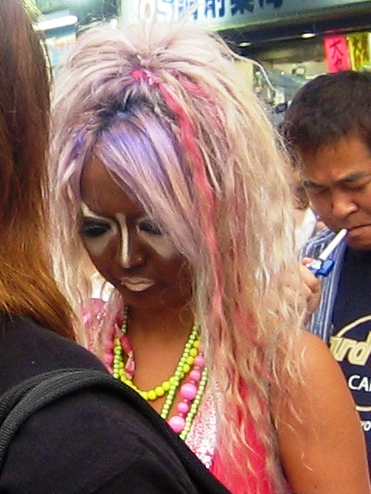
Most ganguro girls were “standard” ganguro. Yamanba and Manba were a small, committed minority who pushed the aesthetic to its absolute extreme. Japanese magazines covered them as a spectacle. International fashion media picked up on yamanba specifically because the look was so visually arresting — you’ll still find yamanba photos in design-history books about Japanese subcultures today.
Why did ganguro die?
Three reasons, in descending order of importance:
1. The bihaku counter-trend
The late 2000s saw a massive commercial push for bihaku (美白, “light-coloured skin”) skincare. Shiseido and other major Japanese cosmetics brands invested aggressively in skin-whitening products, anti-UV sunscreens, and “natural” pale aesthetics. The commercial signal was overwhelming: pale skin is feminine, modern, professional, attractive. Within about five years the entire teen girl market had swung back toward pale as the default.
2. The “sweet” style takeover
In parallel, the “sweet” (amai) or “himekaji” (princess-casual) aesthetic took over from gal as the dominant Shibuya style. Pastel colours, bigger eyelashes rather than bolder eyeliner, romantic frills, light hair. The whole visual register shifted from “rebellious tan gal” to “soft princess” within about three years. Ganguro became literally unfashionable.
3. The 2008 financial crisis
The economic mood shift mattered. The playful economic abundance of the mid-2000s, which had sustained the accessory-heavy ganguro look, ended. Spending money on platform shoes and encrusted phones felt less obviously reasonable when your parents were dealing with another recession.
By 2010, the ganguro girl was a nostalgic memory. By 2017, Fragments Magazine’s feature on Erimokkori was framed as “the last” — because she genuinely might have been.
Is there anywhere you can still see ganguro in Tokyo?
Mostly no. A few specific exceptions:
- 10sion and similar gyaru-nostalgia events. A few times a year, Tokyo hosts organized gyaru-revival parties, often in Shibuya or Shinjuku. Ganguro enthusiasts gather, dress up fully, and photograph each other. These are community-organised events, usually announced on Instagram and X. Dates rotate.
- Gyaru-themed cafes and bars. A small handful of venues in Shibuya and Ikebukuro still run gyaru-themed spaces — usually with staff in full ganguro or yamanba looks. These come and go. The current one worth knowing about is Ganguro Cafe & Bar 10sion in Shibuya, though hours and even existence can change without notice.
- Cosplay events. Ganguro is occasionally revived as cosplay, especially around Halloween and at anime conventions that cover 1990s–2000s pop culture. You’ll see a handful at Nakano Broadway or at specific Harajuku photo meets.
- Street photography tours. Photographers occasionally run nostalgia tours tracing the Shibuya gyaru legacy — you won’t see active ganguro, but you’ll get to see 109 and the specific streets where the style ruled.
Pro tip: If seeing a revival is genuinely important to you, follow the Instagram accounts of Erimokkori (search “エリモッコリ”) and other active gyaru-community figures. They announce events weeks in advance. Most international visitors miss the revival nights purely because they weren’t searching at the right time.
What replaced ganguro in Shibuya?
The gal evolution didn’t stop — it mutated. In rough sequence, Shibuya fashion moved from ganguro (1996–2005) through sweet/himekaji (2005–2010), onesy (2010–2015), jiraikei (2015–2020), and currently a mixture of normcore, K-pop-influenced minimalism, and idol-derived kawaii. The specific peak-ganguro aesthetic with the dark tan and bleached hair is not coming back any time soon — current trends are running the opposite direction.
What has persisted is the Shibuya 109 concept itself: the multi-floor mall full of teen-girl fashion with charismatic staff acting as walking style tutorials. 109 is still there, still serving the teenage demographic, still defining what is currently fashionable on Shibuya streets. The specific look has changed. The cultural engine has not.
How does ganguro connect to the broader Japanese subculture story?
Ganguro sits inside the much longer arc of Japanese youth subcultures asserting themselves against mainstream norms. The taisho-era moga (modern girls) of the 1920s, the post-war teddy-boys and rockers, the 1970s takenoko-zoku dance gangs, the punks of the 1980s, the ganguro and yamanba of the 1990s–2000s, and the jirai-kei of the 2010s — all variations on the same underlying move: Japanese teenagers using extreme fashion to declare social independence.
What made ganguro specifically memorable, rather than just another fashion wave, was its commercial intensity. It had its own shopping mall (109), its own magazines (egg, Popteen, Cawaii), its own music scene (para-para dance, Ayumi Hamasaki), and its own fully-developed identity economy. For about ten years it was inescapable if you were within a kilometre of Shibuya Crossing. That kind of commercial density is what gave the look its cultural weight.
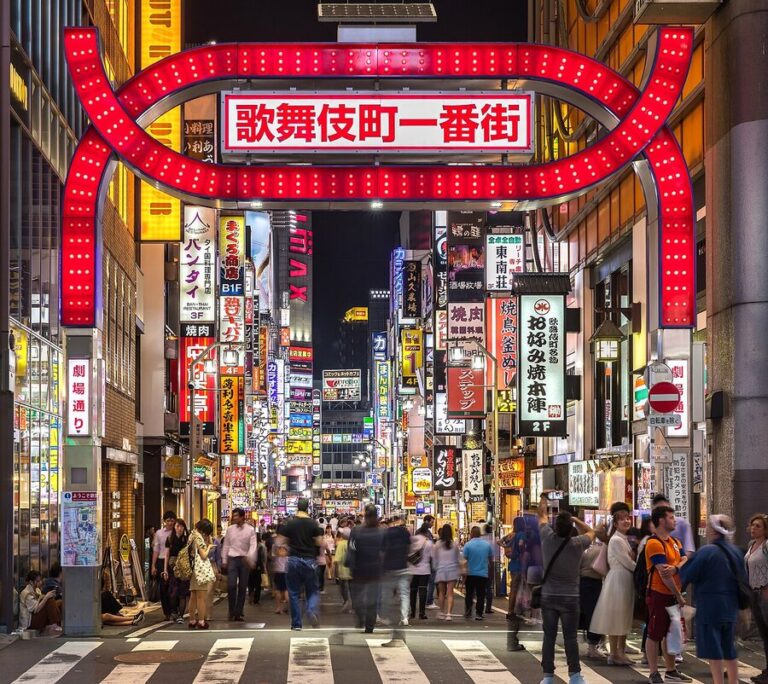
Our Akihabara guide covers the parallel, mostly-male-coded otaku subculture that was developing in eastern Tokyo at the same time — equally commercial, equally visually-distinctive, completely different aesthetic. And our piece on Kabukicho and Tokyo’s nightlife industry picks up the thread of how Japanese visual subcultures interact with adjacent urban economies.
What about ganguro’s international influence?
Ganguro never quite crossed over as a mainstream global fashion trend. But it had a real and lasting impact in a narrower way: as one of the early moments when foreign fashion media started taking Japanese street style seriously as a creative ecosystem worth documenting.
Shoichi Aoki’s photo book Fruits, which documented Harajuku street fashion from 1997 onwards, captured ganguro among many other styles and helped establish the global narrative that Tokyo was the world’s most inventive teen fashion city. That narrative is still in use in 2026, even though the specific fashion waves have turned over multiple times since.
Pop culture references to ganguro showed up in: Gwen Stefani’s 2004 Harajuku Lovers era (broadly gyaru-influenced), Nicki Minaj’s “Your Love” video (direct gyaru costume references), various anime including Gals! (2001) which was basically a ganguro celebration, and probably a thousand cosplay references a month. The look is endlessly recyclable as shorthand for “rebellious Japanese teen girl.”
Is ganguro problematic?
This is a legitimate question and the answer depends on who you ask.
Some contemporary commentators argue that ganguro’s extreme tan constituted a form of cultural appropriation — specifically, that Japanese teenage girls adopting visibly darker skin tones drew on a visual register coded as Black in a way that was reductive or disrespectful. The counter-argument, which you’ll see from most Japanese fashion historians, is that ganguro was not about imitating any specific ethnic group but about inverting the specific Japanese aesthetic norm of pale skin. The tan was a rebellion against domestic beauty ideology, not a reference to any foreign community.
Both positions have reasonable proponents. Fragments Magazine’s Erimokkori profile quotes her directly on this: she frames ganguro as specifically a Japanese anti-beauty rebellion, not a borrowing from elsewhere. That is probably the most honest insider account.
The separate and clearer question is: what did the Japanese media say about ganguro girls at the time? Mostly cruel things. Ganguro girls were routinely called “dirty,” “unhygienic,” “promiscuous,” and worse in mainstream Japanese press from the late 1990s. The girls themselves mostly rejected those framings. Twenty years on, the rehabilitative framing is more sympathetic — ganguro girls are now treated as an interesting moment of Japanese teenage self-expression rather than the moral panic they were once marketed as.
Should you care about ganguro now?
Depends on why you’re interested.
If you’re visiting Tokyo and hoping to see active ganguro on the streets: you will almost certainly be disappointed. The trend is over in any meaningful scale. A random Shibuya Saturday in 2026 will show you zero or one ganguro gals per hundred teenagers passing through.
If you’re interested in understanding late-1990s / early-2000s Japanese pop culture: ganguro is essential. You cannot understand the era’s Shibuya, the rise of para-para dance, Ayumi Hamasaki’s early career, or anime like Gals! without also understanding the subculture. Read the Fragments piece. Look at Shoichi Aoki’s Fruits archive. Watch Gals!.
If you’re specifically interested in Japanese street fashion history: the gyaru-revival nights in Shibuya are worth lining up with your Tokyo trip. Follow the right Instagram accounts, find a date that works, show up, and you’ll see a small but committed community who kept the aesthetic alive. That’s the one live piece of ganguro culture left in Tokyo, and it is genuinely moving if you appreciate what they’re preserving.
For everyone else: ganguro is a fashion history topic now. A very good one, for about a decade, now archived. if you want to see where Tokyo’s visual energy has gone since — our Robot Restaurant piece covers one surviving strand of that same commercial-chaos tradition, worth the detour if ganguro nostalgia is what brought you here.


.jpg)


