Reviewed · ASAKUSA TOURS
Tokyo: Asakusa Temple & Shrine Walking Tour with Local Guide
The most revealing part of this Asakusa walk comes before you reach Sensoji. You begin beside the Sumida River, look across at Tokyo Skytree and its famously nicknamed golden sculpture, then climb to a high viewpoint over the temple grounds. That quick change from modern Tokyo to old temple town gives you useful bearings right away.
In This Article
- Key points at a glance
- Why the first ten minutes matter
- Entering through Kaminarimon Gate
- Nakamise Street, snacks, and useful shopping advice
- Hozomon and the smaller temple stops
- Sensoji Temple and the rituals you can try
- Asakusa Shrine and the Buddhist-Shinto contrast
- What the guides add
- Is $30 a fair price for two hours?
- Who should book this Asakusa walk?
- Final call: a strong first look at old Tokyo
- FAQ
- How long does the Asakusa Temple and Shrine Walking Tour last?
- How many people can join the small group?
- Which languages are available?
- Which major sites are included?
- Can I take part in Japanese temple and shrine rituals?
- Is there a dress code, and are tattoos allowed?
- Is the tour suitable for wheelchair users or people with mobility impairments?
I like the small group of eight or fewer, which leaves room for questions and makes crowded Nakamise Street easier to manage. I also like the hands-on approach: your guide shows you how to wash at the temizuya, draw an omikuji fortune, use incense, and pray at both a Buddhist temple and a Shinto shrine. The main consideration is the walking. There are no long breaks, and the tour is not suited to wheelchair users, people with mobility impairments, or anyone with a low fitness level.
Key points at a glance
- Start with two city views: See the Sumida River and Tokyo Skytree from Azuma Bridge, then look down over the Sensoji area from the Asakusa Culture Tourist Information Center.
- Learn two religious traditions side by side: The tour explains the different customs at Sensoji Temple and Asakusa Shrine.
- Take part in local rituals: Try hand washing, incense, Buddhist prayer, and omikuji fortune telling with guidance.
- Get practical shopping help: Your guide can explain Nakamise Street snacks and souvenirs, offer translation help, and point out worthwhile purchases.
- Ask for photo help: Guides know useful angles around the gates, temple grounds, river, and shrine.
- Good for a first Tokyo morning or afternoon: The two-hour route gives you cultural basics and leaves time for lunch, shopping, or another Asakusa stop.
Why the first ten minutes matter
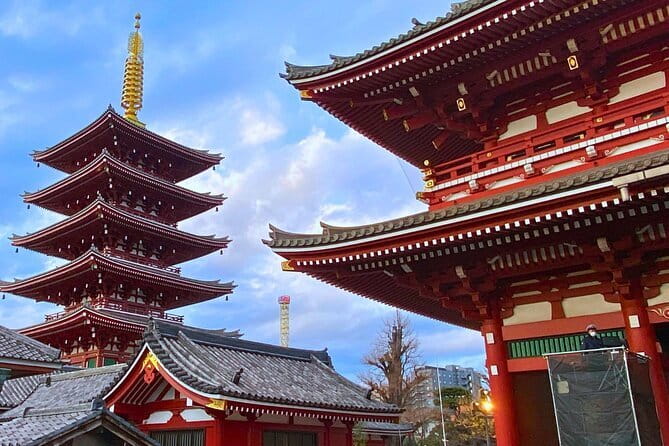
The tour starts at Burger King Asakusa Azumabashi, unless your booked option gives a different meeting point. That is worth checking before you set out. From there, you walk toward Azuma Bridge for about ten minutes of guided sightseeing and photographs.
This opening stop is more useful than it may sound. Asakusa can feel like a mass of gates, shops, side streets, and visitors. From the river, you get a clear sense of where the temple district sits in relation to the Sumida River and Tokyo Skytree. Your guide also points out the gold sculpture on the nearby Asahi building, known locally by the playful nickname golden poop.
It is a short photo stop, not a river cruise or a long history lecture. Still, it gives the tour a relaxed start and offers a modern Tokyo view before the route turns toward traditional architecture.
Next comes the Asakusa Culture Tourist Information Center. The group spends about 15 minutes here, including a stop at the upper viewpoint. You can see much of the Sensoji grounds from above, including the route toward the main temple. This is one of the best practical features of the walk because the view helps you understand the complex before entering it.
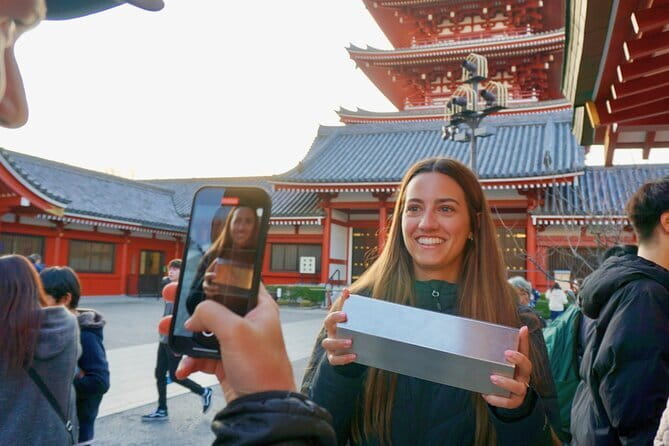
The building is also a handy place for photographs. Ask your guide for the best angle rather than simply taking the first picture from the street. Several guides, including Nicolas and Erik, have been praised for helping with photos and answering questions beyond the basic route.
A few more Tokyo tours and experiences worth a look


Entering through Kaminarimon Gate
The walk then reaches Kaminarimon, or the Thunder Gate. Allow roughly ten minutes here for photos, sightseeing, and explanation.
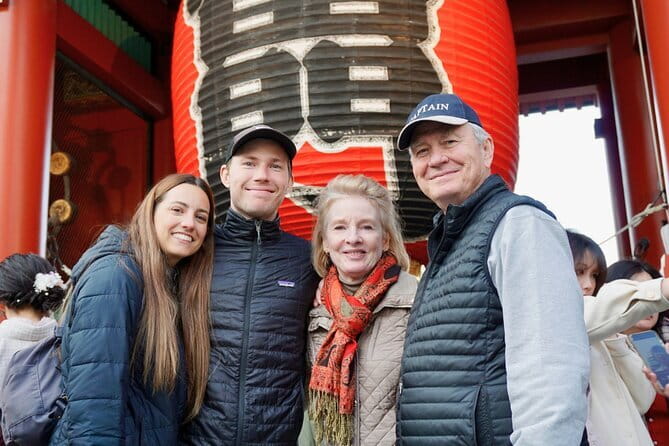
The huge red lantern weighs about 700 kilograms, and its size makes the gate an easy landmark even in a crowded street. Your guide explains the story behind the lantern and the meaning of the gate’s name. This is the sort of detail that can turn a quick snapshot into a place you understand.
Kaminarimon is often packed, so do not expect a quiet entrance. The small group helps, but you will still need to stay close to your guide and be aware of people stopping for photographs. If you want a picture without a crowd immediately around you, ask when to step aside and where to stand.
The tour does not rush you through. At the same time, ten minutes is not enough for every architectural detail, so anyone wanting an extended study of the gate will need to return later on their own.
Nakamise Street, snacks, and useful shopping advice
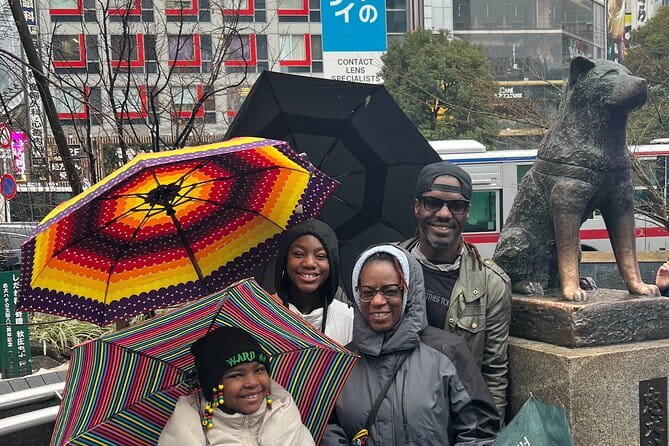
From Kaminarimon, you walk along Nakamise shopping street for about 15 minutes. This is the approach to Sensoji, lined with food stalls, souvenir shops, and traditional-style storefronts.
Your guide explains what different snacks and souvenirs mean, and can suggest where to look for better buys. Translation help is available too, which can be useful if you want to ask about an ingredient, purchase, or local custom.
This part of the tour works best if you treat it as an introduction, not a full shopping session. Fifteen minutes passes quickly, and the group needs to keep moving toward the temple. Make a note of anything you want to buy, then return after the tour. Personal purchases are not included in the $30 price.
Nakamise is also where the route can feel most crowded. The guide’s job is not only to explain the shops, but to keep the group together and adjust the pace. One useful feature of a group limited to eight is that you can ask a quick question without holding up a large crowd.
Hozomon and the smaller temple stops
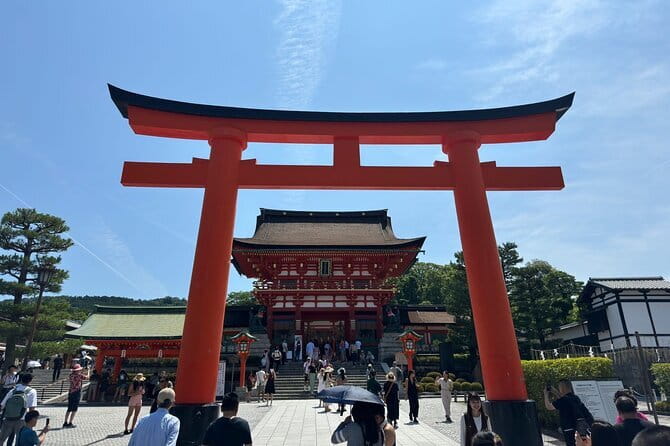
After Nakamise, the route reaches Hozomon Gate and then several smaller temple and shrine sites. The exact names of the two unnamed stops are not specified, but each receives about ten minutes of sightseeing and explanation.
These shorter stops are important because Sensoji can otherwise become a single postcard moment: red gate, shopping street, large temple, photograph, leave. The side sites give you a better sense of how worship fits into everyday Asakusa. They also create breaks from the main flow of people.
Your guide explains how Shinto and Buddhism exist alongside one another in Japan. That topic can be confusing at first, especially because the same neighborhood may contain a temple and a shrine with different customs. The walk makes the contrast practical rather than abstract.
You will learn that a torii gate belongs to a Shinto setting, and that there are customary ways to bow and walk through it. At Buddhist sites, the prayer process is different. The guide also explains details that many people living in Japan may not have been taught formally, such as how these traditions have mixed over time.
The small stops are not grand monuments on the scale of Sensoji. Their value is the explanation. Without a guide, you might pass by them without knowing what you are seeing or how the sites connect to the larger religious district.
Sensoji Temple and the rituals you can try
The tour spends about 30 minutes at Sensoji, the oldest temple in Tokyo according to the experience description. This is the main part of the walk, and it combines history, architecture, etiquette, and participation.
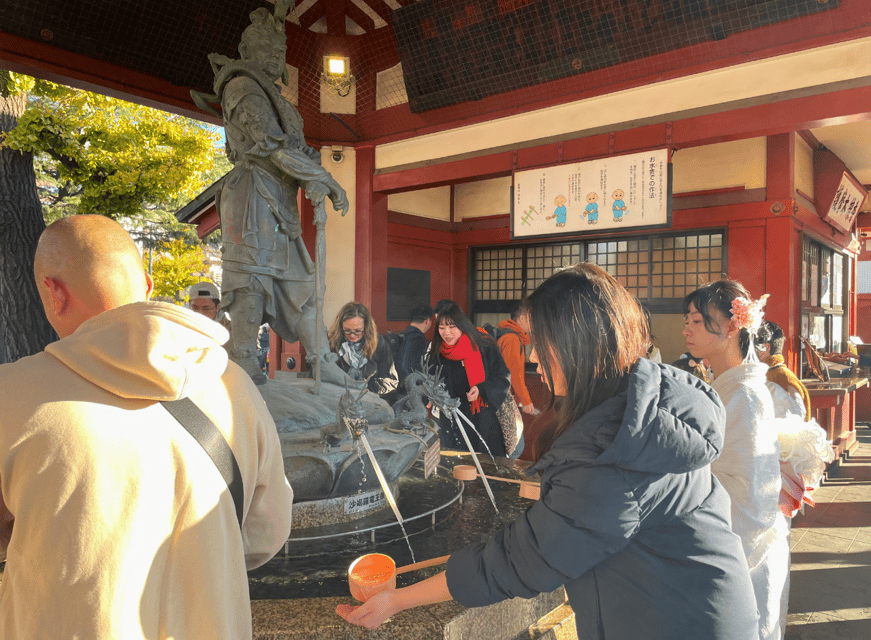
Before praying, you can learn how to use the water at the temizuya for ritual hand washing. Your guide shows the sequence and explains why the action matters. You can also try the incense ritual, traditionally associated with healing for the body and mind. These are simple activities, but they give you a respectful way to take part rather than only observe.
Omikuji fortune telling is another interactive element. Your guide explains how it works and what to do with the result. If you receive an unfavorable fortune, the experience includes the traditional idea of leaving it at the temple rather than carrying it away. The supplied information does not specify the cost of an omikuji, so bring a few small coins if you want to participate.
One particularly helpful detail comes from a guide who provided small coins to a participant who had none. You should not rely on that, but it is sensible to carry some yen for offerings, fortunes, snacks, and souvenirs.
At Sensoji, you learn the Buddhist method of prayer. This matters because the proper procedure differs from what you do at the neighboring shrine. Your guide can explain when to bow, how to approach the worship area, and how to behave without making the process feel stiff or intimidating.
The temple grounds can be crowded, and the tour takes place outdoors in all weather. Wear comfortable shoes, bring water on hot days, and dress for rain or sun. Vending machines are available along the way, but a bottle in your bag is still the easier choice.
A few more Tokyo tours and experiences worth a look

Asakusa Shrine and the Buddhist-Shinto contrast
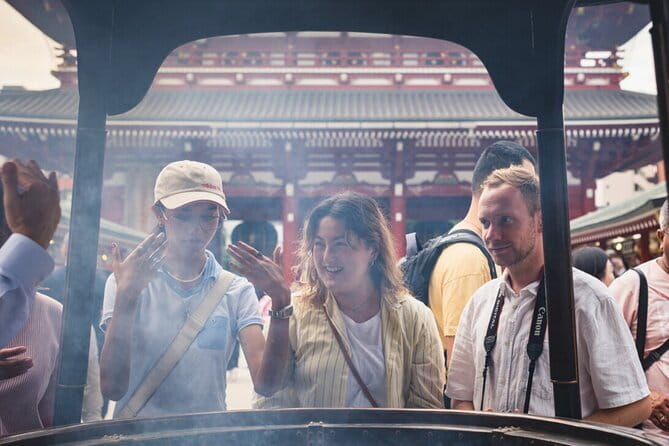
The final major stop is Asakusa Shrine, with about 15 minutes for a visit and guided sightseeing. Its position near Sensoji makes it an ideal place to compare Buddhist and Shinto practice while the details are still fresh.
Here you learn the Shinto approach to prayer and the correct behavior around the torii gate. The guide explains how to bow and which side to use when walking through the gate. These small instructions are valuable if you plan to visit other shrines around Japan.
The side-by-side setting is the heart of the experience. You do not just hear that Buddhism and Shinto are different. You see the difference in the buildings, gates, rituals, and prayer methods within one short walk.
Asakusa Shrine is also a calmer counterpoint to the main Sensoji approach, though conditions vary by time and weather. The group normally returns to the original Burger King meeting point, with two possible drop-off options shown as the same location. Confirm the details when booking, especially if the meeting-point option changes.
What the guides add
The guide makes or breaks a short walking tour, and this one has received especially strong praise for its personal style. Named guides include Nicolas, Erik, Lino, Nana, Diane, Ayaka, Arief, Joe, Somi, and Ariel.
Nicolas has been singled out repeatedly for his clear explanations of Buddhism and Shinto, his personal connection to Asakusa, and his willingness to answer questions. Erik has helped with temple etiquette, supplied coins for an offering, and guided a participant toward Kappabashi Street afterward. Nana worked patiently with children aged five and eight, explaining the sights in ways they could follow.
Those details point to the kind of guide you can expect: friendly, flexible, and open to questions about Tokyo beyond the official route. English and French are offered. The tour is not just a memorized list of dates. It is meant to help you understand what you are seeing and feel comfortable taking part.
The experience can become nearly private if few people book your time. One participant reported being the only person in the group, while another small group of four found it easy to stay together in crowded Asakusa. You should not assume a private tour, but the eight-person limit keeps the setting personal.
Is $30 a fair price for two hours?
At $30 per person, this is a reasonable price for a two-hour small-group walk in central Tokyo. You are paying for a guide who explains rituals, handles questions, helps with photos, and adds context to places you could visit free of charge.
You can certainly walk around Sensoji and Asakusa Shrine without a ticket. The value comes from what you would otherwise miss: why the red lantern matters, how the temple and shrine differ, how to use the washing fountain, what incense means, and how to pray respectfully.
The price looks especially good for a first visit, a solo booking, or a family that wants clear help without committing to a full-day tour. It is less useful if you already know Japanese religious customs or prefer to wander alone and read signs at your own pace.
Budget separately for food and shopping. Snacks, souvenirs, offerings, and fortune slips are personal expenses. The tour itself does not include a kimono rental, though the company can tell you about a partner shop two minutes from the meeting point.
Who should book this Asakusa walk?
I would recommend it to first-time visitors who want a quick cultural foundation before exploring more of Tokyo. After two hours, you will know how a shrine differs from a temple, what to do at the main ritual points, and which parts of Asakusa deserve a slower return visit.
Couples and solo visitors should find the small group easy to manage. Families can also do well, especially with a guide such as Nana, who has experience keeping young children involved. The route includes shopping, photos, stories, and hands-on customs, so it is not only a history lesson.
I would be cautious about booking if you have mobility limitations or a low fitness level. The tour involves continuous outdoor walking, crowded streets, and no stated wheelchair suitability. It also runs in rain or shine, so poor weather can affect comfort even when the guide maintains a relaxed pace.
Book ahead if your dates are fixed because the group is limited to eight. Free cancellation is available up to 24 hours before the activity, and you can reserve now and pay later, which helps if your Tokyo schedule is still shifting.
Final call: a strong first look at old Tokyo
Book this tour if you want more than a photograph of Sensoji. The best parts are the river-to-rooftop opening, the clear comparison between Buddhist and Shinto customs, and the chance to try rituals with a guide beside you.
Skip it if you want a completely independent stroll, a quiet temple visit, or a route designed for limited mobility. For most first-time visitors who can comfortably walk for two hours, $30 buys useful cultural context, personal help, and a better understanding of Asakusa than you are likely to get by simply following the crowds.
FAQ
How long does the Asakusa Temple and Shrine Walking Tour last?
The tour lasts two hours.
How many people can join the small group?
The group is limited to eight participants.
Which languages are available?
The live tour guide is available in English and French.
Which major sites are included?
The route includes Azuma Bridge, the Asakusa Culture Tourist Information Center, Kaminarimon Gate, Nakamise shopping street, Hozomon Gate, Sensoji Temple, Asakusa Shrine, and smaller local temple sites.
Can I take part in Japanese temple and shrine rituals?
Yes. The guide explains and demonstrates temizu hand washing, omikuji fortune telling, incense use, Buddhist prayer, and Shinto customs at the shrine.
Is there a dress code, and are tattoos allowed?
There is no dress code, and tattoos are welcome. You should still dress for the weather because the tour takes place outdoors in rain or shine.
Is the tour suitable for wheelchair users or people with mobility impairments?
No. The activity is not suitable for wheelchair users, people with mobility impairments, or people with a low level of fitness. Comfortable walking shoes are recommended.
More Walking Tours in Tokyo


More Temples & Meditation in Tokyo
More Asakusa Tours in Tokyo
More tours in Tokyo we've reviewed












Asakusa Tours, compared.
 ★ 4.8Tokyo: Japanese Dance Cabaret Theater Asakusa-Kaguwa TicketFrom $492 hours
 ★ 4.7Tokyo: Meiji Shrine, Asakusa, Skytree Bus Tour and CruiseFrom $12210 hours
 ★ 4.9Tokyo: Roll and Authentic Sushi Making Class in AsakusaFrom $581h 40m
 ★ 4.8Tokyo: Asakusa Walking Tour with Sensoji Temple VisitFrom $222 hours
 ★ 5.0Tokyo Asakusa Rickshaw TourFrom $42
 ★ 4.5Tokyo Panoramic 1 Day: Meiji Shrine, Asakusa, Odaiba and SKYTREE®From $85