Reviewed · SUMO EXPERIENCES
Experience the Sumo World in Tokyo
The best part of this Tokyo experience is the access. You sit on chairs beside a working sumo stable, watching rikishi train at close range rather than seeing a polished match from a distant arena seat. After practice, you can ask questions, take photos, and try to push one of these human boulders yourself.
In This Article
- Key points to know before booking
- A rare morning inside Tokyo’s sumo world
- Meeting at Ueno Station at 7:45 a.m.
- Watching practice from a chair beside the dohyo
- Meeting the wrestlers after practice
- Trying to push a professional sumo wrestler
- Chanko nabe, the meal that connects sport and culture
- What makes the guides worth having
- Price, group size, and the real value
- Communication and the late-arrival risk
- Who will get the most from this experience
- Should you book the Sumo World experience?
- FAQ
- Where does the tour begin?
- How long does the experience last?
- How do I reach the sumo stable?
- Is train transportation included?
- Is lunch included?
- Can I take photos with the wrestlers?
- Can I try sumo wrestling?
- What happens if I need to cancel?
I especially like the front-row view of daily training and the meal of chanko nabe, the hearty stew associated with sumo life. Guides such as Ryoko, Haru, and Tomer also add real value by explaining the rules, rituals, rankings, and daily routine while you ride the trains.
The main caution is the early start and the importance of meeting at 7:45 a.m. at Ueno Station. A missed departure can mean a long, costly taxi ride to the stable, and one late arrival resulted in seeing only the final minutes of practice. Good communication before the morning begins matters.
Key points to know before booking
- Watch a working stable at close range: Sit on folding chairs near the training area and see the exertion, technique, and discipline behind professional sumo.
- Try a playful strength test: After practice, you may step forward and attempt to push a wrestler, usually discovering that size is only part of the story.
- Eat chanko nabe with the wrestlers: Lunch gives you a direct taste of the food built around a rikishi’s demanding routine.
- Meet at Ueno before 8 a.m.: The group travels by JR train through Matsudo and Kunugiyama, so punctuality is essential.
- Expect a small to medium group: The maximum is 26 people, though some departures may be much smaller.
- Budget for the train fare: Round-trip JR tickets cost ¥1,060, about $7, and are not included in the tour price.
A rare morning inside Tokyo’s sumo world
Sumo is easy to watch from the outside. You can buy a tournament ticket, see ceremonial entrances, and cheer from the stands. This tour offers something different: a look at the training that makes the public spectacle possible.
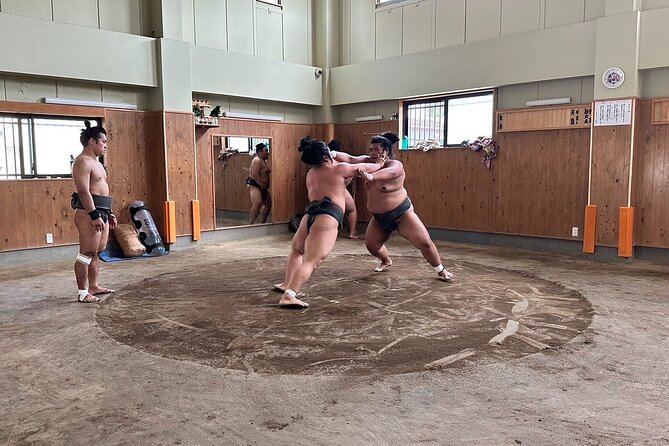
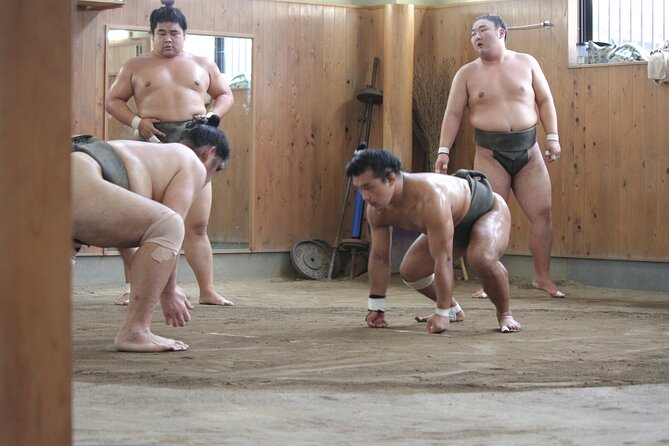
The setting is a real sumo training stable, known here as Asahiyama Beya. The wrestlers practice while the stablemaster oversees the session. You sit close enough to see the force of each clash, the repeated drills, and the physical strain that is easy to miss during a formal tournament.
I like this format because it gives you context before the action begins. The guide explains sumo terms, customs, and basic rules during the journey, so you are not left guessing why the wrestlers stamp, push, or repeat certain movements. The practice becomes far more interesting once you understand that sumo depends on balance, timing, footwork, and tactics, not only body weight.
The experience lasts about four hours from the Ueno meeting point and back again. The stable portion is listed at about two hours, with training, questions, photos, the hands-on activity, and lunch fitting into the morning.
A few more Tokyo tours and experiences worth a look
Meeting at Ueno Station at 7:45 a.m.
Your day starts at the JR Information area at Ueno Station at 7:45 a.m. This is a sensible meeting point because Ueno is easy to reach and has strong rail connections, but Tokyo stations can still be confusing if you are unfamiliar with them.
Give yourself extra time to find the correct station area. The group does not simply walk to the stable. It travels by train, and the morning schedule leaves little room for wandering around with luggage or stopping for breakfast.
The route includes a train ride of about 19 minutes to Matsudo Station, followed by another ride of roughly 15 minutes to Kunugiyama Station. The listed stop times are short, about five minutes each, so you need to stay close to the guide and group.
The train journey is not dead time. Guides such as Ryoko and Tomer use it to explain sumo history, vocabulary, customs, and the life of a rikishi. That early lesson is useful because the stable visit is not built around a long English-language presentation. Much of the value comes from watching the action and understanding what you are seeing.
The round-trip JR fare is ¥1,060, about $7, and you pay it separately. At a tour price of $105.71 per person, the train cost is a small extra, but it is still worth including in your morning budget.
Watching practice from a chair beside the dohyo
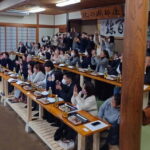
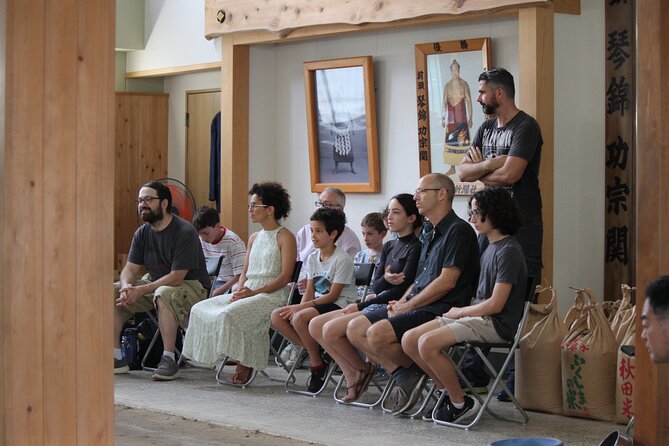
At the stable, you sit on chairs beside the training area. This is one of the strongest parts of the experience. You are not being shown a staged demonstration designed for tourists. You are watching athletes work through a serious practice session in their own training space.
The mood can be quiet and focused. Training includes powerful collisions and repeated movements, but sumo also requires patience and control. You might notice that a wrestler’s strength is only one piece of the sport. Quick reactions, balance, agility, and the ability to force an opponent off position all matter.
The practice session may be intense and absorbing, though the exact length can vary with the stable’s schedule. One family described about 45 minutes of training before photos and the interactive portion, while another person who arrived late saw only about 10 minutes of wrestling and some stretching. That difference is a useful warning: arrive on time, because the stable cannot hold the session for you.
The guide helps interpret what happens. Ryoko, Haru, Tomer, Tammy, and other guides have been praised for explaining the sport in clear terms and answering questions. The experience works best when you watch first and ask questions afterward, when the wrestlers are available.
This close view also gives you a better sense of the athletes’ effort. Sumo is often reduced to a joke about large men pushing one another, but a morning practice shows the discipline and conditioning behind each bout. You see the work before the ceremony and competition.
Meeting the wrestlers after practice
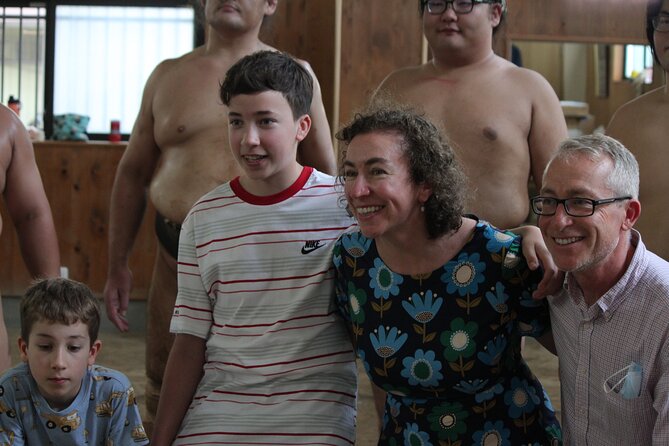
The wrestlers generally meet the group after training. This is the more relaxed part of the morning, when you can learn about individual paths into sumo and ask questions through the guide.
English ability may vary among the wrestlers, so translation can be important. Tomer, Ryoko, and the other guides help explain what the stablemaster or wrestlers are saying. That support makes the conversation more useful than simply posing for a photograph.
The tone is friendly, but remember that this is still the wrestlers’ workplace. Follow the guide’s instructions, wait for the right moment, and avoid treating the session like a noisy sports exhibition. The welcoming atmosphere comes from keeping the interaction respectful.
The chance to hear about the wrestlers’ daily lives is a major reason to choose this tour over a standard cultural demonstration. You are not only learning what sumo looks like. You are getting a small window into the people who train for it.
Trying to push a professional sumo wrestler
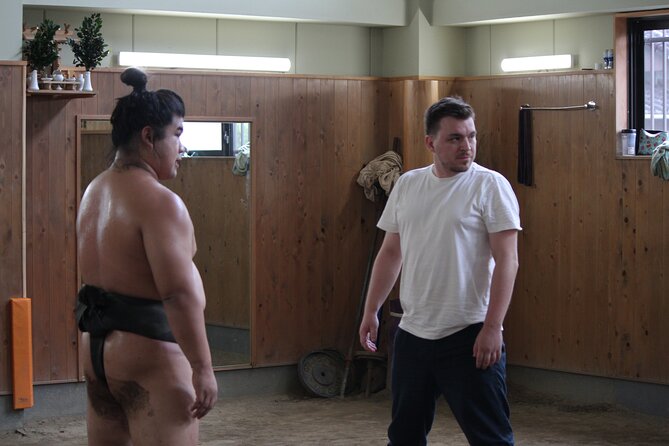
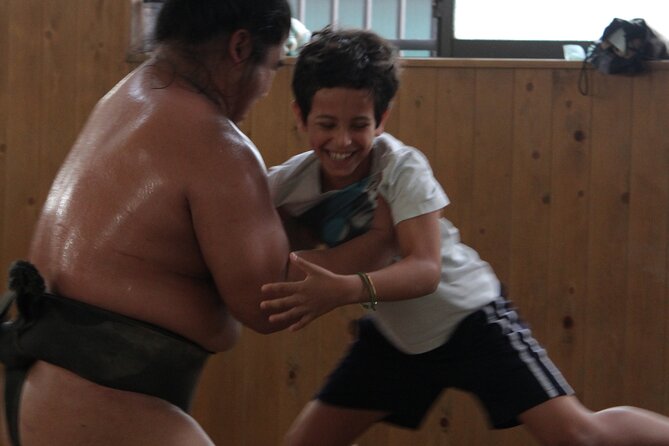
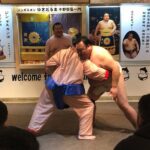
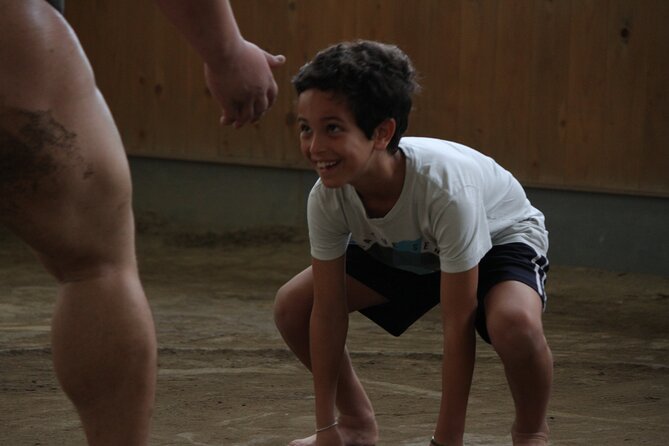
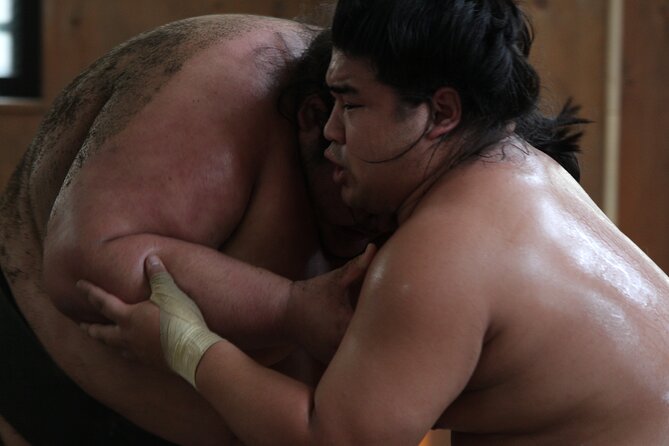
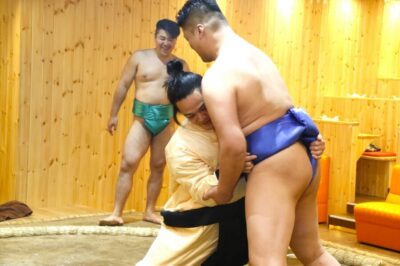
After the practice, participants can try a short sumo wrestling experience. In practice, this usually means bracing yourself and attempting to push one of the wrestlers. You may feel as if you are giving it everything, while the wrestler barely moves.
That mismatch is part of the fun. Several families found the activity especially entertaining for children, and adults enjoyed discovering that their apparent victory may have been generously allowed. The wrestlers are described as gentle and good-humored during this portion, which helps make it suitable for a range of ages.
You should think of it as a playful strength test rather than a real bout. The point is not to compete seriously, but to feel how difficult it is to move someone trained in balance and force. Even a short attempt can make the earlier practice more meaningful.
The activity also creates a memorable photo opportunity. Photography is allowed at the end of the session, after training. That timing is important because you should not assume you can take pictures throughout practice. Keep your camera ready for the closing portion, when photos with the wrestlers are permitted.





Chanko nabe, the meal that connects sport and culture
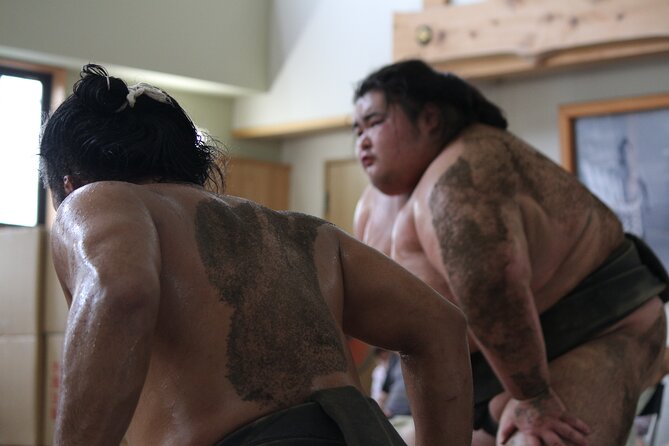
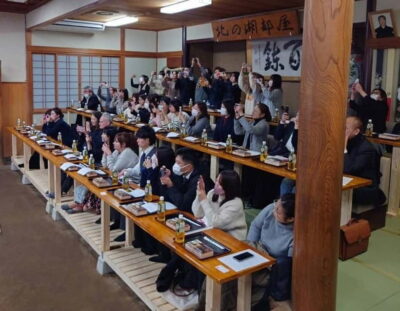
Lunch is included, and the meal is chanko nabe. This is a stew associated with sumo wrestlers, designed as filling fuel for athletes. The exact ingredients can vary, but descriptions of the meal include broth with vegetables and chicken.
I like that lunch is tied directly to the stable rather than added as a random restaurant stop. Food here helps explain how the sport connects to everyday life. You are eating something linked to the wrestlers’ routine, in the same setting where you have just watched them train.
The meal has also been described as light, tasty, and surprisingly good. Do not expect a lavish banquet. The value lies in the cultural link and the chance to share food after seeing the morning practice.
Vegetarian service is available, but you must request it at least three days in advance. This is not a detail to leave until the morning of the tour. If you have dietary needs, notify the operator early and make sure the request is confirmed.
What makes the guides worth having
The train route and stable visit would be harder to interpret without a guide. Sumo has its own language, hierarchy, etiquette, and routines, and a first-time viewer can miss much of the meaning.
Ryoko receives particularly strong praise for her warmth, clear explanations, and willingness to help with the rest of a Tokyo itinerary. Haru is also noted for friendly, helpful guidance, while Tomer has been singled out for explaining sumo on the train and translating at the stable. Tammy has been described as attentive and careful with the group.
The guides also help with practical navigation. You change trains, travel outside central Tokyo, and return to Ueno after the visit. For many people, that support is worth paying for on its own, especially during an early morning when a wrong platform can ruin the schedule.
This is not a tour where the guide talks nonstop for four hours. The strongest guiding happens in short explanations before and after the practice, during train rides, and when translating conversations. The stable itself supplies much of the drama.
Price, group size, and the real value
The price is $105.71 per person, plus about $7 for the round-trip JR fare. That is not a cheap morning, especially for a family, but it includes access that is difficult to arrange independently, lunch, the sumo activity, and translation support.
You are paying less for transport and food than for access. A regular tournament ticket lets you watch a public event, but it does not normally place you beside a working training session or let you speak with wrestlers afterward. If those personal encounters matter to you, the price is easier to justify.
The maximum group size is 26 people. That is large enough to feel like a proper group tour, but not necessarily so large that the stable visit becomes impersonal. Some departures have been much smaller, which can make questions and interaction easier, though you should not book expecting a private tour.
The tour is recommended by 98 percent of past participants and carries a five-star rating based on 111 reviews. Those figures point to very strong satisfaction, but the one serious complaint deserves attention: communication and lateness can cause real problems. The operator may use WhatsApp for last-minute messages, and you should not assume that email alone will cover every morning detail.
Communication and the late-arrival risk
The meeting time is firm for a good reason. The group must catch trains, and the stable’s training follows its own schedule. If you arrive after the group leaves, the stable may be an hour away by taxi, with a reported taxi cost of about $70.
Before the tour, check every message, confirm the Ueno meeting point, and make sure you know how the guide will contact you. If WhatsApp is used, arrange access before the morning of the tour or ask for the same details through the booking channel.
One late arrival was eventually given the stable address, but only after a long period of confusion. The person reached the stable in time to see the final minutes, yet missed most of the training. The operator offered compensation, but no refund can replace the main event you came to see.
I would treat this as an early-morning appointment, not a flexible sightseeing stop. Arrive early, keep your phone charged, and stay with the group during the train changes.
Who will get the most from this experience
This tour suits anyone curious about Japanese sport and culture, from dedicated sumo followers to people who know only the basics. You do not need to understand the rankings or rules before arriving because the guide covers the essentials.
Families can do well here. Children under 15 have enjoyed the intensity of training, the chance to ask questions, the meal, and the playful push against a wrestler. The hands-on moment gives younger visitors something physical to remember, while the practice itself offers a lesson in discipline and effort.
It also works well for adults who want something more personal than a major sightseeing site. The stable is a working place, not a theatrical attraction, and that makes the morning feel different from a standard cultural show.
You may want to skip it if you dislike early starts, train transfers, group schedules, or close observation of strenuous physical training. It is also not ideal if you need a fully predictable timetable, since the stable schedule and transport can lead to minor changes.
Most people can participate, and the activity is near public transportation. Still, the supplied details do not promise a fully step-free route or specify seating beyond chairs at the stable, so contact the operator if you have mobility concerns.
Should you book the Sumo World experience?
I would book this tour if you want to see how sumo works before the arena lights and formal ceremony. The close seating, explanations from guides such as Ryoko and Tomer, conversation with wrestlers, chanko nabe, and playful strength test create a morning with several layers.
Book it with discipline: arrive at Ueno early, confirm communication details, budget ¥1,060 for trains, and request vegetarian food at least three days ahead. If you do those things, the $105.71 price buys access and context that are hard to find elsewhere in Tokyo.
If your main goal is simply to watch a tournament bout, buy a tournament ticket instead. If you want a personal look at the work, people, and customs behind sumo, this is a strong choice.
FAQ
Where does the tour begin?
It begins at the JR Information area at Ueno Station, at 7 Chome-1 Ueno, Taito City, Tokyo. The meeting time is 7:45 a.m.
How long does the experience last?
The full experience lasts approximately four hours and ends back at the Ueno meeting point.
How do I reach the sumo stable?
The group travels by JR train from Ueno to Matsudo Station, then continues by train to Kunugiyama Station. The listed train rides take about 19 minutes and 15 minutes, not including station transfers or waiting time.
Is train transportation included?
No. The round-trip JR fare costs ¥1,060, about $7, and is paid separately.
Is lunch included?
Yes. Lunch includes chanko nabe, and vegetarian service is available if you notify the operator at least three days in advance.
Can I take photos with the wrestlers?
Photography is allowed at the end of the training session. The activity includes a chance to take photos after practice.
Can I try sumo wrestling?
Yes. The experience includes a playful opportunity to try pushing or wrestling with the sumo wrestlers.
What happens if I need to cancel?
You can receive a full refund if you cancel at least 24 hours before the local start time. Cancellations or changes made less than 24 hours in advance are not accepted for a refund.
More Sumo Experiences in Tokyo

More tours in Tokyo we've reviewed












Sumo Experiences, compared.
 ★ 4.8Tokyo: Sumo Show Experience with Chicken Hot Pot and a PhotoFrom $1032 hours
 ★ 4.8Tokyo: Sumo Show and Dining ExperienceFrom $7990 minutes - 2 hours
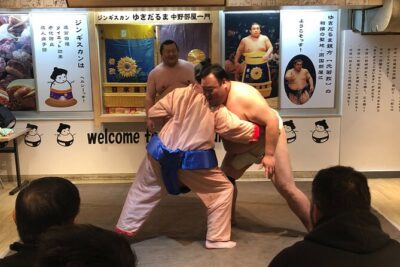 ★ 5.0the SUMO showFrom $89
 ★ 5.0Tokyo Sumo Entertainment Show with Chicken Hot Pot and PhotoFrom $106
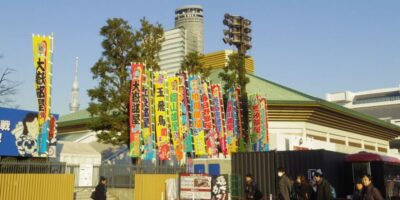 ★ 4.6Tokyo: Sumo Tournament Tour with Chair Seat TicketsFrom $141
 ★ 5.0Tokyo Grand Sumo Tournament Viewing Tour with TicketsFrom $124