Reviewed · WORKSHOPS
Tokyo: Knife Making Workshop (Sharpening, Engraving)
A Japanese knife workshop gives you more than a souvenir. At BUB Activity Center in Asakusa, you sharpen the blade yourself, attach its handle with a traditional hammer, and engrave your name in Japanese. Guides such as Lisa, Joe, Mori, and Agata keep the process friendly and clear in English.
In This Article
- Key points before you book
- Why this Asakusa workshop feels different
- Tea, Japanese knives, and a short cultural lesson
- Choosing the right knife for your kitchen
- Sharpening the blade, one careful stroke at a time
- Engraving your name and fitting the handle
- Packaging, snacks, and the finished souvenir
- Is $161 good value?
- Who will enjoy this most?
- Timing your visit in Asakusa
- Should you book the BUB knife workshop?
- FAQ
- How long does the knife workshop last?
- Where is the workshop held?
- Is the workshop suitable for beginners?
- What knife is included in the price?
- Can I engrave something besides my name?
- Can I bring a friend who does not participate?
- How should I take the knife home on a flight?
I like the useful souvenir and the calm, hands-on work. You learn a skill you can use at home, rather than simply buying another object. I also like the cultural introduction, which explains Japanese kitchen knives alongside the country’s swords and gives you context before you pick a blade.
The main consideration is the price: $161 per person is a serious spend for 90 minutes, especially if you only want a basic knife. Bigger or more specialized knives cost extra, and the handle quality may not satisfy someone seeking a finely finished professional kitchen tool.
Key points before you book
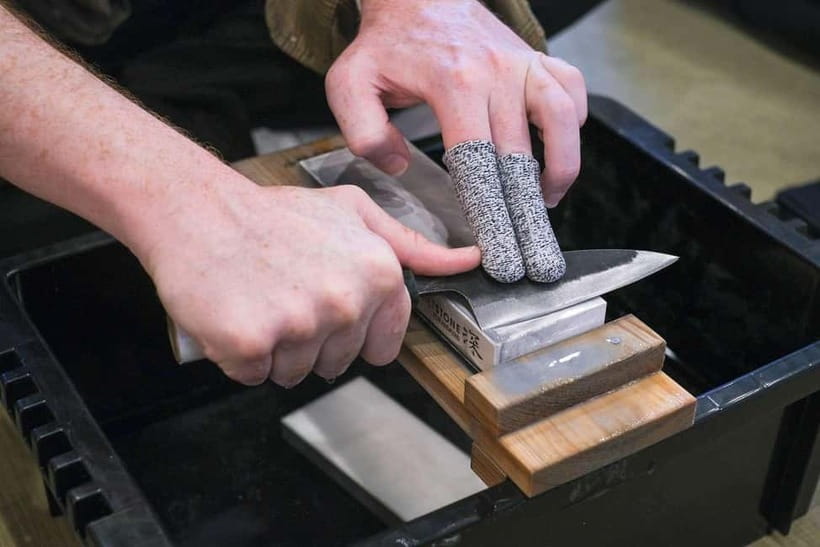
- Sharpen your own blade: Work through the main sharpening process with close help from English-speaking staff.
- Choose from several knife types: The standard multitasking knife is included, while usuba, deba, petit yanagiba, and other options may cost extra.
- Personalize the handle: Engrave your name in Japanese, a picture, or another design, then attach the handle with a traditional hammer.
- Learn the background: A short talk covers Japanese knives, kitchen tools, katanas, and Western swords.
- Take home a complete package: Your knife comes with aesthetic packaging, Japanese snacks, drinks, and a custom key holder.
- Plan for air travel: Put the boxed knife in checked luggage or ask the staff about shipping it.
Why this Asakusa workshop feels different
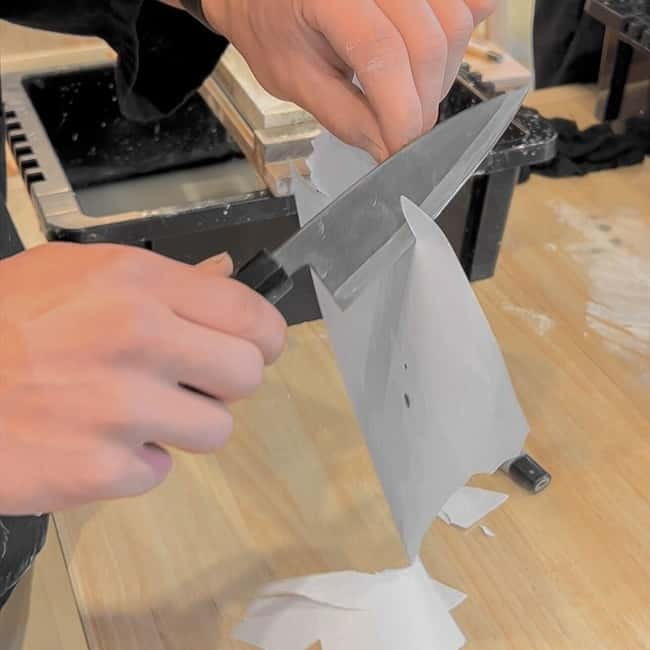
Many Tokyo souvenirs are easy to buy and easy to forget. This one asks you to put in some effort. You leave with a knife, but also with the memory of the work that made it yours.
That work is not blacksmithing from raw steel. You are not forging a blade in a hot workshop. Instead, you choose a prepared blade, sharpen it, customize the handle, and put the finished knife together. That distinction matters because the experience is best understood as a knife-crafting and sharpening class, not a full sword-making demonstration.
The workshop takes place at BUB Activity Center, at 2 Chome 6-11 in Asakusa’s Taito-ku area. Once you find the Heiwa Building, take the elevator to the fifth floor. The activity is easy to reach by public transport, but the building location may not be obvious from the street, so allow a few extra minutes and contact the provider if you have trouble finding the entrance.
At the start, you put on a light haori, a Japanese kimono-style jacket. It protects your clothes from marks or stains during the practical work. You also receive a small badge with your name written in Japanese characters, a nice touch that gets the cultural part of the experience moving before the tools come out.
A few more Tokyo tours and experiences worth a look
Tea, Japanese knives, and a short cultural lesson
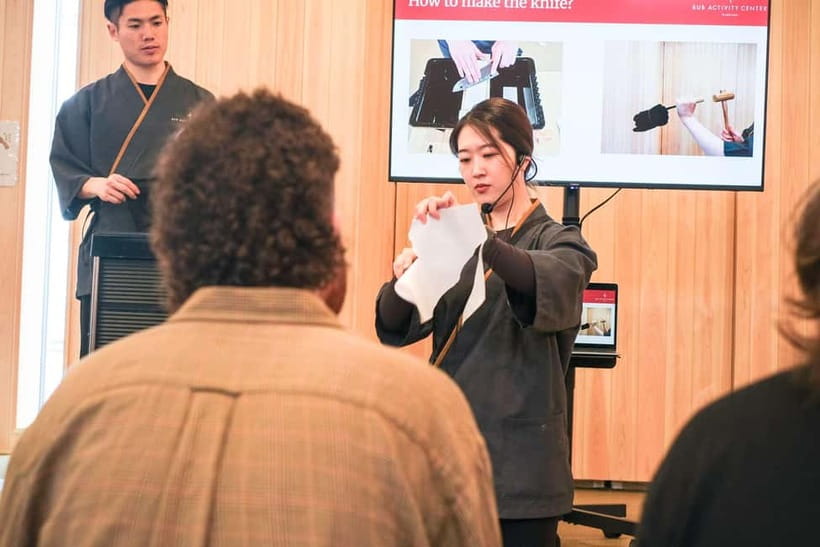
You begin seated with tea, juice, or another soft drink. Japanese snacks are also included. This opening gives the group time to settle in and lets the staff explain the ideas behind Japanese knives and swords.
The introduction covers the differences between Japanese katanas and Western swords, along with the role of different kitchen knives. That makes the later choice of blade more useful. Instead of selecting a knife based only on shape, you get a basic explanation of what each type is intended to do.
The staff’s English is one of the strongest parts of the activity. Lisa and Joe have been especially effective at keeping instructions simple and engaging, while Mori and Agata are also praised for clear English and an upbeat manner. You do not need specialist vocabulary or previous experience. If your English is limited, the explanations are adjusted to your level.
This section will not satisfy someone hoping for a long museum lecture. It is a practical introduction rather than a detailed academic course. Still, it gives the workshop a sense of place. You understand that the knife is connected to Japanese craft traditions, food preparation, and blade culture, not just a sharp object in a box.
Choosing the right knife for your kitchen
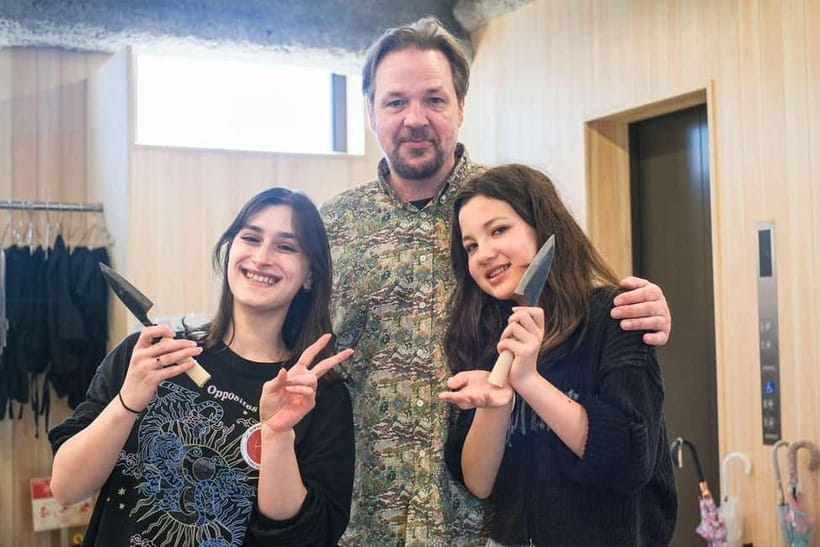
The standard booking includes a standard-size, multitasking knife. Up to five types may be available, with certain larger or more specialized blades offered for a small additional charge. The named upgrade options include usuba, deba, and petit yanagiba.
Your choice should match how you expect to use the knife. A general-purpose blade is the sensible pick if you want something practical for everyday cooking. An usuba is associated with vegetable preparation, a deba with fish, and a petit yanagiba with slicing. The staff can help you decide, which is useful if the Japanese names are new to you.
The upgrade choice is one place where the final cost can change. The $161 starting price is not necessarily the price of every knife on the table. Ask about the extra charge before choosing a larger or specialty blade.
I would not treat this as the best way to shop for a high-end Japanese chef’s knife. You have a limited session and a guided selection, not the broad inventory or quiet comparison you might find in Tokyo’s kitchenware district. But if you want a knife connected to your own time in Japan, the workshop adds something a store cannot.
Sharpening the blade, one careful stroke at a time
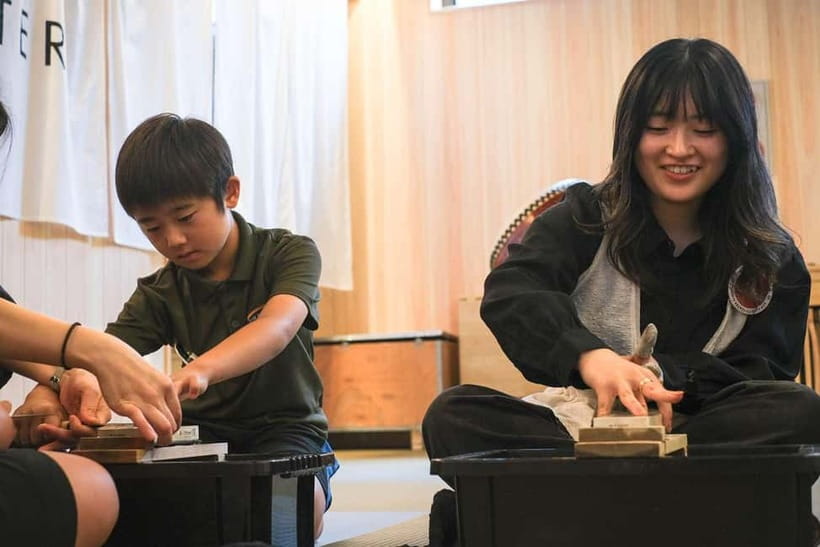
The central task is sharpening. You work the blade across a sharpening stone while keeping your movements controlled and consistent. It sounds simple. It is not quite as easy as it looks.
The process calls for concentration, patience, and repeated correction. Staff watch your position and movement, then step in when you need help. That close attention matters for beginners, since an uneven angle can affect the result and make the work frustrating.
Several English-speaking staff members circulate during the practical part. They answer questions, chat with you, and offer individual advice. Their friendly approach keeps the workshop from feeling like a strict technical lesson, but they still take the sharpening seriously.
Expect some physical effort. The work is tactile and repetitive, and you may find it harder than expected to keep your technique steady. That is also where much of the satisfaction comes from. You see the blade change through your own effort, rather than receiving a finished item with no connection to the process.
The activity has been suitable for children as well as adults, with one reported experience involving a 10-year-old. That does not mean every child will find the sharpening easy, but the staff are used to correcting beginners and making the session engaging. Anyone handling the knife should be able to follow instructions carefully.
Engraving your name and fitting the handle
After sharpening, you personalize the handle. The main option is to engrave your name in Japanese characters, but you may also be able to add a picture or another design. Staff can help with basic Japanese if you want to understand what is being written.
This is a charming part of the workshop, though it is not precision calligraphy. Your engraving may look handmade because it is handmade. That is part of the point. You are creating a personal object, not ordering a factory-perfect monogram.
One useful expectation to set is that the engraving can be challenging. If you are particular about a flawless finish, ask for guidance before you begin and take your time. A previous participant also felt the handle quality could be improved, so this may not be the right activity for someone judging the knife by luxury-level finishing alone.
The handle is attached using a traditional hammer. The sound of the hammering gives this section a satisfying finish, and staff help you complete the assembly safely. By the end, the knife feels like a completed object rather than a blade you merely polished.





Packaging, snacks, and the finished souvenir
The closing presentation is thoughtful. Your knife is placed in aesthetic packaging, and you receive Japanese snacks and tea or another drink during the session. A customized key holder with a unique design is also included as a gift.
The packaging helps if you plan to give the knife to someone at home. The finished item can work as a cooking tool, a display piece, or a gift for someone interested in Japanese food and craft.
Do not forget the practical airline issue. A knife should go in your checked luggage, not your cabin bag. If you are traveling with only hand luggage, ask the staff about shipping it before you leave. This is an important detail, since a beautiful souvenir is not much use if airport security takes it away.
Is $161 good value?
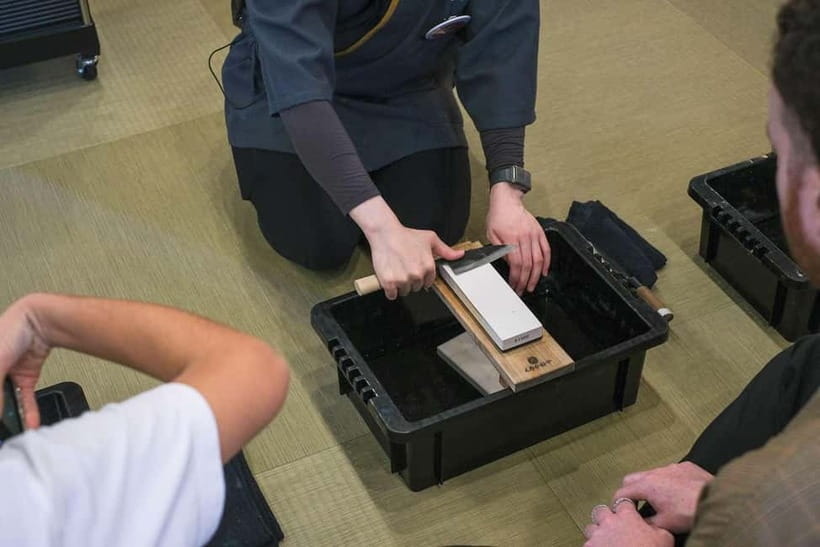
At $161 per person, this is not a cheap short activity. The session lasts about 90 minutes, and the price includes the standard knife, instruction, drinks, snacks, packaging, and the custom key holder. It also includes the personal help that makes the sharpening possible for a beginner.
The value depends on what you want. If your goal is simply to buy a Japanese knife, you can probably spend less or compare more products elsewhere. If you want a guided cultural activity that leaves you with something practical, the price becomes easier to justify.
The biggest value is the teaching. You are not only handed a knife. You learn basic sharpening, hear about Japanese blade traditions, make design choices, and take part in the assembly. The experience also gives couples, friends, or families something to do together.
For two people who do not need two knives, ask about the observation option. One person can participate while another watches for an observation fee paid on site. This may suit a couple where only one person wants to take home a knife, though the observer will not receive the full crafting experience.
Remember that specialized knives may require an additional fee. Transportation to the center, meals beyond the provided snacks, and observation fees are not included.
Who will enjoy this most?
I would recommend this workshop to:
- Home cooks who want to learn basic knife care
- People interested in Japanese food culture and craft
- Couples or friends looking for a shared activity
- Families with older children who can follow careful instructions
- Anyone seeking a personal souvenir rather than a mass-produced gift
- Visitors who enjoy hands-on work more than passive sightseeing
It is less suited to someone who wants a full blade-forging class, a long historical lecture, or a premium professional knife selected from a large shop. It is also not ideal if you dislike repetitive work or want to finish quickly without making your own corrections.
The workshop is wheelchair accessible. Alcohol and drugs are not allowed, which is sensible given the tools involved.
Timing your visit in Asakusa
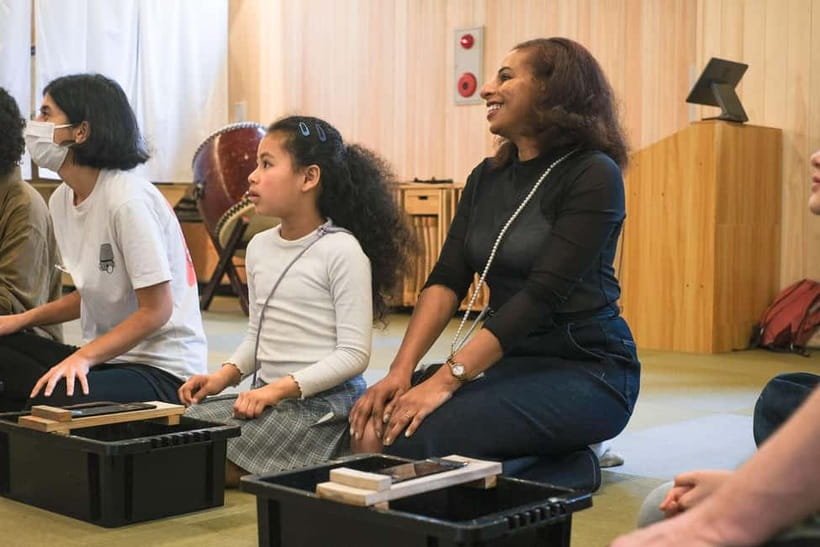
The 90-minute format fits neatly into a day in Asakusa. You can pair it with other nearby plans, but keep a little breathing room afterward. The sharpening and engraving can take longer than expected if you work slowly or need extra help.
One participant had to leave early for another appointment and found the staff willing to help finish the knives. I would not plan on cutting the activity short, but that flexibility is useful if your schedule goes wrong.
Asakusa is a natural setting for this kind of activity because the neighborhood already connects old Tokyo with craft, food, and traditional culture. The workshop itself is indoors, so it also offers a useful break from hot, cold, or rainy weather.
Should you book the BUB knife workshop?
Book it if you want to make a practical souvenir and are happy to pay for instruction, help, and the story attached to the finished knife. The friendly English-speaking team, especially guides such as Lisa, Joe, Mori, and Agata, makes the class approachable even if you have never sharpened a blade.
Think twice if you are mainly shopping for the finest possible kitchen knife or if $161 feels high for a 90-minute activity. In that case, compare knives in Tokyo’s kitchen district and treat this workshop as a cultural class rather than a shopping shortcut.
For most people who enjoy hands-on activities, I see the appeal. You learn a useful skill, meet local staff, make plenty of imperfect but satisfying movements, and leave with a knife that carries your own work. That is a much better souvenir than something picked up at the airport.
FAQ
How long does the knife workshop last?
The activity lasts approximately 90 minutes.
Where is the workshop held?
It is held at BUB Activity Center in the Heiwa Building at Tokyo, Taito-ku, Asakusa, 2 Chome 6-11. Take the elevator to the fifth floor.
Is the workshop suitable for beginners?
Yes. No previous knife-sharpening or crafting experience is required, and bilingual staff provide guidance throughout the activity.
What knife is included in the price?
The booking includes a standard-size, multitasking knife to take home. Usuba, deba, petit yanagiba, and other larger or specialized options may require an additional fee.
Can I engrave something besides my name?
You can engrave your name in Japanese on the handle, and the activity also allows for a picture or another design with staff assistance.
Can I bring a friend who does not participate?
Yes, but an observation fee is charged on site for relatives or friends who come to watch without taking part.
How should I take the knife home on a flight?
Put the knife box into your checked luggage, or ask the staff about shipping it.
More Workshops & Classes in Tokyo

More tours in Tokyo we've reviewed












Workshops, compared.
 ★ 5.0Sushi Making Tokyo Roll and Authentic Japanese Sushi ClassFrom $59
 ★ 4.9Tokyo: Roll and Authentic Sushi Making Class in AsakusaFrom $581h 40m
 ★ 4.9Tokyo: Sushi Making Class in a Happi Coat near a Famous SpotFrom $421h 30m
 ★ 4.8Chopstick Making Workshop in GinzaFrom $251 hour
 ★ 5.0Tokyo Sushi Making Class in Tsukiji with Professional ChefFrom $49
 ★ 5.0Ramen & Gyoza Cooking Class in Tokyo with Local Supermarket VisitFrom $122