Reviewed · SHOW
Tokyo: KABUKI Show at Kabukiza Theatre Admission Ticket
Kabuki is not a quick stage show you squeeze between shopping and dinner. At Kabukiza Theatre, you get several complete pieces of Japan’s traditional theater, presented in the only theater in the world devoted entirely to Kabuki. Expect striking costumes, stylized movement, live music, elaborate sets, and stories that may feel wonderfully unfamiliar at first.
In This Article
- Key points to know before booking
- Why Kabuki at Kabukiza feels different
- What the four-hour program is really like
- The February and March programs show the range
- Captions make old stories easier to follow
- The stage, music, and costumes carry the show
- Arriving at Kabukiza and collecting your ticket
- Seating, comfort, and the long intervals
- Is $106 a fair price?
- Who will enjoy this most?
- My booking advice for a first Kabuki visit
- FAQ
- How long does the Kabuki performance last?
- Are English captions available?
- Where do I collect my Kabuki ticket?
- Can I enter with the GYG Voucher?
- Can I choose my seat?
- Can I bring food and drinks?
- Can I cancel the booking?
I like two things especially: the monthly changing program, which gives each visit a different character, and the caption service, which lets you follow the action without needing Japanese. The main thing to consider is the length. A performance can run about four hours, sometimes a little longer, with intervals and older-style seating that some people find tight.
Key points to know before booking
- A full Kabuki program lasts about four hours, with intervals between separate plays or dance pieces.
- English or simplified Chinese captions are included, a major help with older stories and formal dialogue.
- The program changes every month, so check Kabuki’s official website before choosing your date.
- Tickets must be exchanged at the Basement Level 2 box office, since the mobile voucher alone will not admit you.
- Seats cannot be selected through this reservation, so your location in the theater is assigned.
- The Ginza setting adds an easy pre-show plan, with Kabuki gifts and souvenirs in the theater’s shopping center.
Why Kabuki at Kabukiza feels different
Kabuki is not simply Japanese theater with unusual costumes. It combines acting, singing, dancing, music, formal gestures, and visual design into a theatrical language of its own. Some scenes move slowly and deliberately. Others bring comic timing, acrobatics, or sudden drama.
The style can take a few minutes to understand. The actors do not behave as they would in a modern film or naturalistic play. A glance, pose, turn, or frozen expression may carry as much meaning as a long speech. The costumes and makeup also help identify character and mood, while the stage sets and curtains provide much of the visual pleasure.
You may find yourself enjoying the sound and movement before you understand every plot detail. That is part of the point. Kabuki works through rhythm, gesture, music, and ceremony as much as through spoken language.
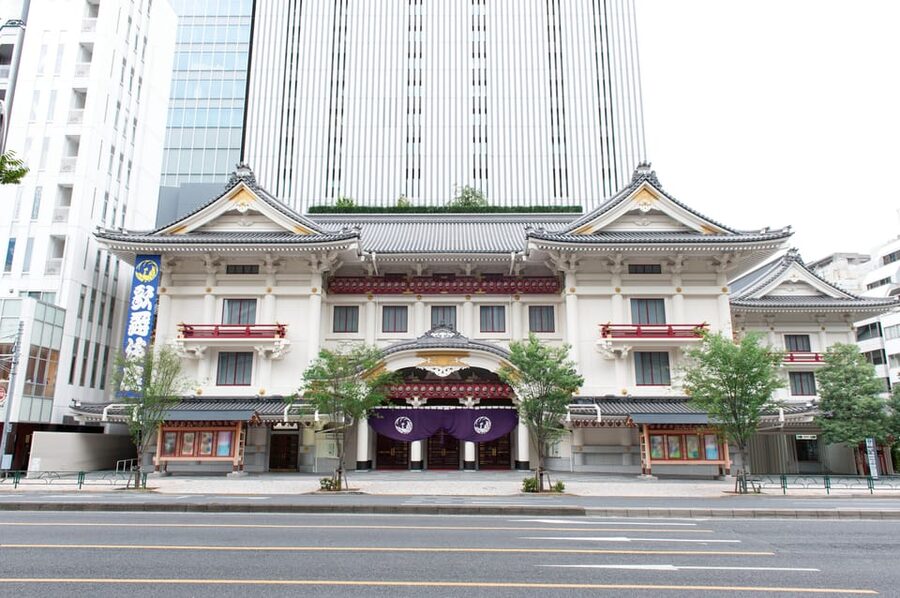
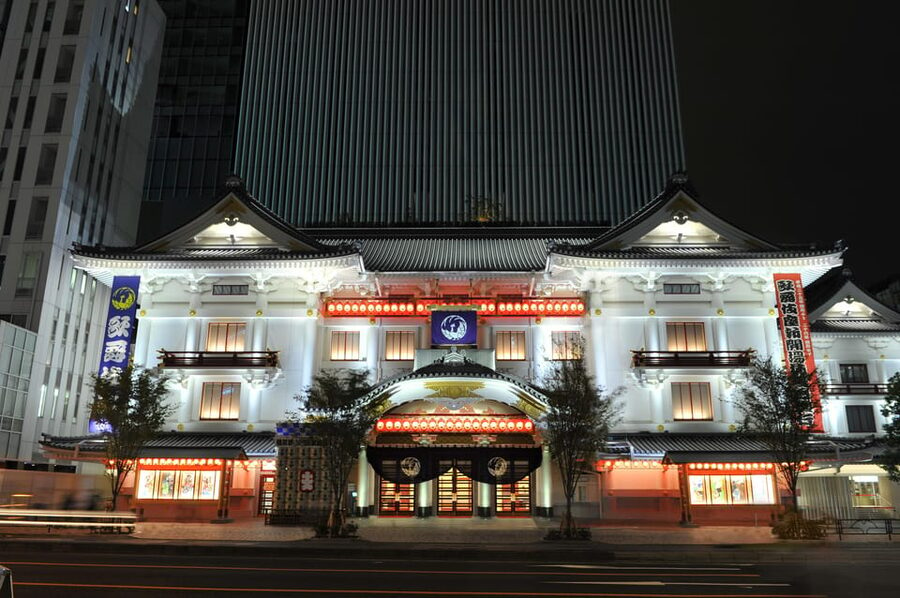
The theater itself is a major part of the visit. Kabukiza is in Ginza, at 4-12-15 Ginza, Chuo-ku, and has a long-established theatrical identity. You are not attending a tourist demonstration created for visitors. You are entering a working Kabuki theater where professional performers present a new program each month.
A few more Tokyo tours and experiences worth a look



What the four-hour program is really like
The advertised duration is four hours, but the exact running time depends on the monthly schedule. For example, a February matinee is planned to run from 11:00 a.m. to 3:21 p.m., while the February evening show is planned from 4:30 p.m. to 9:02 p.m. A March matinee is planned to finish at 3:08 p.m., and the evening schedule at 8:21 p.m.
Those times matter when planning your Tokyo day. A matinee occupies most of the afternoon. An evening performance can take up your entire dinner period, so plan to eat beforehand, bring something with you, or buy food inside during the breaks.
The program is usually made up of several separate pieces rather than one continuous story. One month might include a modern Kabuki play, a dance, a domestic drama, and a historical piece. Another might focus on one longer work presented in several acts.
That variety helps the long sitting time. A serious historical scene may be followed by dance, comedy, or a different visual style. You are not watching the same kind of performance for four hours.
Intervals are built into the schedule. They give you time to stretch, visit the restroom, look at the theater, and eat. Food and drinks, including snacks and alcohol, are available for purchase inside, and you may bring something to eat or drink with you. This is useful advice, not an afterthought. A small snack can make the difference between enjoying the last act and watching the clock.
The February and March programs show the range
The monthly schedule gives you a good sense of Kabuki’s variety. Programs change, so treat these examples as illustrations rather than a promise of what you will see.
A February matinee includes O-EDO MIYAGE, a modern Kabuki work, followed by TONBI YAKKO, a dance featuring a footman and a kite. The program then moves into IYA SAKAE SHIBAI NO NIGIWAI, a domestic play set in front of the Saruwakaza Theatre, before closing with TSUMORU KOI YUKI NO SEKI NO TO, a dance known in English as The Snowbound Barrier.
That is a useful introduction for a first-time visitor because the evening does not depend on one long narrative. You can appreciate changes in mood, movement, costume, and music from one piece to the next.
The February evening program includes scenes from ICHINOTANI FUTABA GUNKI, a historical work concerning the Battle of Ichinotani. It also includes AMAGOI GITSUNE, a dance about a fox praying for rain, and UME GOYOMI, a modern Kabuki story involving Tanjirō’s love triangle.
The March schedule offers a different balance. The matinee is planned around KAGAMIYAMA GONICHI NO IWAFUJI, a historical play presented across its first, second, and third acts. The evening show combines a spring dance with SANNIN KICHISA TOMOE NO SHIRANAMI, a domestic play about three thieves named Kichisa.
You do not need to memorize these titles. The important point is that the program can shift from historical drama to dance to modern Kabuki, and each month offers a fresh selection.
Captions make old stories easier to follow
The ticket includes an English or simplified Chinese caption service. This is one of the strongest reasons for an international visitor to choose this arrangement rather than attend without language help.
Kabuki stories may involve family duties, historical conflicts, romance, disguise, revenge, or characters whose relationships are not obvious from costume alone. Captions help you connect the gestures and dialogue with the action on stage.
The service is not a magic replacement for watching the actors. You need to divide your attention between the caption screen and the performance. One practical issue is timing. The text may change as the performance continues, and it does not always update at a predictable interval. If you spend the entire show reading, you can miss the facial expressions, poses, and stage action that make Kabuki special.
I suggest using the captions as a guide rather than trying to read every word. Glance down when you need the plot, then return your eyes to the stage for the acting, music, costume changes, and movement.
The service is available in English or simplified Chinese. If you are using this plan in Japan and do not need captions, the caption portion cannot be refunded or changed to a Japanese earphone guide. Keep that in mind before booking.
The stage, music, and costumes carry the show
Kabuki’s visual appeal begins before you work out the story. Sumptuous costumes, painted faces, stage screens, curtains, and carefully arranged sets create a theatrical world that is formal rather than realistic.
The acting style is highly controlled. Performers may hold a pose to make a feeling clear, or use a precise movement that would seem exaggerated in an ordinary conversation. Singing and dancing are central to many pieces, and live music helps set the pace and mood.
Shamisen music is part of the traditional sound associated with Kabuki, and the performance may also include narration. The combination of voice, instruments, movement, and silence gives the theater a texture you cannot get from a screen recording.
If you prefer modern, fast-moving drama, some sections may feel slow. If you appreciate classical performance, dance, music, or visual design, the formal style may be the very reason to attend.
A few more Tokyo tours and experiences worth a look



Arriving at Kabukiza and collecting your ticket

The booking process has one detail you must get right: the mobile or PDF voucher is not your admission ticket. On the day of the performance, take your GYG Voucher to the venue box office and exchange it for the physical ticket.
The box office is on Basement Level 2 and is open from 10:00 a.m. to 6:00 p.m. If you arrive after 6:00 p.m., go directly to the theater entrance as instructed. The doors open 30 minutes before the performance, but I would arrive earlier than that if you need to collect your ticket, find the correct level, or look around the building.
This is especially important for an evening show. You do not want to discover at 4:20 p.m. that you still need to collect a ticket for a 4:30 p.m. performance.
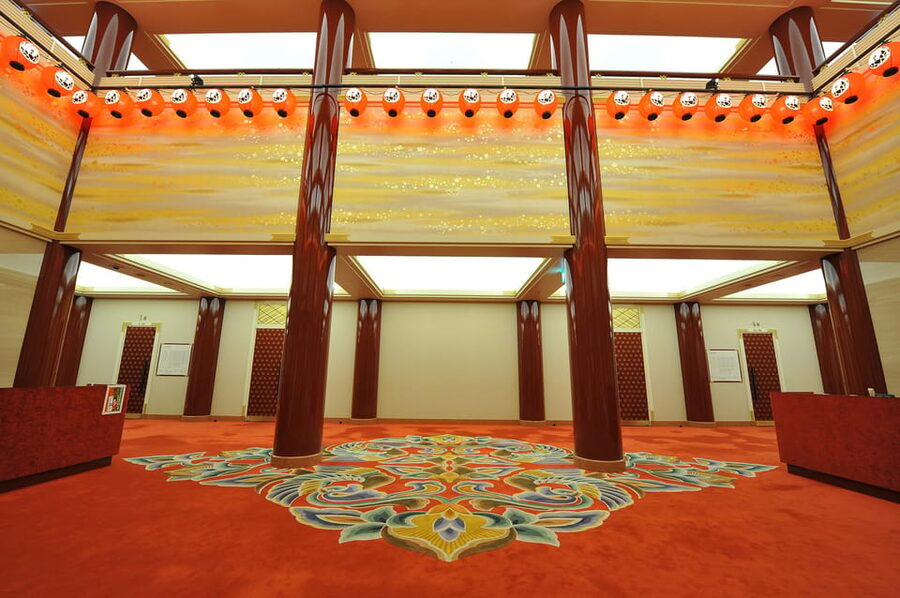
The theater is in Ginza, an easy area to combine with other Tokyo plans. You might visit the Kabukiza shopping center before the show, but do not assume every shop will still be open when a late performance ends. If souvenirs matter to you, shop before the curtain rather than waiting until the final applause.
Seating, comfort, and the long intervals
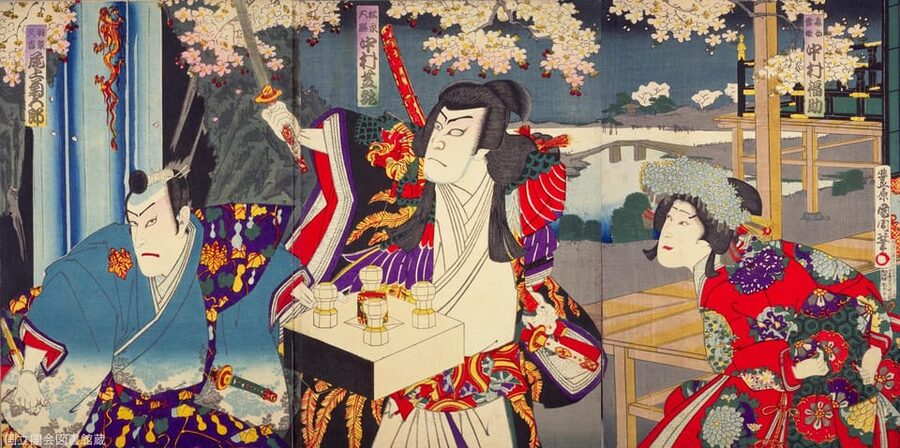
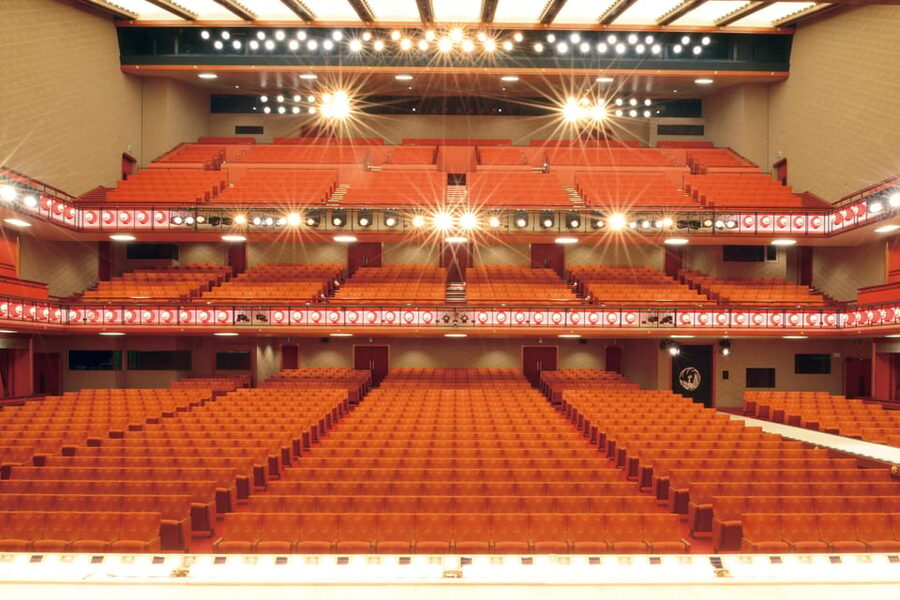
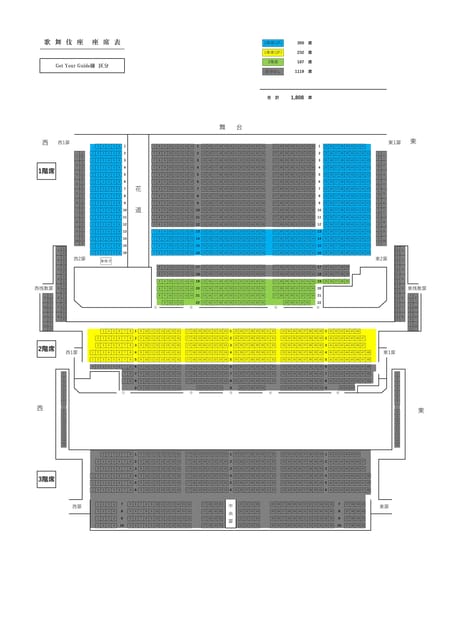
You cannot select a specific seat through this reservation. Your seat is assigned, and that means you should book for the experience as a whole rather than expecting a particular view.
A seat farther from the stage can make small facial expressions harder to see. That matters in Kabuki because a held expression or precise gesture may communicate a character’s emotion. At the same time, the full stage picture, costumes, entrances, and sets can be easier to appreciate from a wider view.
Comfort is the more common concern. The seats are in a historic theater and can feel tight, especially during a four-hour program. If you need extra support, bringing a small cushion may help. You will have intervals, but you still spend a long time seated.
Use each break properly. Stand up, walk a little, get a drink, and return before the next piece begins. The intervals are part of the structure, not wasted time.
Is $106 a fair price?
At $106 per person, this is not a bargain attraction. The value depends on what you want from Tokyo.
You are paying for admission to a professional Kabuki performance in Kabukiza, not a short sample designed only for first-time visitors. The monthly program, live music, costumes, sets, and caption service give the ticket more substance than a simple theater entrance.
The English or simplified Chinese captions are especially valuable if you cannot follow Japanese. Without them, you could still appreciate the acting and design, but the stories and relationships would be harder to follow.
The price may feel high if you are unsure about traditional theater or if you mainly want a brief cultural activity. Four hours is a serious commitment, and the assigned seat means you cannot pay more through this booking to guarantee a preferred location.
For someone who wants one substantial Japanese cultural experience, the cost can make sense. You are seeing an art form with professional performers, a changing program, and a dedicated historic venue. For a casual stop between Ginza shops, it is probably too long and too expensive.
Reservations for the following month begin on the 14th of each month. If you have a fixed Tokyo schedule, check availability early and confirm the program before paying.
Who will enjoy this most?
I would choose this experience if you enjoy classical theater, dance, music, traditional costume, or performances that ask you to watch carefully. It also suits anyone who wants a serious cultural evening rather than another observation deck or themed attraction.
It is a good choice for first-time Kabuki visitors because the caption service removes much of the language barrier. The changing program also gives you several forms of Kabuki in one sitting.
You should think twice if you dislike long performances, formal acting styles, or sitting in older theater seats. Children under four are not suitable for this activity, and younger children who cannot manage several hours of theater may also struggle, even though no higher age limit is specified.
Dress is not presented as a requirement. You may see people dressed formally, but the essential preparation is practical: arrive early, bring the voucher, plan food, and allow enough time for the complete program.
My booking advice for a first Kabuki visit
I would book Kabukiza if you want to see Kabuki in its proper home and are willing to give it an entire afternoon or evening. The caption service, monthly program, and intervals make the experience manageable for a first visit, while the stagecraft gives you plenty to watch even when the plot becomes difficult.
Check the exact month’s schedule first. Then decide between matinee and evening based on your meal plans and energy. Arrive with time to exchange the voucher at Basement Level 2, and do not count on buying souvenirs after a late show.
For the best experience, treat Kabuki as a four-hour cultural event, not a quick performance. If that sounds appealing, $106 buys a distinctive and memorable slice of Tokyo. If you want something short and casual, choose another activity.
FAQ
How long does the Kabuki performance last?
The listed duration is four hours, but the planned running time can be slightly longer or shorter depending on the monthly program. February schedules run about four hours and 21 minutes to four hours and 32 minutes, while the March schedules are shorter.
Are English captions available?
Yes. The ticket includes either an English or simplified Chinese caption service. The mobile voucher itself cannot be used for entry, so you must exchange it for your ticket at the venue.
Where do I collect my Kabuki ticket?
Collect your ticket at the Kabukiza Theatre box office on Basement Level 2. Bring your PDF or mobile GYG Voucher. The box office is listed as open from 10:00 a.m. to 6:00 p.m.
Can I enter with the GYG Voucher?
No. The voucher is used to collect the admission ticket and does not provide direct theater entry. If you arrive after 6:00 p.m., proceed directly to the theater entrance as instructed.
Can I choose my seat?
No. Seats cannot be specified through this reservation. Your seat is assigned.
Can I bring food and drinks?
Yes. You may bring food or drinks, and snacks and alcohol are also available for purchase inside the theater. The performance includes an intermission, making it a useful time to eat.
Can I cancel the booking?
You can cancel up to two days in advance for a full refund. Programs change monthly, so check the official Kabuki website for the current schedule before your visit.
More Tickets in Tokyo



More Shows & Performances in Tokyo
More Tickets & Passes in Tokyo


More tours in Tokyo we've reviewed












Show, compared.
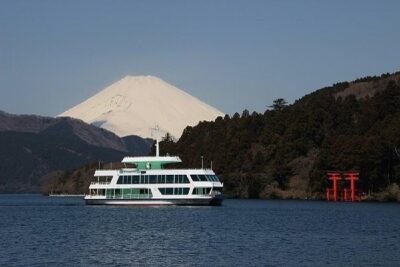 ★ 4.0Mt Fuji & Hakone Cruise, Drum Show Bullet Train 1 Day from TokyoFrom $149
 ★ 4.8Tokyo: Sumo Show Experience with Chicken Hot Pot and a PhotoFrom $1032 hours
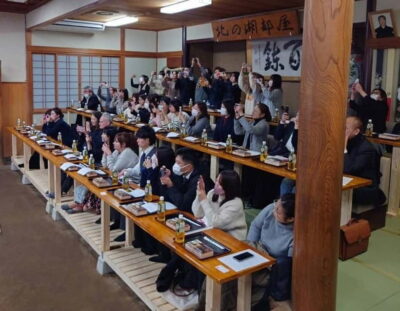 ★ 4.8Tokyo: Sumo Show and Dining ExperienceFrom $7990 minutes - 2 hours
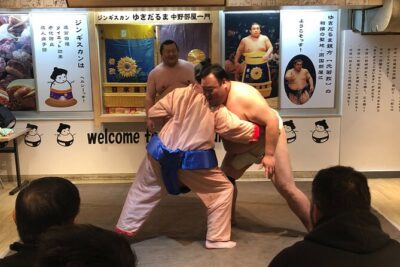 ★ 5.0the SUMO showFrom $89
 ★ 4.5Tokyo: Samurai Restaurant Show Ticket with 2 DrinksFrom $551h 30m
 ★ 4.0Mt Fuji & Hakone Cruise, Drum Show Bus 1 Day from TokyoFrom $122