Reviewed · AUDIO TOURS
Tokyo: 60min Panoramic Open Top Bus Tour with Audio Guide
Tokyo’s best feature on this ride is the open-air view. In one hour, you pass from central Tokyo to Rainbow Bridge, Odaiba, Toyosu, Tsukiji, and Ginza without wrestling with train maps or city traffic yourself. The bus gives you a broad look at how Tokyo’s government district, shopping streets, waterfront, and older market areas fit together.
In This Article
- Key points at a glance
- A one-hour view of Tokyo’s many faces
- Starting near Tokyo Station’s Marunouchi South Exit
- Hibiya Park and the government district
- Tokyo Tower from the moving upper deck
- Crossing Rainbow Bridge toward Odaiba
- Toyosu, Tsukiji, and Tokyo Bay
- Kabuki-za and Ginza before the return
- What the GPS audio guide adds
- Is $14 good value for one hour?
- Timing, weather, and comfort
- Who should book this bus ride?
- My booking advice
- FAQ
- Where does the Tokyo open-top bus tour start?
- Where does the tour finish?
- How long does the tour last?
- Is the tour hop-on hop-off?
- Which languages are available for the audio guide?
- What language does the live guide speak?
- What should I bring for the audio guide?
- Can I eat or drink on the bus?
- What happens if it rains?
- Can children under six ride for free?
I like the easy price, about $14 per person, and the route’s variety. I also like the chance to see Tokyo Tower from several angles, something one recent booking found especially interesting. The catch is that this is a sightseeing loop, not a hop-on hop-off bus, so you cannot get off to explore.
Key points at a glance
- Rainbow Bridge from an open-top deck: Feel Tokyo’s breeze as the bus crosses the bridge, weather permitting.
- Eight GPS audio languages: Choose English, Chinese, Korean, Spanish, French, Thai, Indonesian, or Vietnamese.
- A wide Tokyo sampler: Pass the National Diet Building, Tokyo Tower, Odaiba, Toyosu, Tsukiji, Kabuki-za, and Ginza.
- Simple Tokyo Station meeting point: The Hato Bus office is about two minutes from the Marunouchi South Exit.
- A low-cost first look: At roughly $14, the ride is useful for getting your bearings before choosing where to spend more time.
- Bring your own listening gear: You need a smartphone that works in Japan and your own earphones for the GPS system.
A one-hour view of Tokyo’s many faces

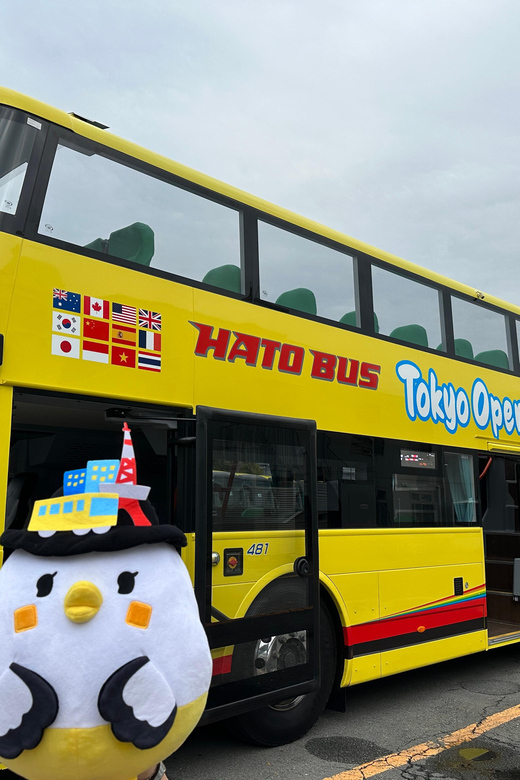
This Hato Bus tour is a moving city introduction. You stay on the double-decker bus for the full hour, with no stops for sightseeing. That limitation is also the point: you can cover a surprising amount of ground quickly, then return to Tokyo Station without having to find your way back from the waterfront.
The bus is open-top when conditions allow. From the upper deck, you get a higher and wider view than from a regular city bus. That matters in Tokyo, where tall buildings can easily block street-level views. You can look across broad roads, see towers from unusual angles, and catch the air as the bus heads toward Tokyo Bay.
A Japanese-speaking guide accompanies the tour, while GPS-based narration is available in eight languages. The audio options are English, Chinese, Korean, Spanish, French, Thai, Indonesian, and Vietnamese. Since the system uses your own smartphone and earphones, test that your phone works in Japan before you arrive. Hato Bus does not provide GPS devices or earphones.
Other guided tours in Tokyo
Starting near Tokyo Station’s Marunouchi South Exit
The tour begins and ends at the Hato Bus Tokyo office near Tokyo Station. From the JR Tokyo Station Marunouchi South Exit, turn left and walk straight for about two minutes. Look for the yellow Hato Bus stop.
This is a handy meeting point if you are already sightseeing around Marunouchi or arriving by train. Tokyo Station is large, so allow enough time to reach the Marunouchi South Exit rather than assuming every station exit leads directly to the bus. The listed meeting coordinates are 35.678964, 139.765781.
There is no hotel pickup or drop-off. You make your own way to the office, and the same location is used at the end. That keeps the price low, but it means this is best for someone comfortable navigating Tokyo Station.
Hibiya Park and the government district

The first part of the route passes Hibiya Park and the National Diet Building. You do not get off at either location, so think of this section as a quick visual introduction rather than a full visit.
Hibiya Park gives the ride a change of pace after the station area. Soon after, the National Diet Building brings you into Tokyo’s political center. The bus also passes through Toranomon, a central business district where modern offices and major roads shape the view.
This early section helps explain Tokyo’s scale. You move from a major railway hub into formal government streets, then toward the city’s famous tower and the bay. If you want detailed architectural commentary or time to walk around the Diet Building, this tour will not provide it. For a first orientation, though, the sequence is efficient.
Tokyo Tower from the moving upper deck

Tokyo Tower is one of the route’s main visual rewards. Because the bus approaches and passes it rather than stopping beside it, you get changing views as the city moves around you. The tower can look quite different depending on which side of the bus offers the better sightline at that moment.
A recent Japanese booking singled out the fun of seeing Tokyo Tower from several angles, and that is a fair reason to choose this ride. You are not simply lining up for one postcard view. You get a brief series of perspectives while the bus continues through the city.
Still, keep your expectations sensible. This is not a Tokyo Tower admission ticket, and there is no scheduled photo stop. If you want to go up the tower or spend time around its base, plan a separate visit after the bus returns.
Crossing Rainbow Bridge toward Odaiba

The tour’s most distinctive stretch is the ride toward Rainbow Bridge. With the roof open, you can feel the Tokyo breeze as the bus crosses the bridge. The upper deck gives you an elevated view of the bay area, and the open sides make the crossing feel more like a city ride than a standard enclosed coach trip.
Weather controls this part of the experience. In rain, the roof may be closed, which changes the feel of the ride and limits the open-air advantage. Heavy rain or poor weather can also lead to cancellation. Check the conditions before setting out and keep a flexible plan for the day.
After Rainbow Bridge, the bus passes Odaiba. The tour does not stop there, so you will not have time to visit individual attractions. Instead, you see the large-scale waterfront setting from the road. For someone deciding if Odaiba belongs on a longer Tokyo day, this quick pass can help.
A few more Tokyo tours and experiences worth a look


Toyosu, Tsukiji, and Tokyo Bay

The route continues through Toyosu and past Tsukiji Outer Market. These areas give the tour a different feel from the government and business districts earlier in the ride.
Toyosu is part of Tokyo’s modern bay area, while Tsukiji Outer Market is associated with food shops and market streets. You only pass by, so the bus cannot replace a meal or a walking visit. Also, food and drinks are not allowed on the bus, though drinks in plastic bottles are permitted. If you are hoping to snack while passing Tsukiji, eat before boarding or wait until the tour ends.
This part of the journey is useful because it shows Tokyo as more than towers and shopping avenues. You see the relationship between central Tokyo and the reclaimed waterfront areas in a short period. The view is quick, but the route gives you a reason to return on foot.
Kabuki-za and Ginza before the return

On the final stretch, the bus passes Kabuki-za and Ginza before returning to the Hato Bus office. Kabuki-za is a major visual landmark, with a design that catches the eye even during a short drive-by. Ginza brings the tour back into one of Tokyo’s best-known shopping and commercial districts.
This ending works well. After the wider views of the bay, you return to dense central streets and finish close to the station. You may find this part less dramatic than Rainbow Bridge, but it is practical. The tour leaves you in a useful location for your next activity.
Again, these are pass-by sights. You will not have time to enter Kabuki-za, browse Ginza, or explore Tsukiji during the ride. Treat the bus as a sampler that helps you mark places for later.
What the GPS audio guide adds

The automated narration is available in eight languages, which makes the ride accessible even though the live guide speaks Japanese. The supported languages are English, Chinese, Korean, Spanish, French, Thai, Indonesian, and Vietnamese.
The system is GPS-based, so the information is tied to the bus’s position along the route. You need to bring a smartphone usable in Japan and your own earphones. The equipment is not rented out, and the audio service is supplied free of charge.
That last point is worth noting. No refund is given for technical problems or malfunctioning earphones. Before boarding, charge your phone, confirm that mobile service or the required connection works in Japan, and bring earphones you know you can use. If the audio fails, the Japanese-speaking guide remains part of the tour, but you should not count on a replacement device.
Is $14 good value for one hour?

At around $14, this is an inexpensive way to see several separate parts of Tokyo in one sitting. A trip covering Tokyo Station, the government district, Tokyo Tower, Rainbow Bridge, Odaiba, Toyosu, Tsukiji, Kabuki-za, and Ginza would take much longer by foot and require several train or road connections.
The value is strongest for three types of people. You might be arriving in Tokyo and want a quick overview. You might have limited time and want a simple city loop. Or you might already know Tokyo but want an open-top ride for the views, especially around Tokyo Tower and Rainbow Bridge.
The price is less attractive if you want in-depth history, photo stops, or the freedom to spend time in each area. Since the bus does not allow you to hop off, you are paying for route coverage and views, not access to attractions. That distinction makes the tour easy to judge.
Timing, weather, and comfort
The ride lasts one hour, though you should allow extra time to find the bus office and get ready to board. The schedule varies, so check available starting times when booking.
The open top is the main attraction, but it also makes comfort weather-dependent. Sun, wind, and rain will be more noticeable on the upper deck than in a normal bus. In wet weather, the roof may close. Heavy rain or bad weather can cancel the tour entirely.
Eating is not allowed. Drinks in plastic bottles are permitted, so bring water if needed. Children under six can ride free without their own seat, with one child per adult. If a child needs a seat, the child should not be treated as a free lap passenger.
The tour has a current score of 4 out of 5 from 40 ratings, which fits the experience: the route and views are a strong match for the right passenger, while the short duration, no-stop format, weather risk, and personal-device audio system will not suit everyone.
Who should book this bus ride?
I would point this tour toward first-time visitors, short-stay visitors, families wanting an easy overview, and anyone who likes seeing a city from above. It is also a useful choice if you want a low-cost introduction before deciding where to return for a longer visit.
It suits you less if you dislike fixed routes or want to explore. You cannot get off at Tokyo Tower, Odaiba, Tsukiji, or Ginza, and the tour does not include food, hotel transport, or attraction entry.
The open-top deck is the key reason to book. If rain closes the roof, you still get the route, but the ride loses some of its special character. I would choose a dry-weather day when possible and keep another Tokyo plan in reserve.
My booking advice
Book this tour if you want a fast, affordable overview of central Tokyo and the bay. The route packs in major landmarks, and Rainbow Bridge gives the hour a clear highlight. Bring a charged smartphone and earphones, arrive at the yellow Hato Bus stop near the Marunouchi South Exit, and check the weather.
Skip it if you need walking time, detailed commentary in your language, or the freedom to choose your own stops. For everyone else, this is a sensible first look at Tokyo, especially at $14.
FAQ
Where does the Tokyo open-top bus tour start?
It starts at the Hato Bus Tokyo office near the JR Tokyo Station Marunouchi South Exit. From the exit, turn left and walk straight for about two minutes to the yellow Hato Bus stop.
Where does the tour finish?
The bus returns to the Hato Bus Tokyo office near Tokyo Station, the same place where the tour starts.
How long does the tour last?
The tour lasts one hour.
Is the tour hop-on hop-off?
No. This is a continuous sightseeing ride, and you remain on the bus for the route.
Which languages are available for the audio guide?
GPS audio guidance is available in English, Chinese, Korean, Spanish, French, Thai, Indonesian, and Vietnamese.
What language does the live guide speak?
The live tour guide speaks Japanese.
What should I bring for the audio guide?
Bring a smartphone that can be used in Japan and your own earphones. GPS devices and earphones are not provided.
Can I eat or drink on the bus?
Eating is not allowed. Drinks in plastic bottles are permitted.
What happens if it rains?
The bus roof may be closed in rain. The tour may be canceled because of bad weather or heavy rain.
Can children under six ride for free?
Children under six can ride without a seat for free, with one child per adult.