Reviewed · SAKE TASTING
Tasting All Types of Sake with Sommelier
Tokyo is a fine place to drink sake, but a sake menu can feel like a code. This Shinjuku tasting gives you a practical key: sommelier Aki explains how sake is made, how to read a bottle, and why one pour tastes dry while another is sweet or fruity. You sample six to seven types, including special Japanese-only bottles.
In This Article
- Key points to know before booking
- Why this tasting helps you understand sake
- Meeting Aki in Shinjuku San-chome
- A sake bar beside Louis Vuitton Shinjuku
- The sake styles you are likely to compare
- Learning how to read a sake label
- Aki’s teaching style and local advice
- How long the 90 minutes feels
- Is the $62.76 price good value?
- Who should book this Shinjuku sake experience?
- My verdict: book it early in your Tokyo stay
- FAQ
- Where does the sake tasting begin?
- What time does the experience start?
- How long does the sake tasting last?
- Where does the main tasting take place?
- How many types of sake are included?
- Who leads the experience?
- What topics are covered besides tasting?
- How large is the group?
- Can I cancel for a full refund?
I like the small-group setting, with no more than 12 people, and the range of styles in the glass. I also like that Aki talks about more than alcohol, adding useful tips on Shinjuku nightlife, Kabukicho, and Golden Gai. The main drawback is simple: this is a serious amount of tasting in about 90 minutes, so eat first and pace yourself.
Key points to know before booking
- Six to seven sake samples: Expect a broad flight, including sparkling, sweet, dry, hot, pasteurized, and unpasteurized sake.
- Aki leads the session: He explains production, flavor, serving methods, labels, and food pairings in clear English.
- Small sake bar setting: The tasting takes place near Louis Vuitton Shinjuku, rather than in a large classroom or brewery.
- Useful for first-timers and sake fans: Beginners get a clear introduction, while experienced drinkers may find bottles not commonly shipped abroad.
- Shinjuku context included: The meeting and walk touch on Shinjuku San-chome, Kabukicho, nightlife, and Golden Gai.
- Afternoon start: The experience begins at 4:00 p.m. and returns to the original meeting point.
Why this tasting helps you understand sake
Sake is often called rice wine, but that label only gets you so far. The drink has its own brewing process, serving customs, and vocabulary. If you walk into a Japanese restaurant knowing only the word sake, you may still have no idea what to order.
This experience tackles that problem head-on. Aki gives you a short handout covering the basics of sake, how it is produced, and the main types. Then the information becomes easier to remember because you taste examples as he explains them.
That matters. A description such as dry, fragrant, sparkling, or unpasteurized means more after you have compared several glasses side by side. You can begin to link words on a label with what you actually smell and taste.
The session is also useful before the rest of your Japan trip. Several participants used it as an introduction at the start of their stay, then felt more comfortable choosing sake in restaurants or buying a bottle in a shop. I think that is the strongest reason to schedule it early, as long as you are not too tired from your flight.
If you're still narrowing it down, here are other tours in Tokyo we've reviewed.


Meeting Aki in Shinjuku San-chome
The meeting point is in front of a location at 3-chome-4-8 Shinjuku, near Shinjuku San-chome Station and public transport. The start time is 4:00 p.m. You first spend a few minutes hearing about the Shinjuku San-chome area before walking toward the sake bar.
This opening is brief, about five minutes, but it gives the outing a local frame. You are not simply being dropped at a counter and handed a glass. You get a little orientation to one of Tokyo’s best-known entertainment districts before the tasting begins.
Shinjuku can be confusing, especially at the end of the day when signs, department stores, and station exits begin to blur together. Aki is reported to keep communication clear and make a point of finding people at the busy meeting spot. Still, check the exact location and allow extra time. The meeting point is not at the tasting bar itself.
The group can reach 12 people. Some sessions may be much smaller, even just two people, which can make the question-and-answer portion feel almost private. A larger group will feel less personal, but the stated maximum is still modest for an expert-led tasting.
A sake bar beside Louis Vuitton Shinjuku
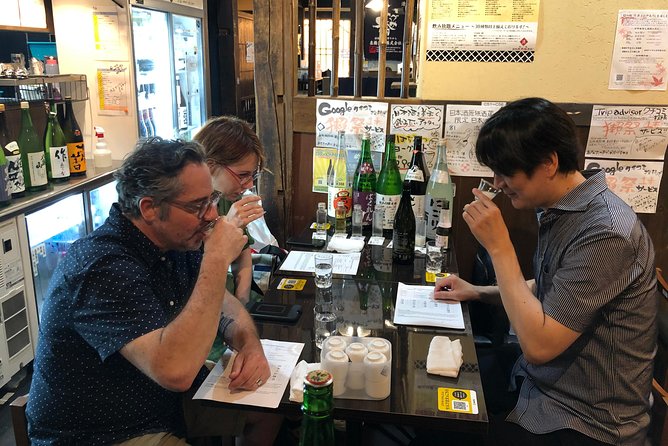
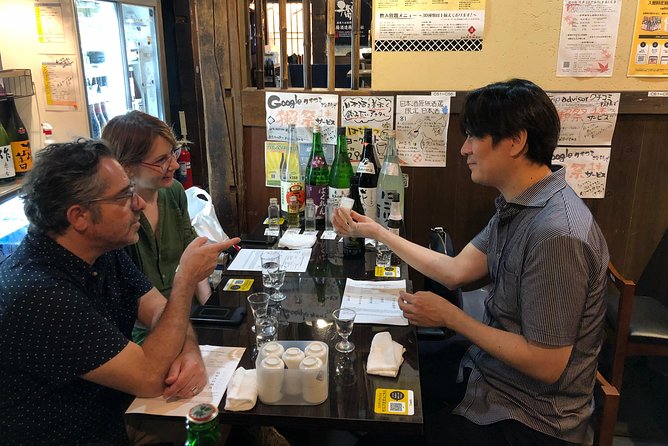
The main part of the experience takes place at a sake bar right next to Louis Vuitton Shinjuku. That location puts you in the middle of modern Shinjuku, not in a rural brewery or a museum-style exhibit.
The setting is worth considering. If you want a polished lesson with tanks, rice fields, and a full production tour, this is not that. If you want to taste several styles in a real city sake-bar environment, it fits well.
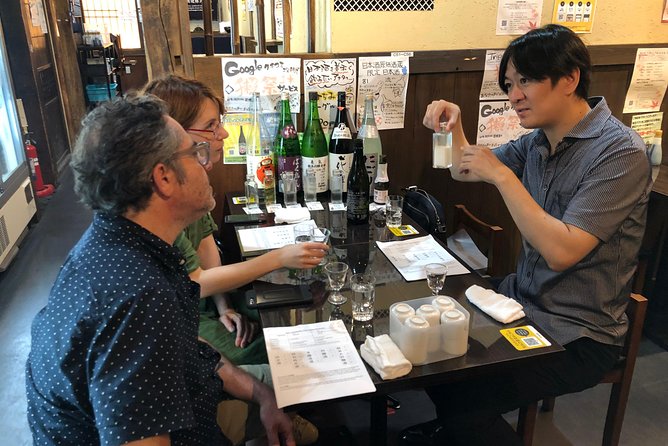
Aki serves the different sakes and explains what he notices in each one. You can ask about flavor, production, serving temperature, and the best way to drink a particular style. He also discusses which foods work well with different bottles, which is more useful than simply labeling one sake good and another bad.
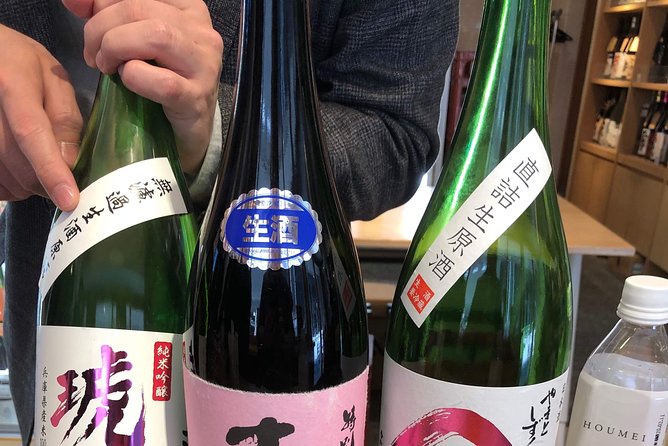
The tasting has included a welcome sake plus six different types in at least one session. The standard description promises six to seven samples, so the exact selection can vary. You might taste sparkling sake, sweet and dry styles, hot sake, pasteurized sake, and unpasteurized sake.
That range is the heart of the experience. A beginner may arrive thinking all sake tastes alike. By the end, you should have a much clearer sense of how different the drink can be.
The sake styles you are likely to compare
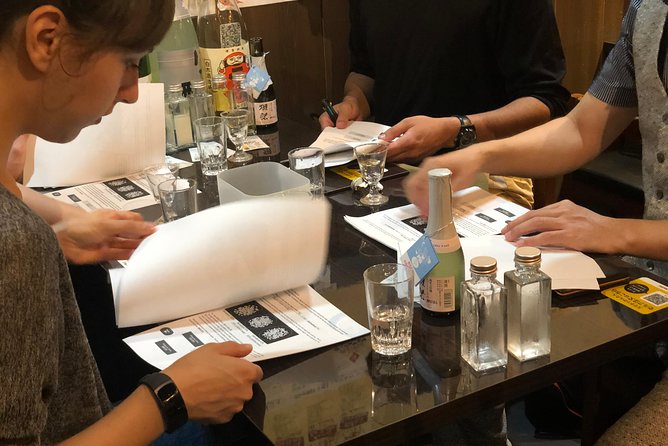
The tasting is built around contrast. Sparkling sake gives you a gentle, lively introduction, while dry sake shows a cleaner and sharper side. Sweet sake can feel softer and more approachable, particularly if you usually avoid spirits or strong drinks.
Hot sake is useful because many first-time visitors assume all sake should be served warm. Aki explains the best way to drink different varieties rather than treating temperature as a fixed rule.
Pasteurized and unpasteurized sake add another useful layer. Unpasteurized bottles can be difficult to find outside Japan because shipping is more complicated. For someone who already enjoys sake, this may be the chance to try a style that is rarely available at home.
The point is not to memorize every Japanese term during one sitting. Instead, you learn a few practical clues. You begin to see why two bottles with the same broad name may taste very different, and you learn which details on a label can help guide your choice.
One limitation is that the handout does not necessarily list every sake poured, along with technical details such as acidity or pasteurization for each individual bottle. If you want a written record for later shopping, take your own notes or ask questions as each sample arrives.
Learning how to read a sake label
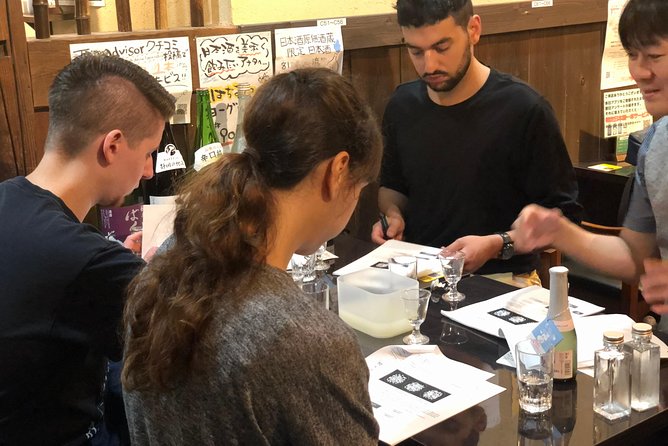
For many people, label reading is the most valuable part of the session. Japanese sake bottles often include information that is hard to interpret if you cannot read Japanese, and even an English label may use terms unfamiliar to a new drinker.
Aki explains how to use the information on the bottle to make a more informed choice. You learn how production affects flavor and how certain styles may suit different preferences. That can help you move beyond ordering whatever bottle has the most attractive design.
This is not a formal qualification course, and you will not leave able to identify every sake in a blind tasting. You will, however, have a working vocabulary and a better idea of what to ask at a restaurant or liquor shop.
I especially like the personal angle. The aim is not to tell you which sake is best. It is to help you identify what you like. Someone who prefers sweet, light drinks needs different advice from someone looking for a dry, full-flavored pour.


Aki’s teaching style and local advice
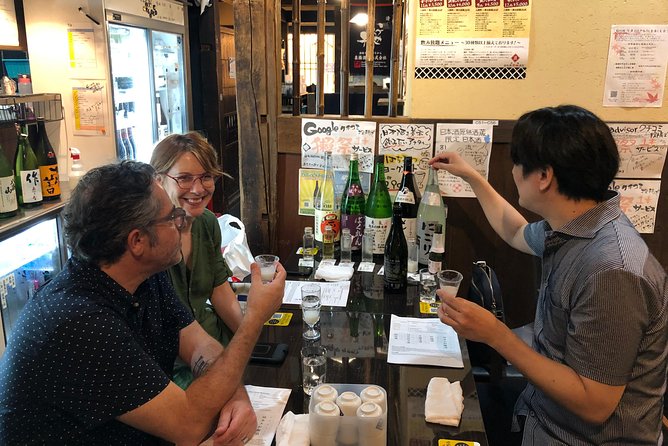
Aki is the main reason this experience feels more like a guided conversation than a row of samples. He has been described as friendly, funny, patient, and passionate about sake. He speaks English well and welcomes questions, including some that go beyond sake.
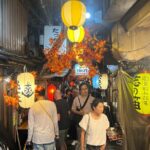
That last point adds value for a short Tokyo visit. Along with brewing and tasting, he talks about nightlife in Kabukicho and the narrow bars of Golden Gai. These subjects make sense in context, since the tasting takes place in Shinjuku, one of Tokyo’s major evening districts.
You may also get suggestions about places to visit, things to avoid, and other Japanese drinks such as whiskey and wine. The exact amount of side advice depends on the group and the conversation, but the experience is not limited to a memorized lecture.
The tradeoff is that a talkative guide can cover a lot of material quickly. If you want only a short drink-and-snack stop, the information may feel heavy. One participant compared the session to an introductory college class about sake. That is a good warning for anyone expecting a casual bar crawl.
How long the 90 minutes feels
The advertised duration is about one hour and 30 minutes. Most of that time is spent at the sake bar, with roughly five minutes at the first Shinjuku stop, five minutes around Shinjuku San-chome, and about 80 minutes for the main tasting.
Some sessions have lasted closer to two hours. That can be a pleasant bonus if you enjoy conversation, but you should not plan a tightly timed dinner reservation immediately afterward.
The 4:00 p.m. start is well chosen. You can spend the morning sightseeing, take a break in the afternoon, then move into Tokyo’s evening with a better sense of what to order. Since the activity ends back at the meeting point, you can continue shopping, eat nearby, or explore Kabukicho and Golden Gai afterward.
Do not treat the tasting as a full meal. The available details focus on sake and explanations, not a substantial food pairing menu. Eat lunch or a proper snack first. That is practical advice, not a minor detail, since six or seven pours can catch up with you.
Is the $62.76 price good value?
At $62.76 per person, this is more than simply buying several drinks at a bar. You are paying for the guided comparison, the explanations, the handout, and the chance to ask an expert how to choose sake later.
The value is strongest if you are new to sake, plan to visit restaurants during your Japan trip, or already enjoy sake but rarely find unpasteurized or less common bottles at home. A few well-chosen samples can save you from ordering blindly for the rest of your trip.
It is less compelling if you already know the major sake styles and prefer to discover bottles on your own. You might spend less by visiting a sake bar independently, though you would lose the structured tasting and the label-reading help.
The small group also matters. With a maximum of 12 people, the fee supports a more personal format than a large commercial tasting. Smaller bookings may bring even more direct time with Aki, though you should not assume every date will be private.
The experience is booked an average of 23 days ahead, so planning early makes sense during a busy Tokyo visit. Free cancellation is available until 24 hours before the 4:00 p.m. start time. Changes or cancellations inside that window are not accepted for a refund.
Who should book this Shinjuku sake experience?
I would recommend it to first-time sake drinkers who want help without feeling foolish for asking basic questions. Aki’s explanations cover how sake is made, how to read a bottle, and how different types taste, so you do not need prior knowledge.
It also suits couples, families with adult children, and friends. The session has worked well for people tasting sake together for the first time, and the relaxed guide helps keep the lesson social rather than stiff.
Sake fans have a reason to book too, especially if you live outside Japan. The chance to taste bottles that are hard to ship abroad adds something beyond a standard beginner flight.
I would be more cautious if you want a brewery visit, a large meal, or a late-night drinking tour. The experience is centered on education and comparison at a small bar. The nightlife talk is an added feature, not the main event.
My verdict: book it early in your Tokyo stay
Book this tasting if you want to understand sake well enough to make your own choices afterward. The combination of six to seven contrasting samples, label advice, food-pairing tips, and Aki’s easygoing teaching style gives you useful knowledge in a short afternoon.
Schedule it near the beginning of your trip, after you have eaten and had time to shake off jet lag. You can then use what you learn in Tokyo restaurants, department-store food halls, and bottle shops across Japan.
Skip it if you only want a quick drink or already feel confident ordering sake. For everyone else, $62.76 buys more than a flight of alcohol. It gives you a practical guide to one of Japan’s most interesting drinks, right in the heart of Shinjuku.
FAQ
Where does the sake tasting begin?
It begins in front of the meeting location at 3-chome-4-8 Shinjuku, Shinjuku City, Tokyo, near Shinjuku San-chome.
What time does the experience start?
The scheduled start time is 4:00 p.m.
How long does the sake tasting last?
The advertised duration is approximately one hour and 30 minutes. Some sessions have taken closer to two hours.
Where does the main tasting take place?
The tasting takes place at a sake bar next to Louis Vuitton Shinjuku.
How many types of sake are included?
You can expect to taste six to seven types of sake, with at least one session also including an additional welcome sake.
Who leads the experience?
The session is led by Aki, also referred to as Aki-san in the experience details. He is a sake sommelier who explains production, types, labels, serving methods, and pairings.
What topics are covered besides tasting?
The experience covers how sake is made, how to read a sake label, the best way to drink different styles, and foods that pair well with them. It also includes discussion of Shinjuku, Kabukicho, nightlife, and Golden Gai.
How large is the group?
The maximum group size is 12 people.
Can I cancel for a full refund?
Yes. You can cancel at least 24 hours before the experience start time for a full refund. Cancellations or changes made less than 24 hours before the start are not accepted for a refund.
More tours in Tokyo we've reviewed












Sake Tasting, compared.
 ★ 5.0Ramen and Sushi Cooking Class with Sake Pairing Set in TokyoFrom $79
 ★ 5.0Sake Tasting Masterclass in Shinjuku (8+ Varieties with a Pro)From $72
 ★ 5.0Sake Omakase in Tokyo: Guided Tasting by Certified SommeliersFrom $79
 ★ 5.0Wagyu & Sake Pairing in Shinjuku – Steak, Shabu-Shabu & MoreFrom $148
 ★ 5.0Tokyo Wagyu & Sake Pairing Tasting Experience with Local FlavorsFrom $151
 ★ 4.9Tsukiji: Outer Market Walking Tour & Sake Tasting ExperienceFrom $703 hours