Reviewed · TOKYO FOOD TOURS
Small-Group Wagyu Beef and 7 Japanese Dishes Tokyo Cooking Class
Tokyo’s best food lessons do more than show you how to roll sushi. This small-group cooking class starts with dashi, the basic stock behind much of Japanese cooking, then moves through seven dishes, Japanese seasonings, careful knife work, and tender Wagyu beef. You finish by sitting down to eat what you made, with sake and green tea.
In This Article
- Key points to know before booking
- Why starting with dashi matters
- Seven dishes, one busy morning
- Wagyu beef and the value of the main course
- What the small group changes
- A taste of Japanese home cooking
- Eating what you prepared
- Finding Cooking Sun Tokyo
- Dietary needs and cooking level
- Is $72.96 a good price?
- Who should book this class?
- FAQ
- How much does the cooking class cost?
- How long does the class last?
- What time does the class begin?
- Where does the class meet?
- How many people can join the class?
- What is included?
- Is the class taught in English?
- Can I request vegetarian food or report allergies?
I like the maximum of eight people, because you cook instead of watching from the edge. I also like the practical focus: the recipes, ingredient tips, and techniques are meant to work in your own kitchen. The main drawback is finding the studio at 18-39 Shinanomachi, since more than one person has found the building tricky to locate.
Key points to know before booking
- Dashi comes first: You learn the foundation of Japanese cooking before using it in other dishes.
- Wagyu is the main event: Prepare a tender beef dish, commonly described in the class as sukiyaki.
- Small means hands-on: The class takes no more than eight people, so you should have a real task at the counter.
- Seven dishes in about three hours: The menu covers appetizers, soup, vegetables, a main dish, and dessert, though the description also allows for up to eight dishes.
- English instruction: Local instructors explain ingredients, methods, and food customs in English.
- Useful take-home value: Recipes, cooking tips, and ingredient guidance make this more than a meal in Tokyo.
Why starting with dashi matters
The class begins with dashi, and that is a smart choice. Japanese cooking can look simple on the plate, but its flavor often depends on a few well-handled basics. Dashi is one of them.
You learn how this soup stock supports other dishes, rather than treating it as a mysterious ingredient you can only find in Japan. The instructors also explain common Japanese seasonings and how they fit into everyday cooking. That context gives you a better sense of why a dish tastes the way it does.
I especially like this approach for anyone who wants to cook Japanese food at home. A sushi-making lesson can be fun, but learning the stock and seasonings gives you a wider set of skills. You leave with a better grasp of soups, sauces, vegetables, and simmered dishes, not just one showy recipe.
The short teaching sections also help keep the pace moving. You get information about ingredients and food customs, then put it to use at once. That suits beginners who want clear guidance, as well as confident home cooks looking for a few new methods.
A few more Tokyo tours and experiences worth a look
Seven dishes, one busy morning
The class begins at 9:30 a.m. and lasts about three hours. The timing works well for a morning in Tokyo. You can cook, eat a substantial lunch, and still have much of the afternoon free.
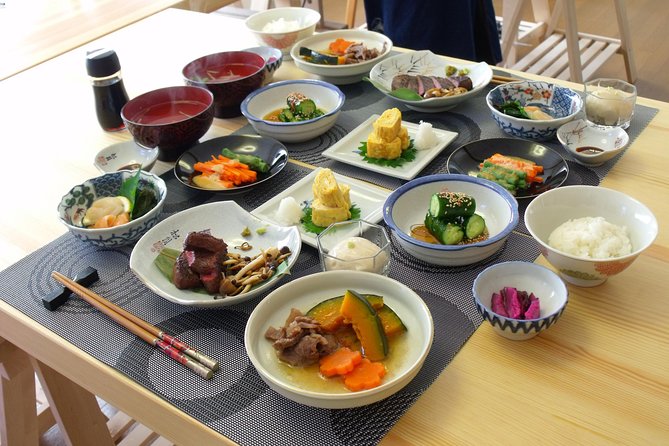
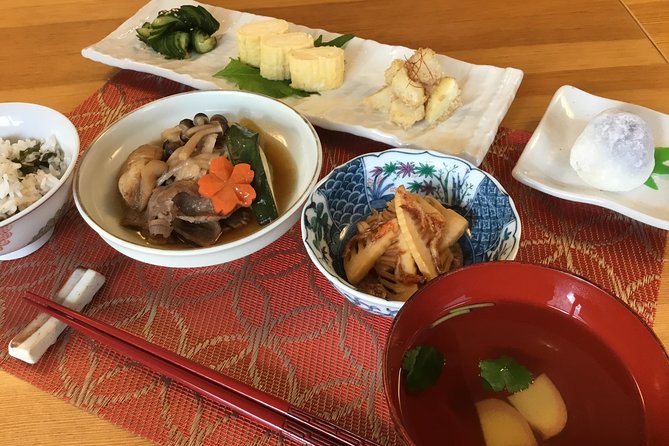
The exact menu should not be treated as a rigid restaurant-style tasting course. The experience is presented as seven Japanese dishes, with the full description allowing up to eight. The material refers to appetizers, soup, vegetables, Wagyu beef, and dessert, so you get a broad meal rather than a single focused dish.
You may work on:
- Dashi and a soup such as miso soup
- Japanese vegetable preparations
- A cucumber salad or similar side dish
- Rice and other home-style accompaniments
- A Wagyu beef main course, often described as sukiyaki
- A small dessert
- Additional dishes or garnishes depending on the class
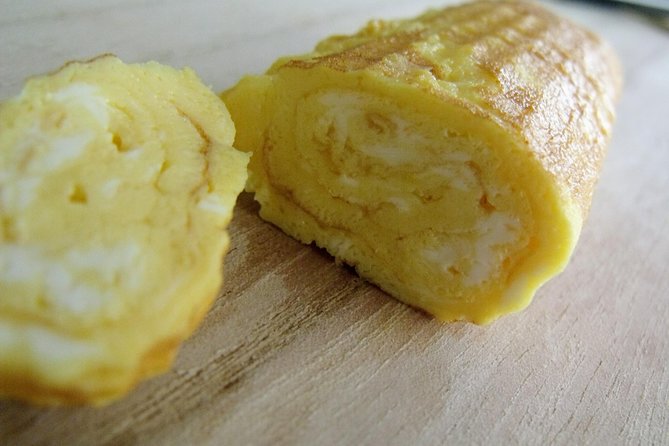
One particularly useful detail is that some components are prepared ahead by the staff. For example, the lotus-root dish with minced chicken is prepared in advance, while participants handle tasks such as chopping, mixing dressings, cooking an egg, and searing the prepared item.
That means the class is hands-on, but not every dish is made entirely from the first cut to the last simmer by you. I would set your expectations accordingly. You get plenty of participation and explanation, but the instructors also need to manage seven or eight dishes within three hours.
This is a good trade for many people. You see how a full Japanese meal comes together without spending half a day waiting for one stock to reduce. The staff keeps the meal on schedule, while you practice the steps most likely to be useful at home.
Wagyu beef and the value of the main course
Wagyu gives the class a clear centerpiece. The word simply means Japanese beef, with wa referring to Japan and gyu meaning beef, but the ingredient has become famous far beyond Japan.
Here, the beef is part of a full Japanese meal rather than a stand-alone luxury tasting. The class material highlights a beautiful, tender Wagyu main dish, and sukiyaki is repeatedly associated with the meal. Sukiyaki is a good teaching dish because it shows how beef, vegetables, broth, and seasoning work together.
The Wagyu also helps explain the price. At $72.96 per person, you are paying for a three-hour lesson, a meal, ingredients, an instructor, recipes, and use of an apron and towel. For Tokyo, that is a fair package if you value both the food and the instruction.
It would be less compelling if you only wanted to eat Wagyu. A restaurant meal may be simpler for that purpose. But the class lets you understand how the beef fits into Japanese home cooking, and you get several other dishes for the same fee.
What the small group changes
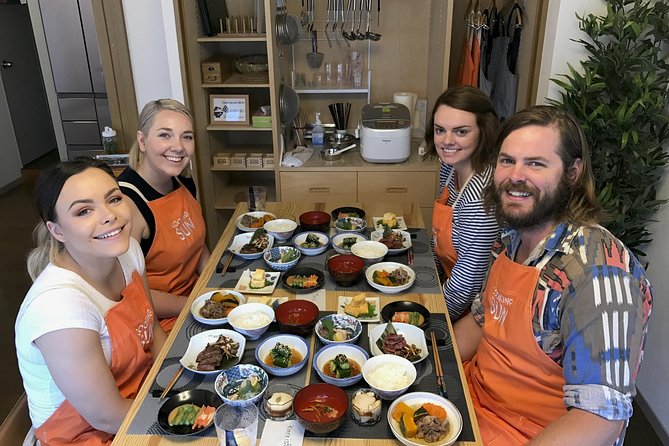
The class is limited to eight people. That number matters more than it first appears.
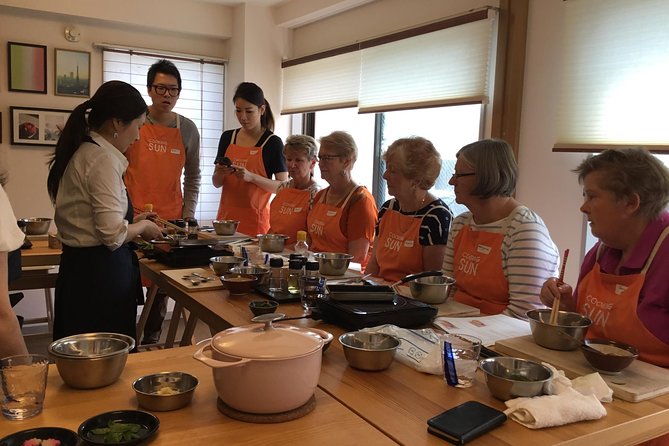
In a large cooking demonstration, you might spend much of the session holding a camera while an instructor does the work. Here, the small format is designed so you are not just a bystander. You should expect to chop, mix, season, prepare garnishes, and take part in the cooking under supervision.
The instructors are described as friendly, English-speaking locals. Names associated with the teaching team include Aya, Hidemi, Megumi, Yoko, and Kaori. The strongest part of the teaching style is its patience and clarity. Explanations are short enough to follow while you work, and the instructors offer help when a technique is unfamiliar.
This setup suits couples, families, solo visitors, and mixed-skill groups. You do not need advanced cooking ability. The class is also relaxed enough for someone who feels unsure in a kitchen, while still offering useful details to an experienced cook.
The small size creates a social element, too. You work beside people from other places, then share the finished meal at the end. If you want a quiet private lesson, this may not be the right format. If you like cooking with a few other people, it adds warmth without the disorder of a large class.
A taste of Japanese home cooking
The class uses the language of kaiseki ryouri, or haute Japanese cuisine, but the practical value comes from its home-style elements. You learn staple ingredients, traditional seasonings, food presentation, and cutting methods that appear across Japanese cooking.
That mix is useful because restaurant dishes can be hard to reproduce at home. A cooking class needs to bridge the gap between what looks impressive in Japan and what you can reasonably make in your own kitchen. The instructors share recipe stories, preparation tips, and occasional less-obvious techniques to help with that.
The dishes also show how Japanese meals balance different textures and flavors. Tender beef, vegetables, soup, rice, small side dishes, and dessert create a complete meal. You learn that Japanese cooking is not only about raw fish or noodles.
Some of the most useful lessons may be the simplest ones. A cucumber salad, a dressing, a soup base, or a careful cut can become part of your regular cooking. Several recipes are straightforward enough to repeat at home, which gives the $72.96 price more value than a meal you simply finish and forget.
Other cooking classes in Tokyo

Eating what you prepared
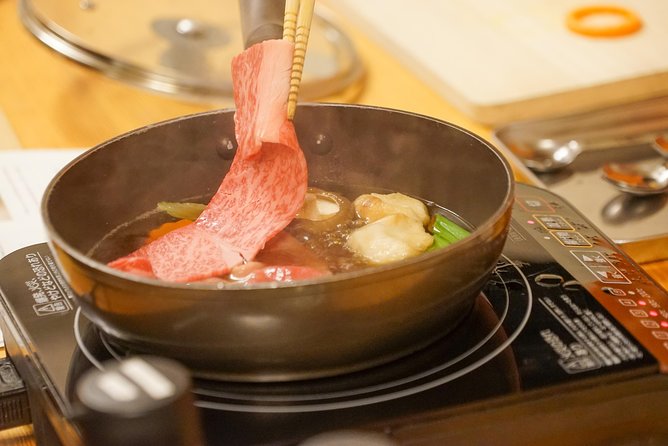
Once the cooking ends, you sit down for the meal and say itadakimasu, the customary phrase said before eating. The meal is accompanied by sake and green tea according to the class description.
This final part is not just a reward. It lets you taste the results while the techniques are still fresh. You can connect the texture of the beef to the cooking method, compare the seasoning in each side dish, and see how the dashi changes the meal.
The food is described as plentiful, and the class covers enough dishes to make lunch feel substantial. Sukiyaki is often the favorite, but the smaller vegetable dishes matter too. They show how a Japanese meal gains variety from several modest portions rather than one oversized plate.
Do note that the beverage details may not always feel central to the lesson. One attendee hoped for a small sake serving with lunch, so if sake is important to your plans, treat it as part of the stated offering but not the main reason to book. The cooking and shared meal are the core experience.
Finding Cooking Sun Tokyo
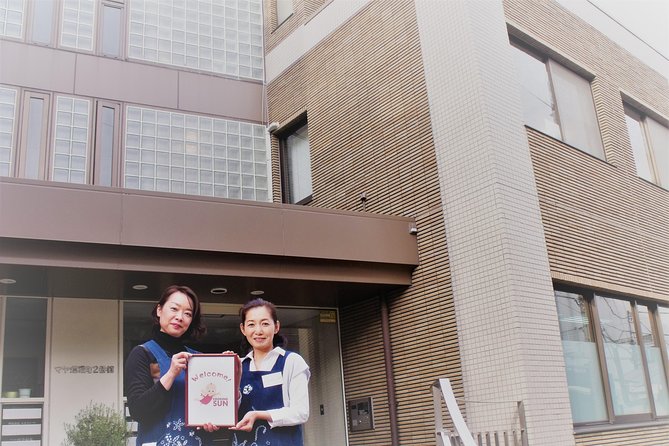
The meeting point is Cooking Sun Tokyo, at 18-39 Shinanomachi, Shinjuku City, Tokyo 160-0016. The class ends at the same location, and hotel pickup and drop-off are not included.
The studio is near public transportation, but allow extra time to find the entrance. The address is in a quieter residential setting, and the building can be easy to miss. A careful Google Maps check is wise before you leave, rather than trying to search for it at exactly 9:30.
There is a large park nearby, and the walk through the area can be pleasant. That quieter setting is part of the appeal, but it also means the class does not announce itself like a major attraction on a wide commercial street.
I would arrive early, especially for a first visit. Keep the meeting address visible on your phone, and do not assume a taxi driver will recognize the cooking school by name alone. This is the one practical issue that comes up repeatedly in the experience details.
Dietary needs and cooking level
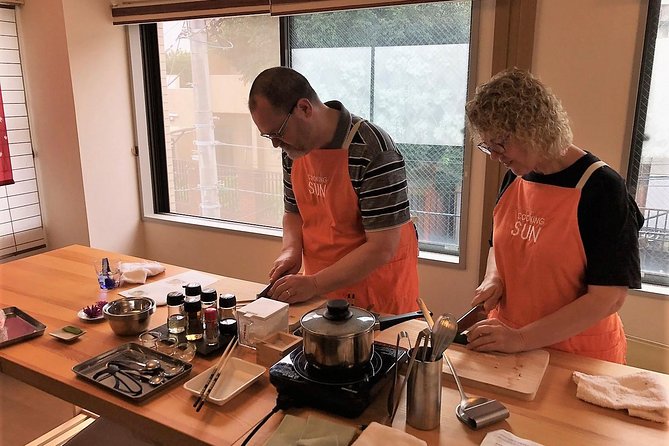
A vegetarian option is available, but you must request it when booking. You should also provide any other dietary requirements at that time. Do not wait until you arrive, since the menu depends on advance preparation and specific ingredients.
The class is suitable for beginners. The instructors explain each step in English and give feedback as you cook. You do not need to know Japanese cooking terms or arrive with a particular skill level.
For experienced cooks, the value lies less in mastering basic chopping and more in the ingredient knowledge, dashi, presentation, and Japanese methods. You may find some tasks familiar, while other ingredients and flavor combinations offer something new.
Families can also enjoy the class, though young children may need close supervision around knives and hot cooking surfaces. The provided information confirms that families have taken part, but it does not give a specific minimum age, so ask before booking if that matters for your group.
Is $72.96 a good price?
At $72.96 per person, this is priced as a lesson and meal rather than a short food demonstration. You receive the instructor, ingredients, recipes, apron and towel rental, and a full meal built from several dishes.
The strongest value comes from the number of techniques covered. You are not paying only for Wagyu. You are learning dashi, seasonings, vegetable preparation, presentation, and several recipes in one session.
The class is also a good use of a morning in Tokyo. Three hours is long enough to feel substantial but short enough to fit around other plans. You can follow it with sightseeing in Shinjuku or nearby areas without sacrificing a whole day.
The limitation is that not every component is prepared entirely by you. Some work is done ahead of time so the group can finish the menu within the allotted period. If you want a slow, intensive chef-training session, this is not that. If you want a practical introduction with plenty of food and a manageable schedule, the price is strong.
Who should book this class?
I would recommend it to you if you want to understand Japanese food beyond restaurant menus. It is especially useful if you enjoy cooking, want recipes you can repeat at home, or prefer a cultural activity that produces lunch.
It also fits a first visit to Tokyo. You learn the meaning of dashi, Japanese seasonings, Wagyu, sukiyaki, and itadakimasu in one relaxed setting. The small group makes it easier to ask questions and receive help.
You might skip it if your main goal is a luxury Wagyu tasting, a private class, or a single specialized dish such as sushi. The menu is broad, and the pace is organized around making a full meal. Also, if you dislike group activities or do not want to cook on vacation, a restaurant will be more direct.
For most food-minded visitors, the balance is good: useful instruction, a generous meal, a friendly English-speaking teaching team, and recipes that can travel home with you. Just plan extra time to locate the studio and tell the organizers about dietary needs in advance.
FAQ
How much does the cooking class cost?
The listed price is $72.96 per person.
How long does the class last?
The experience lasts approximately three hours.
What time does the class begin?
The stated start time is 9:30 a.m.
Where does the class meet?
It meets at Cooking Sun Tokyo, 18-39 Shinanomachi, Shinjuku City, Tokyo 160-0016, Japan.
How many people can join the class?
The class has a maximum of eight people.
What is included?
A local cooking instructor, recipes, ingredients, an apron, and a towel rental are included.
Is the class taught in English?
Yes. The instructors are English-speaking locals, and the class includes English instructions.
Can I request vegetarian food or report allergies?
Yes. A vegetarian option is available, and you should advise the operator of vegetarian needs or other dietary requirements when booking.
More Cooking Classes in Tokyo
More Cooking Classes in Tokyo
More Tokyo Food Tours in Tokyo


More tours in Tokyo we've reviewed












Tokyo Food Tours, compared.
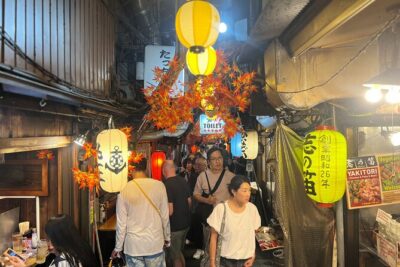 ★ 5.0Tokyo: Shinjuku Food Tour (13 Dishes at 4 Local Eateries)From $86
 ★ 4.9Tokyo: Shinjuku Food Tour (13 Dishes and 4 Eateries)From $97
 ★ 5.0Tokyo Night Foodie Tour in Shinjuku – Seasonal Sushi, Wagyu BeefFrom $111
 ★ 5.0Eat and Drink Like a Local: Tokyo Ueno Food Tour-Taverns&RamenFrom $95
 ★ 5.0Tokyo: Shibuya Food Tour (13 dishes and 4 Eateries)From $77
Tokyo: Shinjuku Food Tour – 15 Dishes, 3 Drinks, 4 EateriesFrom $723 hours
★ 5.0Tokyo: Shibuya Food Tour (13 dishes and 4 Eateries)From $77
Tokyo: Shinjuku Food Tour – 15 Dishes, 3 Drinks, 4 EateriesFrom $723 hours