Reviewed · KAMAKURA & ENOSHIMA DAY TRIPS
From Tokyo: Kamakura & Enoshima 1-Day Bus Tour
Kamakura gives you a quick change of scene from Tokyo: samurai-era temples, quiet shrine grounds, old shopping streets, and the bronze Great Buddha. Then the tour heads to Enoshima, a small island with sea views, shrine paths, shops, and, on a clear day, a look toward Mt. Fuji.
In This Article
- Key points at a glance
- Why Kamakura makes a smart day trip from Tokyo
- Tsurugaoka Hachimangu and Komachi Street
- The Great Buddha at Kōtoku-in
- Hase-dera’s gardens, views, and Kannon statue
- Two hours on Enoshima Island
- What the bus arrangement adds, and what it cannot fix
- Timing, meeting points, and small preparations
- Who will get the most from this tour
- Should you book the Kamakura and Enoshima bus tour?
- FAQ
- How long does the Kamakura and Enoshima tour last?
- Where does the tour start and finish?
- How early should I arrive?
- Is lunch included?
- Which entrance fees are included?
- What languages are offered?
- Can I bring luggage?
- What happens if the weather is bad or the tour lacks enough participants?
I like two things here: the bus takes care of the long trip from Tokyo, and the schedule links four major sights without forcing you to plan several train changes. I also like the mix of guided context and free time, which lets you follow your guide or wander on your own. The main drawback is the long day, especially the return drive through Tokyo traffic, plus plenty of stairs on Enoshima.
Key points at a glance
- Four major stops in one day: Tsurugaoka Hachimangu, Komachi Street, the Great Buddha, Hase-dera, and Enoshima are combined into one route.
- A useful escape from Tokyo: Roundtrip bus transport saves you from arranging local trains and transfers.
- Strong guides can make the difference: Omar, Yuki, Chen, Mitsuko, Koji, and others have been praised for clear explanations, warmth, and practical help.
- Lunch is your responsibility: Enoshima has seafood, restaurants, snacks, and shops, but the meal is not included.
- Enoshima requires stamina: Shrine paths, hills, stairs, and optional attractions can make the final stop tiring.
- Strict departure rules apply: Arrive at least 10 minutes early, find the guide with the pale blue flag, and do not count on the bus waiting.
Why Kamakura makes a smart day trip from Tokyo
Kamakura is close enough to visit in a day, yet it feels far removed from Tokyo’s towers and constant motion. It was the seat of Japan’s first military government, founded by Minamoto no Yoritomo in the late 12th century. That samurai connection helps explain the scale and importance of its shrines, as well as the concentration of temples around the town.
The tour gives you a broad first look rather than a slow, specialist visit. You see a major Shinto shrine, two important Buddhist sites, a shopping street, and an island shrine complex. For a first visit to the area, that range is the point.
At about $66.05 per person, the value comes mainly from the transportation and the amount you cover. Entrance fees to Hase-dera and Kōtoku-in are included, along with taxes and an air-conditioned vehicle. Lunch costs extra, and the day may last nine or ten hours, but arranging the same route independently still requires careful timing and several local journeys.
This is not a private tour. The vehicle can hold up to 90 people, although some departures feel smaller and more manageable. The quality of the day depends partly on the guide assigned to your bus. Guides such as Omar and Yuki have been singled out for humor, clear English, quick thinking, and thoughtful help, while one departure had weaker explanations. Keep that variation in mind when choosing a group tour.
A few more Kamakura tours and experiences worth a look


Tsurugaoka Hachimangu and Komachi Street
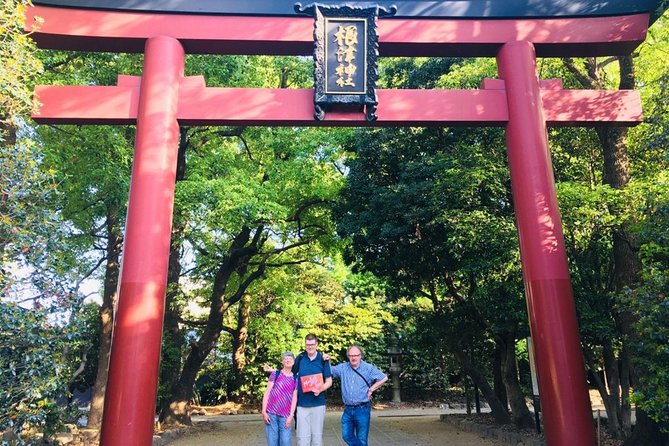
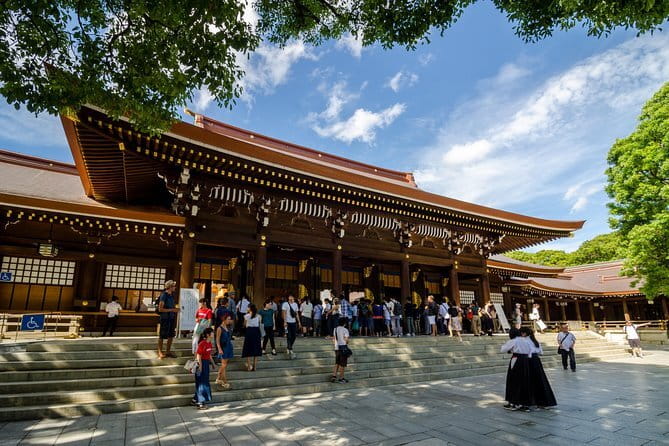
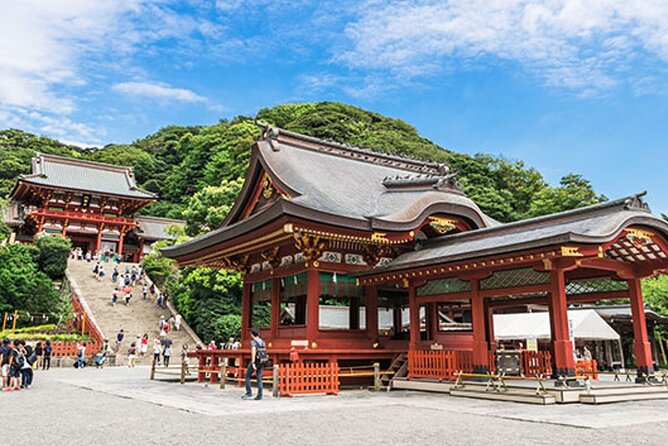
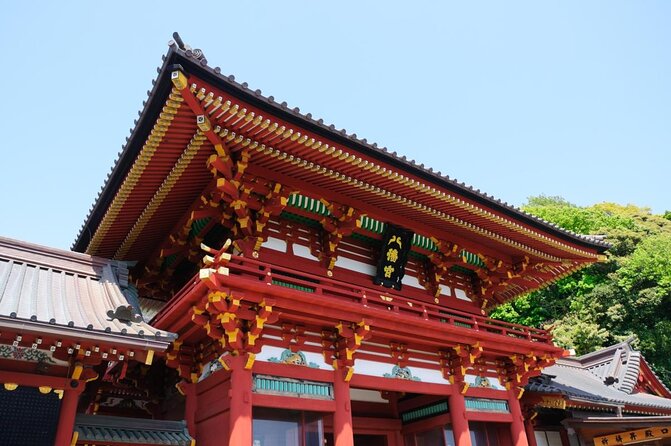
The day begins at Tsurugaoka Hachimangu, Kamakura’s main shrine and one of its key cultural sights. You enter through a large torii gate and walk toward the shrine grounds, passing ponds with koi and areas of open space. The long approach gives the visit a formal rhythm, with the shopping street on one end and the shrine buildings farther uphill.
The allocated visit is about two hours, which gives you time to see the shrine and explore nearby Komachi Street. The length is generous compared with the shorter temple stops later in the day. One practical point: two hours can feel slightly loose if you move quickly, so use the extra time for snacks, small shops, or a slower look at the shrine grounds.
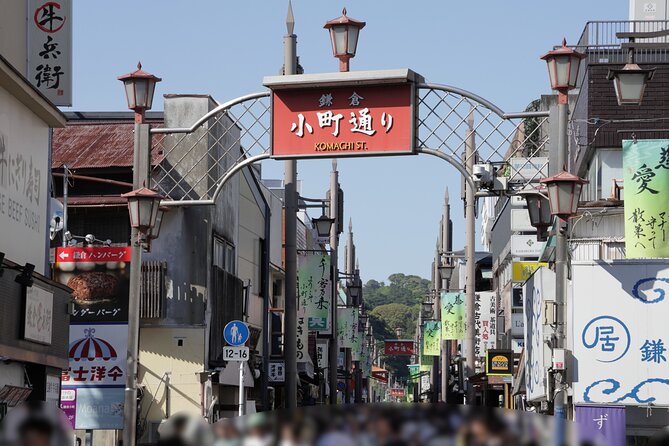
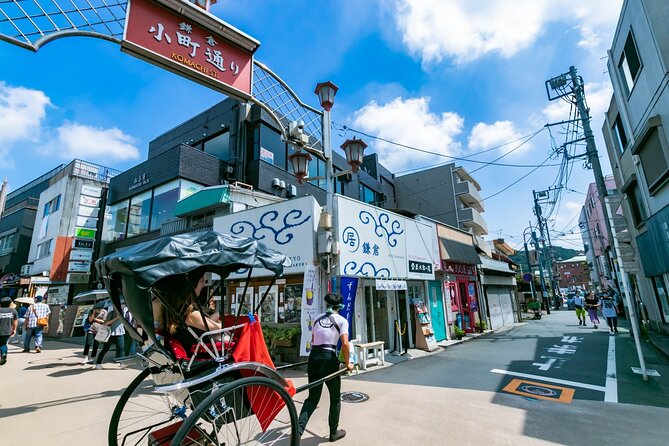
Komachi Street runs toward Tsurugaoka Hachimangu and is packed with food stalls, souvenir shops, handmade goods, and Kamakura-themed purchases. This is a good place to sample small snacks rather than commit to a full meal. Some restaurants open later in the day, so do not assume this first stop will solve lunch.
The shrine area includes several smaller points of interest, including Shirahata Shrine beside Yanagihara Pond. That shrine is connected with Minamoto no Yoritomo, the founder of the Kamakura shogunate. Depending on the guide and the amount of free time, you may also hear about other nearby shrines, museums, or Kamakura’s response to the 1923 earthquake.
I would treat this opening stop as your chance to get oriented. Listen for the guide’s explanation of Shinto customs and Kamakura’s political past, then use the free time to explore at your own pace. Some guides provide lively background and useful food suggestions. Others focus more on meeting times and logistics, so your own wandering matters here.
The Great Buddha at Kōtoku-in
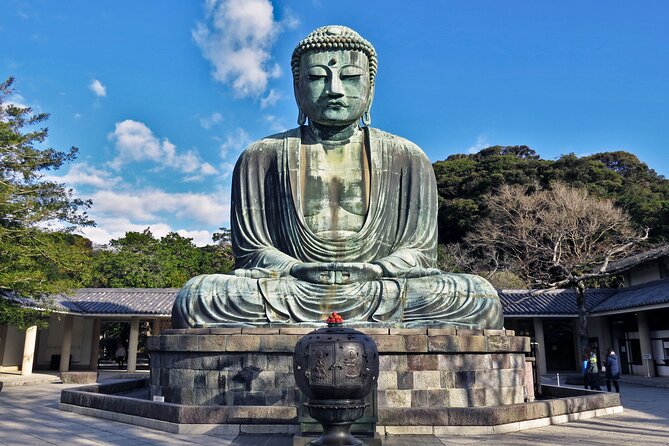
Kōtoku-in is home to Kamakura’s famous bronze Great Buddha, an Amida Buddha that has sat outdoors for centuries. The statue is the visual centerpiece of this stop, and it is easy to understand why the site appears on nearly every first-time Kamakura route.
You have about 30 minutes here, with admission included. That is enough to see the statue, take photographs, and look around the temple grounds. It is not much time for a slow visit, especially when the site is crowded.
The Great Buddha can draw a queue, and one useful detail is that a small additional charge may allow you to enter the statue from the rear. One tour member was short of the required 50 yen and received help from the guide, but you should carry coins so you are not caught out. The information provided does not make this extra entry part of the included admission, so treat it as optional.
This stop is a good example of the tour’s compromise. The bus gets you there efficiently, and the entrance fee is covered, but you have limited control over crowd levels and time. If you want a detailed examination of the statue and grounds, an independent visit would be calmer. If you mainly want to see Kamakura’s best-known monument, 30 minutes works.
Hase-dera’s gardens, views, and Kannon statue
Hase-dera is often the most layered stop on the Kamakura portion of the route. The temple is known for its eleven-headed wooden Kannon, the Buddhist goddess of mercy, and for its carefully arranged grounds. You may find gardens, ponds, statues, and hillside paths here rather than one single monument to check off.
The visit lasts about 50 minutes, with admission included. That gives you a worthwhile look, but the clock can feel tight if you want to see every corner. One account of the tour found this stop rushed, particularly when lunch and movement between sites took time. Keep your watch visible and listen closely for the meeting instructions.
The temple’s hillside setting also means steps. You do not need to treat this as a hard hike, but it is not flat sightseeing. Wear shoes with a good grip, especially in wet weather, and do not spend all your time taking photographs at the first viewpoint.
The guide can add useful context here, especially when explaining Kannon and the role of temple worship. If your guide is one of the stronger history presenters, this is a place where a short explanation can make the architecture and statues more meaningful. If the commentary is brief, the grounds still reward independent exploration.
Two hours on Enoshima Island
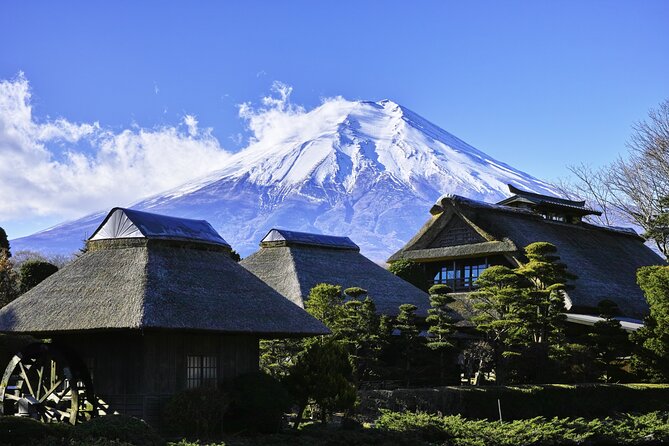
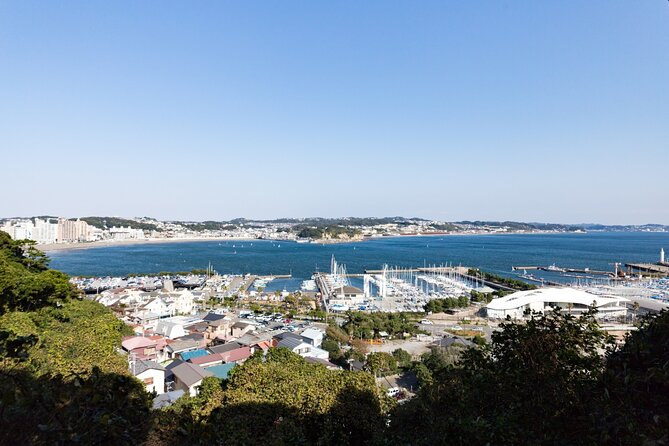
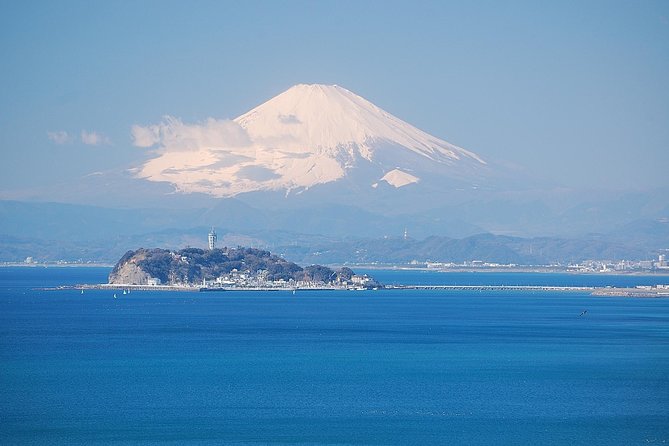
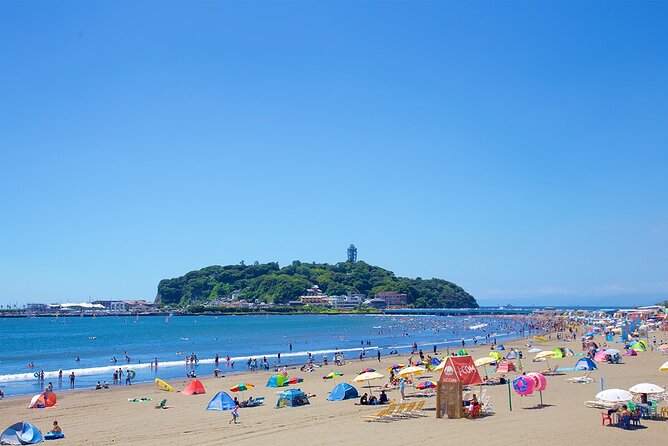
Enoshima is the tour’s change of mood. After Kamakura’s temple and shrine grounds, you cross to a compact island lined with shops, restaurants, shrine buildings, and paths that climb toward higher viewpoints. The island is especially appealing when the weather is clear, since you may see broad ocean views and Mt. Fuji in the distance.
The scheduled two hours sounds generous, but Enoshima can use every minute. The main approach includes a narrow shopping street after the bronze torii gate. You will find restaurants, seafood, sweets, and souvenirs, making this the natural lunch stop. Your meal is not included, so check the meeting time before sitting down for a full meal.
Enoshima Shrine is actually a group of three shrines dedicated to Benzaiten, the goddess associated with music, wealth, and wisdom. The complex includes Hetsu-no-miya and Nakatsu-no-miya, with paths continuing across the island. The route gives you a taste of the shrine complex rather than a slow religious study.
You can also find the Samuel Cocking Garden and its observation lighthouse. The tower rises 59.8 meters, with the top reaching 119.6 meters above sea level. The information provided does not say that admission to the lighthouse is included, so check locally before paying for optional attractions.
The most important Enoshima tip is to plan your route before you set off. The island has stairs, slopes, and optional paths toward a cave. Buying an escalator ticket may save energy on part of the climb, but it does not remove all stairs, and the cave route can take longer than expected. One visitor reported climbing more than 600 steps while trying to see the island and return to the bus.
Do not let that put you off. You can keep your Enoshima visit simple by staying near the main shrine and shopping area, eating lunch, and enjoying the sea views. But if you want the garden, lighthouse, shrines, and cave, you must move briskly and follow the guide’s return instructions.
The bus meeting point may not be beside the most obvious tourist area. In rain or darkness, finding it can take time, so leave the island early. This is the place where a relaxed stroll can turn into a hurried uphill and downhill dash if you lose track of the schedule.
A few more Kamakura tours and experiences worth a look
What the bus arrangement adds, and what it cannot fix
The air-conditioned bus is the tour’s practical backbone. You avoid handling local train connections between Tokyo, Kamakura, Hase, and Enoshima, and you return to Tokyo at the end. Some buses have USB charging ports, which is helpful after a full day of maps, photos, and translation apps.
Comfort is not completely consistent. One departure used an older, basic bus, and some seats near the wheel were cramped. Another departure had a clean, modern vehicle. If seating matters to you, arrive early, though your assigned seating may still be controlled by the operator.
The return drive can be long because of traffic. The tour is advertised at roughly nine to ten hours, but road conditions can affect the schedule. The bus operates in poor weather unless the local operator tells you otherwise, and the route can change after an accident or other road problem.
One useful example is a route being reversed because of a traffic accident. That solved the road problem, but it also pushed lunch to around 11 a.m., when many Enoshima restaurants were not yet open. Stay flexible, carry a snack, and expect the order of stops to change if traffic requires it.
The guide provides commentary in English and Chinese, sometimes on the same bus. English clarity varies by guide. Omar, Yuki, Chen, Mitsuko, and Koji have received particularly warm praise for their friendliness, explanations, or practical assistance. The tour’s strongest version is not just a ride between sites. It gives you enough context to understand what you are seeing and enough free time to make the day feel personal.
Timing, meeting points, and small preparations
The experience offers a choice of two centrally located Tokyo pickup points, but the exact point selected during booking matters. The stated meeting location is Shinjuku Post Office at 1-chōme-8-8 Nishishinjuku, and Shinjuku is the only drop-off point at the end. The bus does not return to Ikebukuro.
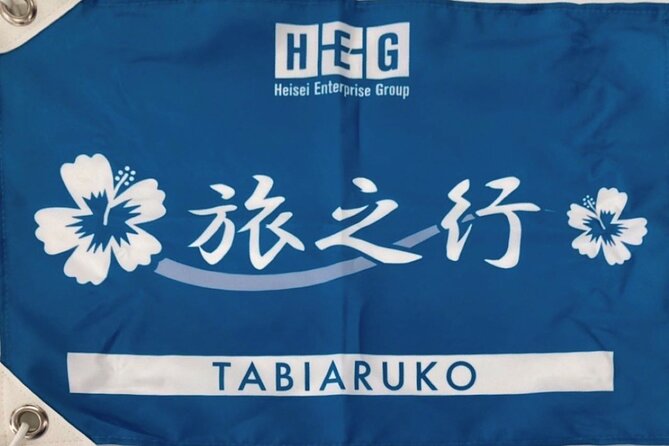
Look for the guide holding a pale blue flag. Arrive at least 10 minutes early, and check the exact Google Maps location before the morning of the tour. The bus leaves on time and does not wait for late arrivals, even if you have made contact.
You may bring one piece of luggage per person, provided it fits comfortably in the vehicle. Trunk luggage must not exceed 155 centimeters when height, width, and depth are added together. You cannot access stored luggage between stops, so keep passports, medication, money, and electronics with you.
The tour requires at least 10 participants and may be canceled three to four days before departure if that number is not reached. Free cancellation is available up to 24 hours before the start time. Within 24 hours, changes and refunds are generally not accepted.
Who will get the most from this tour
I would choose this tour if you have limited time in Tokyo and want a broad introduction to Kamakura and Enoshima without building the day yourself. It works particularly well for families and first-time visitors who value a clear schedule, included temple admissions, and a guide who can point out food and shopping areas.
It also suits you if you like a blend of structure and independence. You receive meeting instructions and a route, but you can often break away from the guide to browse Komachi Street, take photographs, or choose your own lunch.
I would think twice if you want deep time at each temple, an unhurried lunch, or a quiet visit to Enoshima’s more distant attractions. The day is long, traffic can delay the return, and the island’s stairs are real. An independent train trip gives you more control, but it asks you to manage the route and timing yourself.
Should you book the Kamakura and Enoshima bus tour?
Book it if your priority is efficient coverage. For about $66.05, you get roundtrip transport from Tokyo, two major Kamakura temple admissions, four main sightseeing areas, and a full day outside the city. That is a fair deal when you value convenience.
Go in with realistic expectations. This is a fast overview, not a slow temple retreat. Bring coins, water, comfortable shoes, a snack, and a phone with the meeting point saved. Keep lunch flexible, start back toward the bus early on Enoshima, and arrive at Shinjuku well before departure.
The best guides turn the route into a lively introduction to Japan’s samurai and religious traditions. Even with a less talkative guide, the sights themselves are worthwhile. For a first look at Kamakura and Enoshima, I would book it, especially when Tokyo’s traffic and train transfers sound more tiring than the fixed schedule.
FAQ
How long does the Kamakura and Enoshima tour last?
The tour lasts approximately 9 to 10 hours, though traffic, weather, and other unexpected conditions can affect the schedule and return time.
Where does the tour start and finish?
The stated meeting point is Shinjuku Post Office at 1-chōme-8-8 Nishishinjuku, Shinjuku City, Tokyo. Shinjuku is the only available drop-off point, and the bus does not return to Ikebukuro.
How early should I arrive?
Arrive at least 10 minutes before departure. Look for the guide carrying a pale blue flag, and make sure you go to the exact pickup point selected for your booking.
Is lunch included?
No. Lunch is not included, so you will need to buy your own meal. Enoshima has restaurants, seafood, snacks, and a shopping street.
Which entrance fees are included?
Entrance fees to Hase-dera and Kōtoku-in are included. The tour also includes taxes and transportation. Optional attractions on Enoshima, such as the lighthouse, should be checked locally.
What languages are offered?
The tour includes an English or Chinese-speaking guide. Depending on group size, English and Chinese commentary may be provided on the same bus.
Can I bring luggage?
One piece of luggage per person is allowed if it fits comfortably in the vehicle. Luggage stored in the trunk must not exceed 155 centimeters when its height, width, and depth are combined, and it cannot be accessed between stops.
What happens if the weather is bad or the tour lacks enough participants?
The tour generally departs regardless of weather and traffic unless the local operator notifies you otherwise. It may be canceled if the minimum group size of 10 people is not reached, in which case you will be offered another date or experience, or a full refund.
More 1-Day Tours in Kamakura
More Kamakura & Enoshima Day Trips in Kamakura

More tours in Kamakura we've reviewed
Kamakura & Enoshima Day Trips, compared.
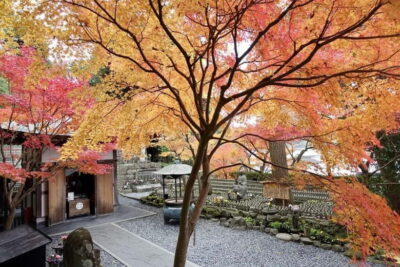 ★ 4.5Tokyo: Kamakura & Enoshima Day Trip including Temple TicketsFrom $589 hours - 570 minutes
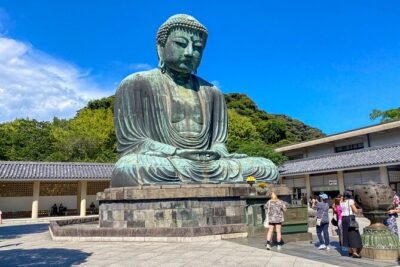 ★ 5.0Mount Fuji, Kamakura, Big Buddha, & Lake Ashi Day TripFrom $109
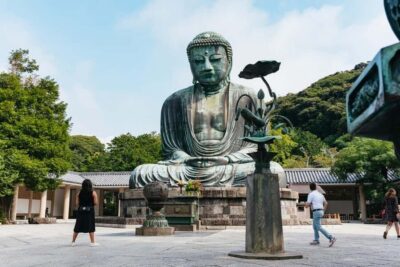 ★ 4.7Tokyo: Mt Fuji, Kamakura, Lake Ashi & Big Buddha Guided TourFrom $50
 ★ 4.9Tokyo:Sea of Mount Fuji, Hakone Ropeway, Ōwakudani, EnoshimaFrom $5010 hours
 ★ 5.0Kamakura 8 hr Private Walking Tour with Licensed Guide from TokyoFrom $201
 ★ 5.0Kamakura Private & Customizable Tour – All-in-One ExperienceFrom $512 - 8 hours