Reviewed · UENO & YANAKA WALKS
Mini Origami Lamp and Mizuhiki knot Belt Workshop in Ueno
The best part of this Ueno workshop is that you do not simply watch a Japanese craft demonstration. You fold and glue handmade washi paper into a small lamp, then shape mizuhiki paper cords into a decorative belt ornament. The finished lamp closes like a book, which makes it far easier to carry home than many bulky souvenirs.
In This Article
- Key points at a glance
- Folding washi paper into a small glowing lamp
- Learning what mizuhiki knots mean
- A quiet break with Japanese sweets and kozo tea
- Why the Ueno setting works well
- Private teaching with Kaho Shinoda
- What the $107.50 price includes
- Who will enjoy this workshop most
- Practical planning for the two and a half hours
- The souvenirs are the real payoff
- Should you book the Ueno origami lamp class?
- FAQ
- Where does the workshop take place?
- How long does the activity last?
- What will I make?
- Is the activity private?
- Are materials included?
- Are food and drinks included?
- Is the workshop suitable for young children?
I like the private instruction from Kaho Shinoda, since detailed paper work is much easier when you can stop, ask questions, and correct a fold before moving on. I also like the useful keepsakes: a warm little lamp, a mizuhiki piece, and a quiet memory of Tokyo that is not mass-produced. The main consideration is that the work requires patience and careful hand movements, so it is not suitable for young children. A cat is also present in the workshop, which matters if you have allergies.
Key points at a glance
- Make two Japanese crafts: Fold and glue a washi paper lamp, then create a mizuhiki knot ornament for a belt.
- Private class format: Your group receives personal instruction and can ask questions throughout the session.
- Compact souvenir: The bellows-style lamp folds down to look like a closed book, making it practical to take home.
- Ueno location: The workshop is near public transportation and ends where it begins in Taito City.
- Tea and sweets included: Finish with Japanese sweets and kozo, or Japanese paper, tea.
- Plan ahead: The class lasts about two and a half hours and is usually booked about 29 days in advance.
Folding washi paper into a small glowing lamp
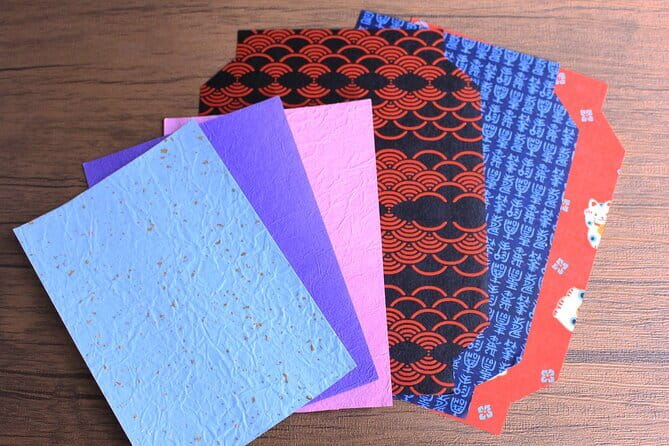
The workshop begins with an introduction to washi paper and the basic ideas behind the craft. You receive a guide document, then learn how handmade paper behaves before starting the lamp.
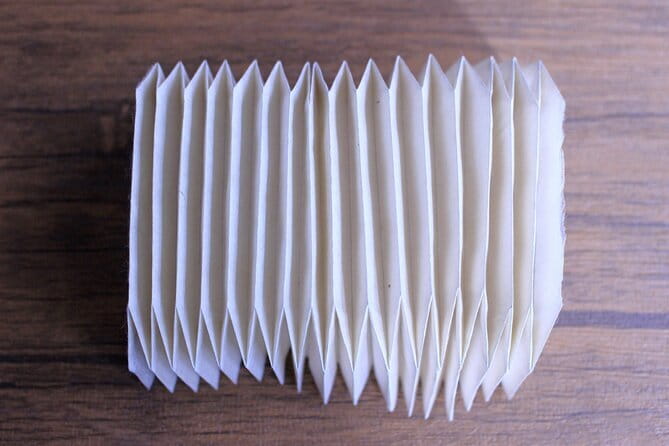
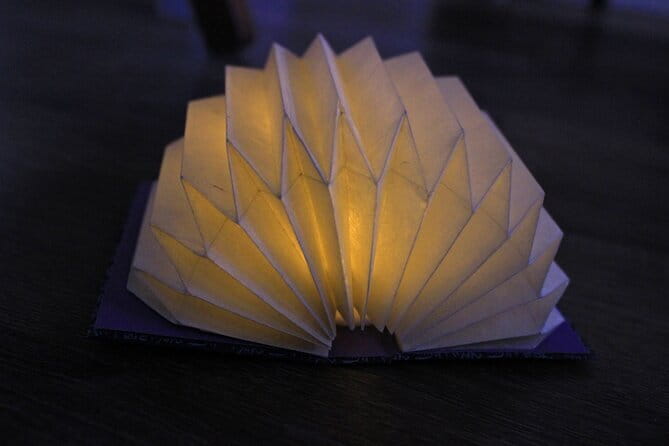
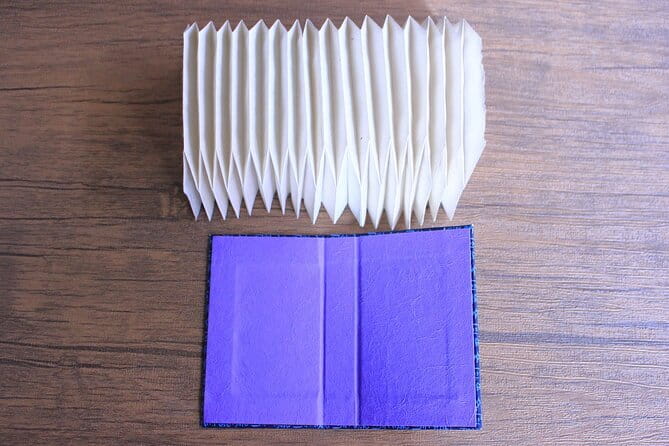
The lamp uses several sheets of washi folded and glued into a bellows shape. Think of an accordion with a softer, more refined look. When open, it creates a small lampshade. When closed, it resembles a book, a clever design for anyone who must pack carefully.
Washi is light but durable, so it works well for a decorative object that you can actually use. Once a small lamp is placed inside, the paper gives off a gentle, warm light. The material does not merely decorate the light. Its folds shape the whole character of the lamp.
This is a hands-on class, not a quick craft activity where you rush through a template. You will need to line up folds, handle glue carefully, and pay attention to how the paper opens and closes. The private setting helps here. If a fold is uneven or the bellows shape does not move properly, you can ask for help as you work.
The finished size is also part of the appeal. You leave with something meaningful but manageable. It is not a large interior piece that needs special luggage space. The lamp can serve as a small room decoration at home and remind you of your time in Japan when it is lit.
A few more Tokyo tours and experiences worth a look


Learning what mizuhiki knots mean
The second project introduces mizuhiki, the decorative paper cord used in Japanese gift presentation and ornaments. Mizuhiki has a core of twisted washi paper covered with nylon or film, giving it both structure and a polished surface.
You create a mizuhiki knot ornament for a belt. The work is precise, and the cord can be less forgiving than it first appears. This is another reason the private format helps. You can follow the instructor’s hand movements closely instead of trying to keep up with a large group.
The knot is not only a pattern. Different mizuhiki knots carry different meanings, and that makes the craft especially fitting for gifts. The experience gives you a small window into how Japanese design often combines beauty with intention. A cord tied in a certain way can express a wish, a connection, or a good occasion.
You may also find the knotting more challenging than the lamp. The lamp involves repeated folds, while mizuhiki asks you to manage paper cords and maintain an even shape. Take your time. The point is not to finish first. It is to understand the movement well enough to keep practicing later.
A quiet break with Japanese sweets and kozo tea
At the end, the class shifts from careful making to a slower tea break. Japanese sweets are included, along with Japanese paper tea, described as kozo tea. Kozo is one of the plants traditionally used in washi making, so the drink connects naturally with the paper craft you have just learned.
This is not an ordinary tea stop added simply to fill time. It gives you a chance to look at the lamp, check the knot, and enjoy the result before packing everything away. The sweets also add a small food element without turning the workshop into a meal.
The tea is unusual because it is tied to the subject of the class. If you enjoy trying local drinks with a story behind them, this will likely be one of the more memorable details. The snack and tea are also useful if you have booked the class during the afternoon and want a calm pause between sightseeing stops.
Why the Ueno setting works well
The meeting point is Washi Labo TOKYO, at 3-30-2 Taito, Taito City, Tokyo 110-0016. The activity is near public transportation, and you return to the same point at the end.
Ueno is a practical base for this kind of class. You can combine the workshop with time in the wider Ueno and Asakusa area, rather than setting aside a full day for a distant craft center. The class itself offers a useful change of pace from busy streets and major sights.
That change matters. Tokyo can fill a day with stations, shops, temples, and packed sidewalks. Two and a half hours at a worktable gives you time to focus on one physical task. You leave with more than photographs, but you also do not need to sacrifice an entire day of sightseeing.
Allow extra time to reach the meeting point. The address is given in Japanese as well as English, which is useful for showing a driver or checking your route. The experience begins and ends at the workshop, so there is no second drop-off point to arrange.
Private teaching with Kaho Shinoda
Kaho Shinoda leads the instruction at Washi Labo TOKYO. The format is private, meaning only your group participates. That can make a real difference in a craft class, where each person may fold, glue, and tie at a slightly different speed.
You can ask questions as soon as you need help. You are not waiting for an instructor to circle back through a room full of tables. The class also feels more personal because the projects are your own rather than a demonstration that someone else completes for you.
Past participants have especially valued the clear preparation of the materials and the patient guidance. That fits the structure of the activity: the materials are ready, the projects have been planned with the finished size in mind, and the instructions take you through two related crafts without requiring previous experience.
The class is suitable for beginners, but beginner-friendly does not mean effortless. You should expect detailed work. If you enjoy making things with your hands, that slow pace is part of the pleasure. If you want a quick souvenir with no concentration required, choose a different activity.
A few more Tokyo tours and experiences worth a look




What the $107.50 price includes
At $107.50 per person, this is not a bargain craft class. The value depends on what you want from a Tokyo experience.
You are paying for about two and a half hours of private instruction, all materials for two finished pieces, the expertise of an instructor, Japanese sweets, and tea. You also leave with a lamp and mizuhiki ornament rather than a small purchased trinket. For a private activity, the price is easier to justify if you are traveling as a couple, family group with older children, or a small set of friends.
The lamp gives the price practical weight. A handmade interior item can be used for years, and the folded design reduces the usual concern about transporting a fragile or oversized craft. The mizuhiki piece adds a second skill and souvenir rather than making you spend the entire session on one object.
Still, you should be honest about your interests. If you do not care about paper craft, interior decoration, or learning a traditional Japanese technique, the price may feel high. You are not paying for a major sightseeing landmark or a full meal. You are paying for focused instruction and the chance to make something yourself.
The average booking time is about 29 days in advance. That suggests you should not leave this until the last day of your Tokyo plans, especially if your schedule is tight.
Who will enjoy this workshop most
I would recommend this experience to anyone who likes craft, design, or quiet cultural activities. It suits adults and older children who can manage careful folding and knotting. The private setting is also a good fit if you prefer asking questions freely rather than learning in a large class.
It works well for couples because you can make separate pieces while sharing the same calm activity. Friends can compare lamp shapes and knot patterns. Solo visitors may appreciate having a structured way to meet an instructor and spend an afternoon away from the usual sightseeing route.
The workshop is also a strong choice for a rainy-day plan, but note the stated policy: the activity requires good weather, and poor weather can lead to a new date or a full refund. The reason for that condition is not explained, so check the status before setting out if conditions are poor.
This is not a good pick for very young children. Small, precise tasks can frustrate a child who wants fast results. If anyone in your group has allergies, tell the provider before attending because a cat is in the workshop.
Practical planning for the two and a half hours
Set aside the full two hours and thirty minutes rather than assuming you can squeeze the class between two fixed appointments. The work includes an introduction to washi, lamp construction, mizuhiki knotting, and the final tea and sweets.
Wear something that allows you to work comfortably at a table. The available information does not specify clothing rules, but glue and delicate paper reward a relaxed approach. Keep your schedule open enough that you do not feel pressured to finish.
A mobile ticket is provided, and confirmation arrives at booking. Most people can participate, and the workshop is near public transportation. Since the activity returns to its starting point, it is easy to continue exploring Ueno or head toward Asakusa afterward.
Cancellation is free up to 24 hours before the start time for a full refund. Changes or cancellations inside that 24-hour window are not accepted, and the local Tokyo cut-off time applies. If poor weather causes the provider to cancel, you are offered another date or a full refund.
The souvenirs are the real payoff
Many Tokyo craft activities give you a small object that looks attractive for a day and then disappears into a drawer. This one gives you two pieces with clear links to the work you performed.
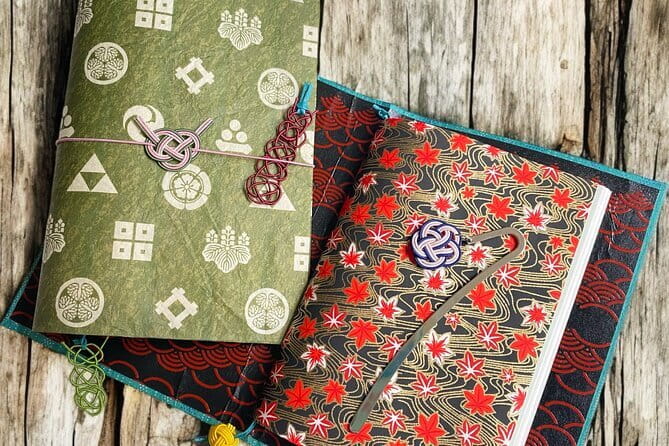
The lamp is the stronger souvenir for practical use. Open it and place a small light inside, or close it like a book when you want to store it. The warm glow can bring back the memory of the workshop without requiring you to display a sign or figurine.
The mizuhiki ornament is smaller, but it carries more cultural meaning. Once you understand that knots can express different ideas, the belt piece becomes more than a decorative cord. You can also continue practicing mizuhiki after the class.
I especially like that both projects are personal without being too difficult for a first attempt. The instructor’s guidance and prepared materials keep the class approachable, while the careful steps leave room for real satisfaction when the pieces come together.
Should you book the Ueno origami lamp class?
Book it if you want a private, hands-on activity and would rather make a Japanese souvenir than buy one. The combination of washi, mizuhiki, sweets, and kozo tea gives the class a clear identity, and the compact lamp is practical to carry home.
I would skip it if your Tokyo schedule is packed with major sights, if you dislike detailed manual work, or if anyone in your group is allergic to cats. At $107.50, the value is strongest for people who care about the process as much as the finished objects.
For craft lovers, couples, and older children, this is a thoughtful Ueno addition. Reserve ahead, allow the full two and a half hours, and arrive ready to work slowly. That is how you get the most from the class.
FAQ
Where does the workshop take place?
The workshop takes place at Washi Labo TOKYO, 3-30-2 Taito, Taito City, Tokyo 110-0016. It is near public transportation.
How long does the activity last?
The workshop lasts approximately two hours and thirty minutes.
What will I make?
You will make a small origami-style lamp from handmade washi paper and a mizuhiki knot ornament for a belt.
Is the activity private?
Yes. Only your group participates in the private workshop.
Are materials included?
Yes. Materials for making the washi lamp and mizuhiki belt ornament are included.
Are food and drinks included?
Yes. Japanese sweets and Japanese paper tea, also described as kozo tea, are served at the end.
Is the workshop suitable for young children?
No. The detailed skills required mean the workshop is not suitable for young children. A cat is also present, so you should notify the provider about any allergies.
More Workshops & Classes in Tokyo
More Ueno & Yanaka Walks in Tokyo
More tours in Tokyo we've reviewed












Ueno & Yanaka Walks, compared.
 ★ 5.0Eat and Drink Like a Local: Tokyo Ueno Food Tour-Taverns&RamenFrom $95
 ★ 4.5The Old Quarter of Tokyo – Yanaka Walking TourFrom $40
 ★ 5.0Yanaka Walking Tour: Historic and Traditional District of TokyoFrom $72
 ★ 4.8Tokyo: Old Quarter Yanaka Walking TourFrom $323 hours
 ★ 5.0Tokyo: Food Tour in Ueno with 10+ Tastings of Japanese ClassicsFrom $142
 ★ 4.9Tokyo:Stroll in Old traditional culture towns~Yanaka & NezuFrom $293h 30m