Reviewed · CRAFT WORKSHOPS
Kintsugi Experience with Arita Ware in Tokyo (English Guide)
Kintsugi turns a broken plate into something worth keeping, tracing its cracks with gold instead of hiding them. This 90-minute workshop uses Arita Ware, Japan’s first porcelain tradition, inside Nihonbashi Mutoh, a lacquerware and glassware shop founded in 1923.
In This Article
- Key points to know before booking
- Why Kintsugi makes a memorable Tokyo souvenir
- Entering Nihonbashi Mutoh Main Store
- The 400-year story behind Arita Ware
- What happens during the 90-minute class
- Bringing your own broken ceramic item
- The English instruction and class atmosphere
- What your $139 includes
- The finished plate and care at home
- Who will enjoy this Kintsugi experience
- Booking details that matter
- Should you book it?
- FAQ
- How long does the Kintsugi workshop last?
- What start times are available?
- Is the workshop taught in English?
- What do I take home?
- Can I bring a broken item from home?
- Can I use the repaired plate for food or drinks?
- Is the activity suitable for children?
I like the clear English instruction and the fact that you leave with a handmade souvenir, not just a photo. I also like the small group limit of 10, which gives the session a calm feel. The main drawback is choice: the available plate selection may feel limited, and your finished piece needs about a week to dry before it is ready.
Key points to know before booking

- Repair Arita Ware with gold: Work with porcelain tied to a 400-year Japanese craft tradition.
- Finish one object in 90 minutes: The class is focused and manageable, even for first-time crafters.
- Learn in English: The instructor explains the process for English-speaking participants.
- Take home a decorative souvenir: The supplied plate is included, or you may bring a suitable broken ceramic item.
- Work in a historic Nihonbashi shop: Nihonbashi Mutoh has operated since 1923 and displays lacquerware and glassware.
- Plan for careful aftercare: Your piece must dry indoors for about a week and cannot be used with food, drinks, a dishwasher, or a microwave.
Why Kintsugi makes a memorable Tokyo souvenir

Many Tokyo activities give you something to buy. This one gives you something to finish.
Kintsugi is the Japanese craft of joining broken pottery and highlighting the repaired cracks with gold. Its appeal is not only visual. The method treats damage as part of an object’s story, rather than something to disguise. That idea connects with wabi-sabi, a Japanese way of seeing beauty in imperfection, age, and change.
You do not need an artistic background to take part. The session is designed as an introduction, and the class length keeps the task from becoming tiring. You have enough time to work on one object, but not so much time that the activity takes over your day in Tokyo.
I especially like the personal nature of the finished piece. Even if everyone begins with a similar plate, the repaired lines and small choices will make your item your own. It is a useful gift for someone who appreciates Japanese design, handmade objects, or souvenirs with a story behind them.
There is one important catch. This is a decorative craft, not a way to restore everyday tableware for regular use. After you take the piece home, you must let it dry indoors for about one week. It should then be washed only by hand with dishwashing detergent, and it should not be used for eating or drinking.
A few more Tokyo tours and experiences worth a look
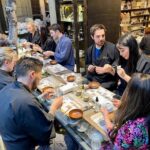
Entering Nihonbashi Mutoh Main Store
The workshop takes place at Nihonbashi Mutoh Main Store, at 1-8-3 Honcho, Nihonbashi, Chuo City, Tokyo 103-0023. The shop dates from 1923 and deals in high-quality lacquerware and glassware, so you are not walking into a bare classroom.
That setting matters. Before you begin, you are surrounded by traditional craft items rather than generic workshop furniture. The displays help place Kintsugi within a wider Japanese craft culture, even though the class itself focuses on one repair project.
The workshop may run alongside regular customers. If you want a private studio setting, this is not that. Still, the arrangement can make the experience feel connected to a working shop, rather than staged only for tourists.
The location is in Nihonbashi, an area that works well with a day of central Tokyo sightseeing. The activity itself does not include food or drinks, so plan a meal before or after the session. The three available start times are useful:
- 10:30 to 12:00
- 13:30 to 15:00
- 15:30 to 17:00
Each session lasts 90 minutes. Arrive with time to find the shop and settle in, since arriving late does not extend the end time.
The 400-year story behind Arita Ware

The pottery used in the activity is Arita Ware, a porcelain tradition with about 400 years of history. It is described as the first porcelain produced in Japan, which gives the workshop a stronger cultural link than a simple craft class using ordinary blanks.
Arita pieces are valued for their fine porcelain and careful decoration. Here, you get to handle one as the basis for your own repair work. The supplied plate is included in the price and becomes the souvenir you take home.
The pieces come from Shobido Honten, a popular Arita Ware brand with customers in Japan and abroad. You are not merely painting an anonymous ceramic object. You are working with a piece connected to one of Japan’s best-known porcelain traditions, then giving it a new history through Kintsugi.
The class does not promise a large range of objects. One person specifically wished for more variety in the selection. That is worth considering if you are hoping to choose from several shapes, colors, or sizes. The focus is on completing one object well, not browsing a large craft catalog.
What happens during the 90-minute class
The experience begins with instruction from an English-speaking instructor. Explanations are given in Japanese first and then translated into English, according to the class format described by participants. That approach may take a little time, but it gives you access to the same basic guidance provided to regular customers.
You learn the main idea behind Kintsugi and how to approach the repair. The class then moves into the hands-on portion, where you work on the supplied plate or an approved personal item.
The 90-minute length is a good fit for a first introduction. You have time to complete one object, but you are not signing up for a full-day course. The activity feels more like a focused cultural appointment than a major production.
You should expect a practical workshop rather than a lecture on Japanese art. The instructor guides you through the process, answers questions, and helps you create a finished item. The most praised features are the calm pace, clear directions, and friendly teaching style.
The group can include up to 10 participants. A group of eight has been described as comfortable and uncrowded, so the maximum size still remains fairly modest. Because the class can include regular customers, the exact mix of people may vary from one session to another.
Bringing your own broken ceramic item
You can bring a personal object instead of using the provided plate, but it must meet strict limits. It should be ceramic or porcelain, no larger than approximately 15 centimeters in diameter and 15 centimeters in height, and have only one or two broken sections.
This option can make the activity much more meaningful. A chipped family dish, a broken souvenir, or a small ceramic item with sentimental value may become a personal reminder of your time in Japan.
Do not bring a large vase, a heavily shattered bowl, or an item made from another material. The stated limits are there so the piece can be handled within the 90-minute session.
If your item is important to you, remember that the workshop may not be able to accept every object. The safest plan is to bring a modest ceramic or porcelain piece that fits the size and damage rules. You also have the included plate as a reliable alternative.
Other guided tours in Tokyo






The English instruction and class atmosphere
For an English-speaking visitor, clear instruction is the difference between a relaxing craft class and a frustrating one. This workshop is built around an English-speaking instructor, with the process explained in a way that lets you follow along without needing Japanese.
The teaching style is described as friendly and clear. Instructions may first be delivered in Japanese and then translated into English, so you should expect a short pause between explanations and action. That is normal for a class shared with regular customers.
I like this format because it keeps the activity tied to a local shop rather than creating a separate English-only bubble. You still receive the language support you need, while taking part in a class that operates in a Japanese setting.
The session has a quiet, patient character. Kintsugi rewards careful hands more than speed, and the workshop is short enough to maintain that calm mood. Wear clothes you do not mind getting dirty. The activity involves craft materials, and practical clothing is a better choice than your smartest Tokyo outfit.
What your $139 includes

The price is $139 per person. That is not a bargain-basement craft class, but the fee covers more than admission to a demonstration.
Included are the 90-minute workshop, all necessary materials, an English-speaking instructor, and the plate used during the experience. You take the finished plate home, giving the fee a clear souvenir value.
The setting adds to the cost in a useful way. You are working at a shop with about a century of history, using Arita Ware connected to a 400-year porcelain tradition. The class also gives you direct guidance rather than asking you to watch a demonstration from the sidelines.
Still, value depends on what you want from a Tokyo activity. If you want several objects, a long studio session, or a broad selection of plates, $139 may feel high. If you want a compact cultural experience and a handmade item that you actually create, the price is easier to justify.
There are no included meals or drinks, and personal expenses are separate. The experience is best judged as a small-group craft lesson with materials and a take-home object, not as a full-day tour.
The finished plate and care at home

Your item will not be ready for immediate practical use. After the workshop, bring it home and let it dry indoors for roughly one week.
Once dry, wash it by hand with dishwashing detergent. Do not put it in a dishwasher or microwave. The finished piece is intended for decoration, not for serving food or drinks.
This care requirement is easy to overlook when you are choosing an activity. If you are flying home soon after the class, pack the piece carefully and allow room for it in your luggage. The details of transport are your responsibility, and the workshop does not include a shipping service in the stated inclusions.
The limitations are not a flaw in the experience, but they do shape the souvenir. Think of the plate as a display piece, wall decoration, or shelf object. It is a record of the class and the repair, not a replacement for your everyday dishware.
Who will enjoy this Kintsugi experience

I would choose this workshop if you want a hands-on activity that connects a souvenir with Japanese history. It suits couples, solo visitors, friends, and anyone who would rather make something than shop for another mass-produced gift.
It is also a good choice for mixed artistic ability. You do not need to arrive as a skilled painter or potter. The class is an introduction, and the instructor provides the needed materials and guidance.
The experience is not suitable for children under 13. Older teenagers and adults who can work carefully within the class format are the intended audience.
You should also choose it if you enjoy slower activities. This is not a loud, fast-moving Tokyo attraction. The pleasure comes from paying attention to the object in front of you and seeing how a flaw becomes part of its design.
I would hesitate if you need a private class, want a large range of objects, or prefer souvenirs that can be used for meals. I would also think twice if your schedule is tight, since a late arrival means less working time and the session still ends at the scheduled hour.
Booking details that matter
The activity is wheelchair accessible, and the group is limited to 10 participants. The English instruction is included, along with the workshop materials and the plate.
You can cancel up to three days in advance for a full refund. If you do not attend on the scheduled day, no refund is issued.
The experience provider is Yomiuri Travel Service. Choose one of the three listed start times when checking availability, since the available schedule may affect how easily you can fit the class around other Tokyo plans.
Should you book it?
Book this Kintsugi workshop if you want a calm, practical introduction to a Japanese craft and a souvenir with personal meaning. The strongest reasons are the English guidance, the small group size, the historic Nihonbashi setting, and the chance to work with Arita Ware.
At $139, it is best for people who value the lesson and the finished object, not just the amount of material received. The limited object selection and decorative-only result are fair trade-offs for a short class that fits neatly into a Tokyo day.
Bring a small broken ceramic item if you have one that meets the rules. Otherwise, use the included plate, wear washable clothes, and leave enough time at home for the piece to dry properly. For a hands-on souvenir tied to Japanese ideas about beauty and repair, this is a thoughtful choice.
FAQ
How long does the Kintsugi workshop last?
The experience lasts 90 minutes, or 1.5 hours.
What start times are available?
The listed start times are 10:30 to 12:00, 13:30 to 15:00, and 15:30 to 17:00. Check availability when booking.
Is the workshop taught in English?
Yes. An English-speaking instructor leads the activity. Instructions may be given in Japanese first and then translated into English.
What do I take home?
You take home the plate used during the experience. You may also bring your own qualifying ceramic or porcelain item instead.
Can I bring a broken item from home?
Yes, if it is ceramic or porcelain, measures no more than approximately 15 centimeters in diameter and 15 centimeters in height, and has one or two broken sections.
Can I use the repaired plate for food or drinks?
No. The finished item is for decoration only. Wash it by hand with dishwashing detergent, and do not use a microwave or dishwasher.
Is the activity suitable for children?
The workshop is not suitable for children under 13 years old.
More Guided Tours in Tokyo
More Craft Workshops in Tokyo

More tours in Tokyo we've reviewed












Craft Workshops, compared.
 ★ 4.8Chopstick Making Workshop in GinzaFrom $251 hour
 ★ 5.0Kintsugi Experience: Art of Golden Joinery in TokyoFrom $59
Tokyo: Shinjuku Chopstick Making ClassFrom $121 hour
★ 5.0Kintsugi Experience: Art of Golden Joinery in TokyoFrom $59
Tokyo: Shinjuku Chopstick Making ClassFrom $121 hour
 ★ 5.0Private Craft Your Own Ring Handmade Experience in Asakusa, TokyoFrom $21
 ★ 5.0Authentic Pure Gold Kintsugi Workshop with Master Taku in TokyoFrom $142
 ★ 5.0Tokyo: Calligraphy on Kanji Fan & Scroll with DrinkFrom $531h 20m