Reviewed · CRAFT WORKSHOPS
Small Group Japanese Calligraphy Workshop Experience
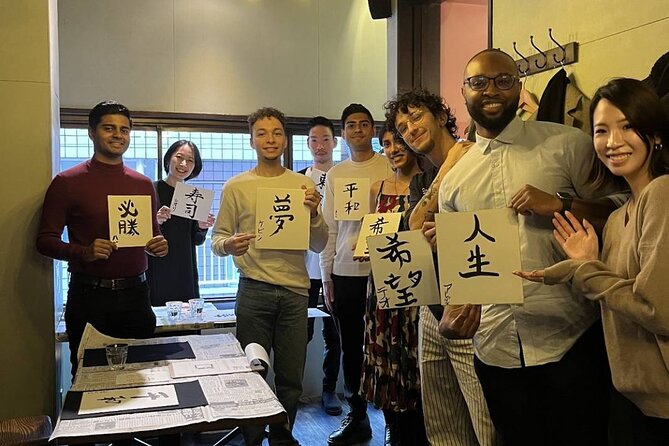
Japanese calligraphy here is not a quick brush-and-photo stop. You sit down with a certified master calligrapher, learn how Japanese brush writing works, and practice writing your name or a word that matters to you. The lesson takes place inside Monja Kurya Restaurant during its quiet off-hours, which gives the hour an unusual, local feel.
In This Article
- Key points at a glance
- Your first brushstroke at Monja Kurya Restaurant
- What the one-hour lesson covers
- Why a small group makes a difference
- Learning from a certified master calligrapher
- Choosing your name and favorite word
- The restaurant atmosphere and what it means
- Is $55.52 a fair Tokyo activity price?
- Who will enjoy this calligraphy workshop?
- A practical plan for the day
- Should you book this shodo experience?
- FAQ
- How long does the Japanese calligraphy workshop last?
- Where does the workshop begin and end?
- How many people can join the workshop?
- Is calligraphy equipment included?
- What will I write during the lesson?
- Are food, drinks, and hotel transfers included?
I like the small maximum group of seven, since brush control is easier to learn when the teacher can watch each person. I also like that every tool is supplied, so you can arrive with nothing more than your booking and an interest in trying something new.
The main thing to consider is the short one-hour format. You will get a focused introduction and a finished piece, but not a long art course. The restaurant setting may also feel quiet and simple rather than polished or theatrical.
Key points at a glance
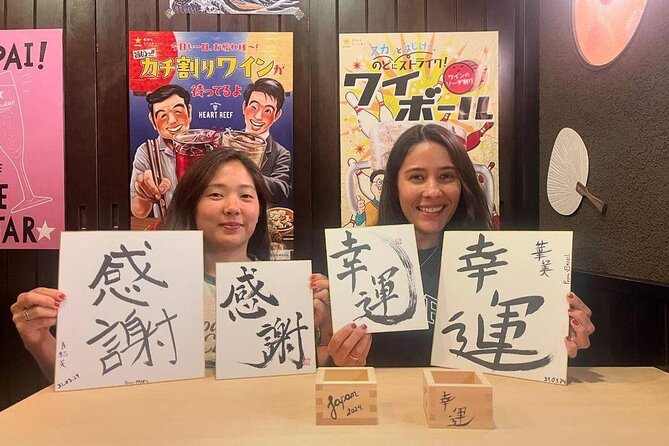
- Write your own name in Japanese: Practice your name or nickname in Japanese characters, then try a favorite Japanese word.
- Learn from a certified master: The lesson is taught under the eye of a trained calligrapher, with an English guide included.
- Small group, maximum seven: The limited size leaves more room for personal help with brush technique.
- Restaurant setting: Monja Kurya Restaurant hosts the workshop during its off-hours, creating a calm, informal room for the lesson.
- Everything is provided: Brushes and other necessary calligraphy equipment are included.
- A possible keepsake: If you agree, one of your pieces may be displayed on the restaurant wall like an autograph.
Your first brushstroke at Monja Kurya Restaurant
The workshop begins at Monja Kurya Restaurant in Higashiikebukuro, in Tokyo’s Toshima City. The listed address is Higashiikebukuro 1-chome 25, Toki Building, floors 2 and 3. The activity starts and ends at this meeting point, and the location is near public transportation.
Do not expect a grand museum classroom. The lesson uses the restaurant when it is not serving its regular customers. That is part of the charm, but it also explains why the room may seem unusually quiet when you arrive. If the door or interior does not look like a typical art studio, check that you are at the right place.
I like this setting because it connects the activity with ordinary Tokyo life. You are not simply watching a staged demonstration in a tourist center. You are sitting in a Japanese restaurant, using a traditional art form in a place that has another everyday purpose.
The restaurant does not provide food or drinks as part of the workshop. You should think of the booking as a calligraphy lesson, not a meal with an art add-on. That keeps the price clear, but you may want to plan a separate meal before or after the class.
A few more Tokyo tours and experiences worth a look
What the one-hour lesson covers
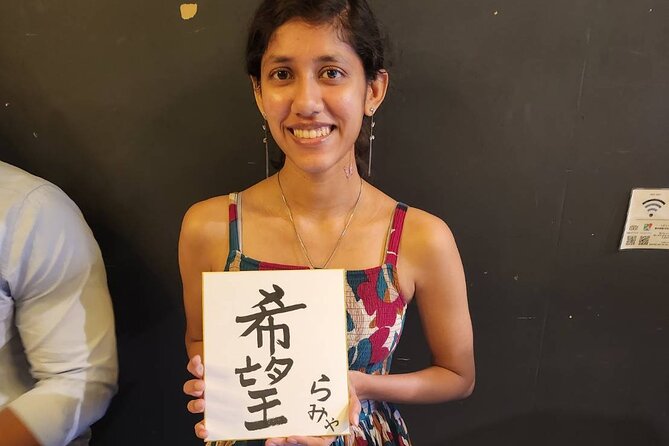
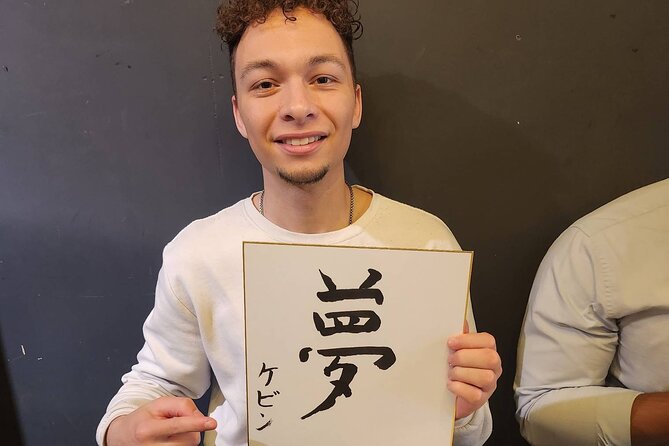
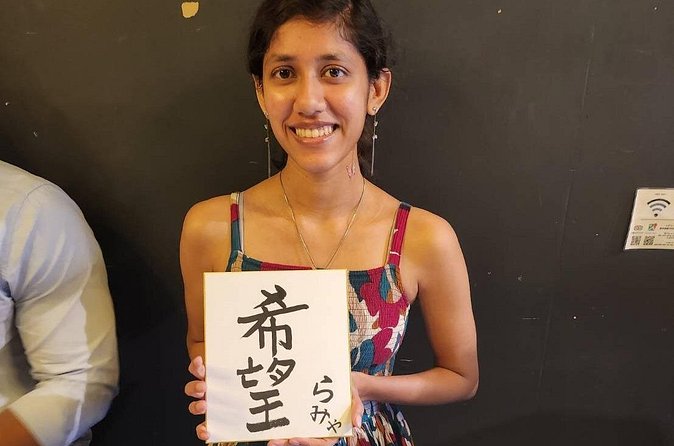
The central goal is to experience shodo, the Japanese art of calligraphy. You practice with a Japanese calligraphy brush and learn to form two kinds of writing: your own name or nickname in Japanese, and one Japanese word or favorite word.
The choice of subject matters. A name gives you a personal souvenir, while a favorite word lets you focus on the visual shape and meaning of a Japanese expression. If you already have a word in mind, this is the place to use it. If not, you can work with a word selected during the lesson.
The available information does not set out a minute-by-minute schedule, so I would not expect a formal series of long classroom stages. The experience is best understood as a compact, guided practice session. You learn the basic feel of the brush, work on selected characters, and finish with artwork of your own.
A short class can be a good fit in Tokyo. You can add it between larger sightseeing plans without giving up half a day. At the same time, calligraphy rewards repetition. One hour is enough to give you a taste and a finished result, but you will leave with only an introduction to the craft.
Why a small group makes a difference
The group limit is seven people. That number is small enough for the instructor to look at individual brushwork rather than speak only to the room as a whole.
For a first-time student, this matters. You are likely to need help with pressure, direction, spacing, and the order of each stroke. Calligraphy is not simply drawing a pretty symbol. The movement of the brush is part of the writing, and a teacher’s correction can save you from repeating the same mistake over and over.
I especially like the personal scale for visitors who may feel uncertain about handling a brush in front of others. A group of seven still gives the class some shared energy, but it is not a crowded demonstration where you sit at the back and copy from a distance.
The activity is also suitable for most participants, according to the supplied practical information. No special skill level is listed. You do not need to bring equipment, and an English guide is included, which removes two common barriers for international visitors.
Still, this is a hands-on art class, not a performance. You will need to take part, practice, and accept that your first characters may look uneven. That is normal. The point is to understand the process, not to produce museum-quality work in one sitting.
Learning from a certified master calligrapher
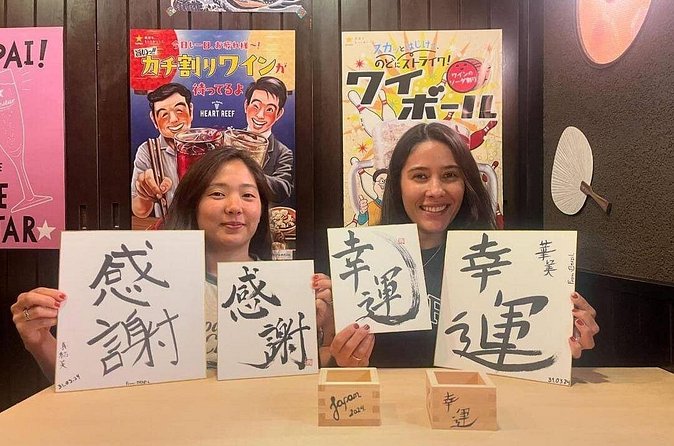
The teacher is described as a certified master calligrapher. That gives the session more substance than a casual craft activity led by someone who has simply prepared a tourist demonstration.
You should expect instruction from someone who understands the discipline behind Japanese brush writing. The lesson is meant to show how letters are written in a traditional Japanese way and to help you understand more about calligraphy and Japanese culture.
The strongest practical benefit is correction. A master can show you how a character should be formed and help you see why a stroke feels wrong. In a craft based on controlled movement, that kind of guidance is more useful than a printed instruction sheet.
The English guide is another important feature. The supplied information does not name the instructor, so you should not expect to book a particular teacher by name. What is clear is that the session is arranged for English-speaking visitors and includes professional guidance.
I would approach the class with modest expectations. The teacher can give you a solid introduction, but a single hour cannot cover the full range of Japanese calligraphy styles, history, or technique. You are buying access to a focused lesson, not a complete education in shodo.
Choosing your name and favorite word
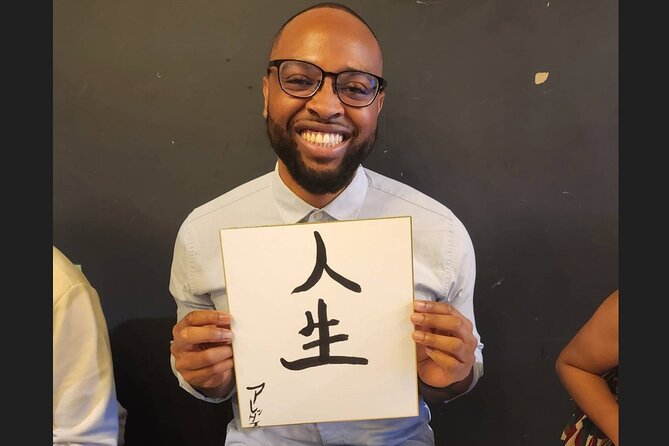
Writing your own name is one of the most appealing parts of this activity. You can use your given name or a nickname, which makes the final piece feel more personal than a standard souvenir purchased in a shop.
You also get to write one Japanese word or a favorite word. This gives the lesson a creative choice that many short workshops lack. You can focus on the look of a character, the meaning of a word, or the connection between the two.
I suggest deciding before the class if you have a particular word in mind. The supplied details do not say how many options you will be shown or how much time is available for choosing. A little preparation can help you spend more of the hour with the brush in your hand.
Do not assume that the result will be a perfect translation of any English word you bring. The activity says you can write one Japanese word or your favorite word, but it does not explain the translation process. If the exact wording matters to you, confirm it during the session.
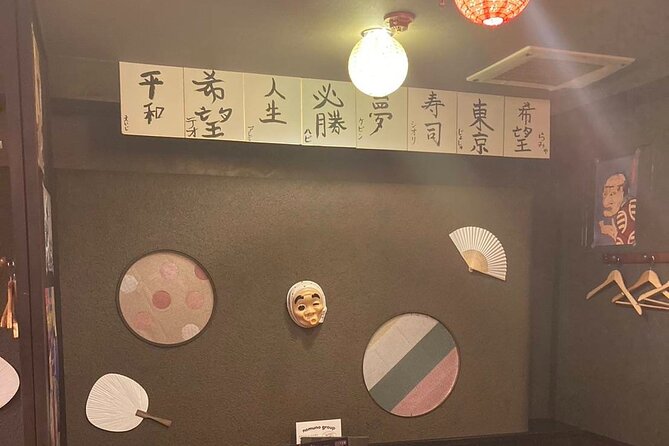
The finished work may be displayed on the restaurant wall, if you are comfortable with that. This is an unusual touch. Your piece becomes part of the room rather than disappearing into your luggage, and you may be able to see it again if you return to Monja Kurya Restaurant with friends.
That display is optional, so you are not giving up your artwork unless you want to. If you prefer to take it home, ask about keeping it at the end of the lesson.
A few more Tokyo tours and experiences worth a look



The restaurant atmosphere and what it means
A restaurant used during off-hours creates a different mood from a dedicated studio. The room may be calm and spare, with fewer distractions and less of the polished presentation found at some visitor-focused workshops.
One previous assessment described the class as relaxing and noted that the quiet restaurant setting can make you wonder if you are in the right place. That is useful advice. Arrive at the stated meeting point, and do not mistake a quiet room for a canceled class.
I see the atmosphere as a tradeoff. You get a more ordinary Japanese venue and a peaceful hour for concentrating. You do not get a purpose-built art room with a large display of finished examples or a full cultural show.
The setting also gives the activity a social connection to the restaurant. If your artwork is placed on the wall, it may remain there like an autograph. That small detail makes the class feel tied to the place rather than being a disposable stop on a busy sightseeing route.
Food and drinks are not included. Keep that clear when planning your day. You can treat the restaurant as the workshop venue, but the booking itself does not promise a meal.
Is $55.52 a fair Tokyo activity price?
At $55.52 per person, this is not the cheapest way to spend an hour in Tokyo. The value comes from the combination of a certified instructor, a very small group, provided equipment, an English guide, and a piece of work you create yourself.
If you only want to hold a brush for a few minutes and take a picture, the price may feel high. You could find less formal ways to try Japanese art. But those alternatives may not give you personal instruction, a capped group, or the chance to write your own name and selected word under a master’s guidance.
I think the price makes the most sense for visitors who want an authentic hands-on activity rather than another viewing experience. You are paying for access to instruction and attention, not just materials. Since all necessary equipment is included, there are no listed supply costs to add.
The average booking lead time is 104 days. That is a useful planning signal, especially if your Tokyo dates are fixed. I would not leave this until the last few days if the class is important to your schedule. The group is capped at seven, so the small class that makes the experience attractive also limits the number of available places.
The booking includes free cancellation if you cancel at least 24 hours before the start time. Cancellations made less than 24 hours ahead are not refunded, and late changes are not accepted. Cutoff times use Tokyo local time, so check the clock carefully if you are changing plans from another time zone.
Who will enjoy this calligraphy workshop?
I would recommend it most strongly to you if you want a quiet cultural activity that gives you something personal to take away. It suits first-time visitors who want to try a traditional Japanese craft without committing to a long class.
It is also a good choice for people who prefer small groups. The maximum of seven makes it easier to ask questions and receive help. Families and friends may enjoy comparing their names and words, though the supplied information does not specify a minimum age or any child-specific format.
The activity works well for art lovers, stationery fans, and anyone who likes souvenirs with a story. A purchased calligraphy print can be beautiful, but writing your own name gives you a stronger connection to the object.
I would be less likely to choose it if your schedule is already packed with major Tokyo sights. The activity lasts about one hour, yet you still need to reach the restaurant and return to your plans. It also may not satisfy you if you want a long, technical course or a meal included.
Most people can participate, and the class is near public transportation. However, no further mobility details are provided, so anyone with specific accessibility needs should confirm the arrangements before booking.
A practical plan for the day
Allow enough time to reach the meeting point in Higashiikebukuro. The activity starts and ends at Monja Kurya Restaurant, so you do not need to arrange a separate return transfer or hotel pickup.
The mobile ticket is convenient. Keep it available when you arrive, and use the exact address rather than relying only on the restaurant name. The venue occupies the second and third floors of the Toki Building.
Since equipment is supplied, pack light. You do not need to carry brushes, ink, or paper for the class. Wear something you are comfortable using around art materials, although the supplied information does not give a specific clothing requirement.
Plan your meal separately. Food and drinks are not included, and the workshop takes place during the restaurant’s off-hours. You may want to eat before the lesson or arrange a meal afterward rather than assuming one will be part of the visit.
Should you book this shodo experience?
I would book this workshop if you want a personal Tokyo memory, a calm hour away from major sights, and instruction from a certified master in a group of no more than seven. The option to write your own name and a favorite word makes the result more meaningful than a generic craft souvenir.
I would skip it if you need a full cultural lecture, a restaurant meal, or advanced calligraphy training. The class is short, and the venue is informal.
For most visitors who value direct practice over passive sightseeing, $55.52 is a reasonable price. Book ahead if your dates are firm, arrive at the quiet restaurant without worrying that you are lost, and treat the finished brushwork as a record of trying something new rather than a test of artistic perfection.
FAQ
How long does the Japanese calligraphy workshop last?
The activity lasts approximately one hour.
Where does the workshop begin and end?
It begins and ends at Monja Kurya Restaurant in Higashiikebukuro, Toshima City, Tokyo. The listed address is 1-chome 25 Higashiikebukuro, Toki Building, floors 2 and 3.
How many people can join the workshop?
The activity has a maximum of seven participants.
Is calligraphy equipment included?
Yes. All necessary equipment is included, so you do not need to bring your own materials.
What will I write during the lesson?
You will practice writing your name or nickname in Japanese and one Japanese word or favorite word.
Are food, drinks, and hotel transfers included?
No. Food and drinks, as well as hotel pickup and drop-off, are not included.
More Workshops & Classes in Tokyo
More Craft Workshops in Tokyo

More tours in Tokyo we've reviewed



Craft Workshops, compared.
 ★ 4.8Chopstick Making Workshop in GinzaFrom $251 hour
 ★ 5.0Kintsugi Experience: Art of Golden Joinery in TokyoFrom $59
Tokyo: Shinjuku Chopstick Making ClassFrom $121 hour
★ 5.0Kintsugi Experience: Art of Golden Joinery in TokyoFrom $59
Tokyo: Shinjuku Chopstick Making ClassFrom $121 hour
 ★ 5.0Private Craft Your Own Ring Handmade Experience in Asakusa, TokyoFrom $21
 ★ 5.0Authentic Pure Gold Kintsugi Workshop with Master Taku in TokyoFrom $142
 ★ 5.0Tokyo: Calligraphy on Kanji Fan & Scroll with DrinkFrom $531h 20m