Reviewed · IMPERIAL PALACE & SHOGUN TOURS
Tokyo walking tour around Imperial Palace and Tokyo Station
Tokyo’s grandest contrast appears in one compact walk: polished office towers and historic stone gates share the same two-hour route. You start near Tokyo Station, pass through Marunouchi, and finish beside the Imperial Palace Outer Garden.
In This Article
- Key points at a glance
- Why this short Tokyo walk works
- Starting beside Tokyo Station’s Marunouchi South Exit
- Marunouchi Building and the Japan Post building
- Meiji Seimei Kan and the older face of Marunouchi
- Walking toward the Imperial Palace Outer Garden
- Nijubashi Bridge, the visual center of the tour
- Sakuradamon Gate and the route’s final chapter
- What the small group changes
- Who should book this walk
- Timing, price, and practical value
- Should you book this Tokyo walking tour?
- FAQ
- Where does the tour meet?
- Where does the tour finish?
- How long does the walking tour last?
- How much does the tour cost?
- How many people can join the group?
- Which languages are available?
- Does the tour visit the Imperial Palace?
- What buildings are included?
- Can I see Tokyo Station from KITTE?
- Can I cancel for a refund?
- Do I have to pay when I reserve?
I like the small group of up to four, which gives your guide room to adjust the pace and answer real questions. I also like the mix of architecture, public squares, palace views, and local context, rather than a tour focused only on photo stops.
The main drawback is the tight schedule. Thirty minutes at Meiji Seimei Kan, followed by thirty minutes at Nijubashi and twenty-five at Sakuradamon, leaves little time to linger, shop, or explore inside buildings.
Key points at a glance
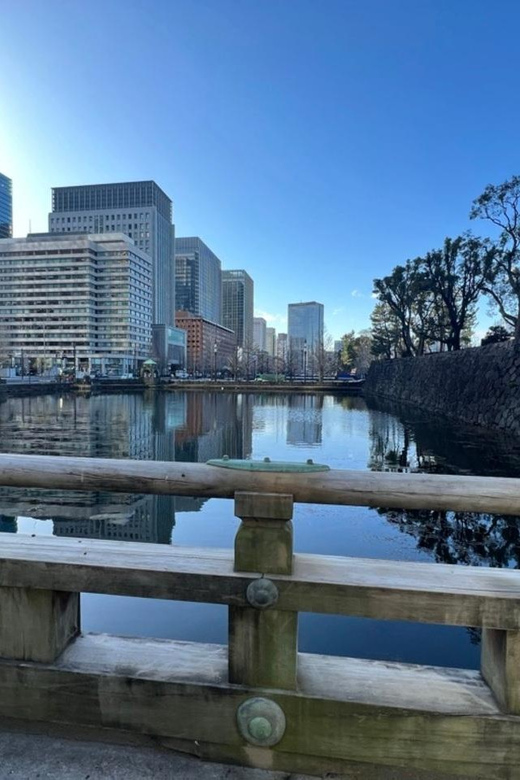
- Tokyo Station begins the story: See the famous red-brick station and learn how the Marunouchi district developed around it.
- KITTE offers a useful photo angle: The Japan Post building gives you a view back toward Tokyo Station.
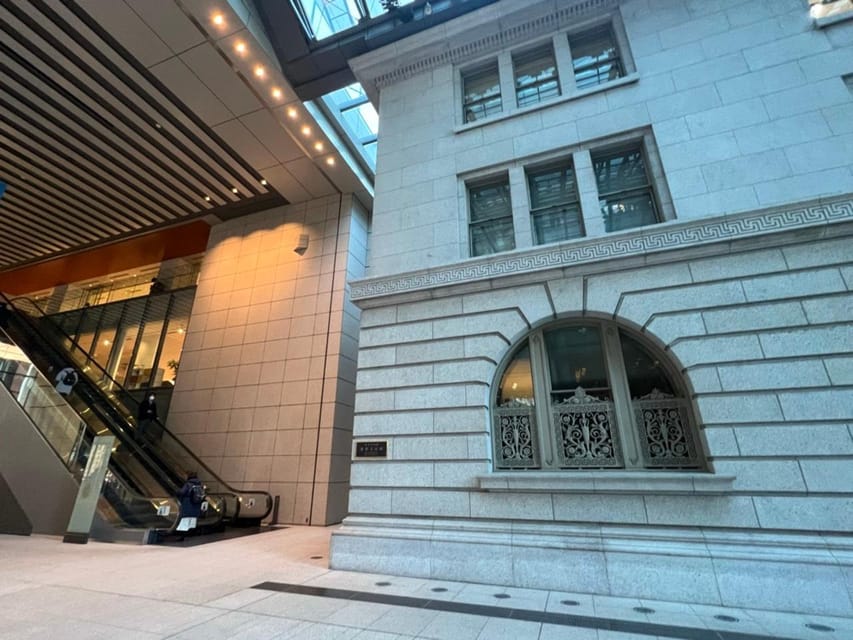
- Meiji Seimei Kan adds elegant early twentieth-century architecture: This stop breaks up the modern office towers with a more formal historic building.
- Nijubashi connects the city to the Imperial Palace: Your guide explains the stone and iron bridges and their role at the palace front.
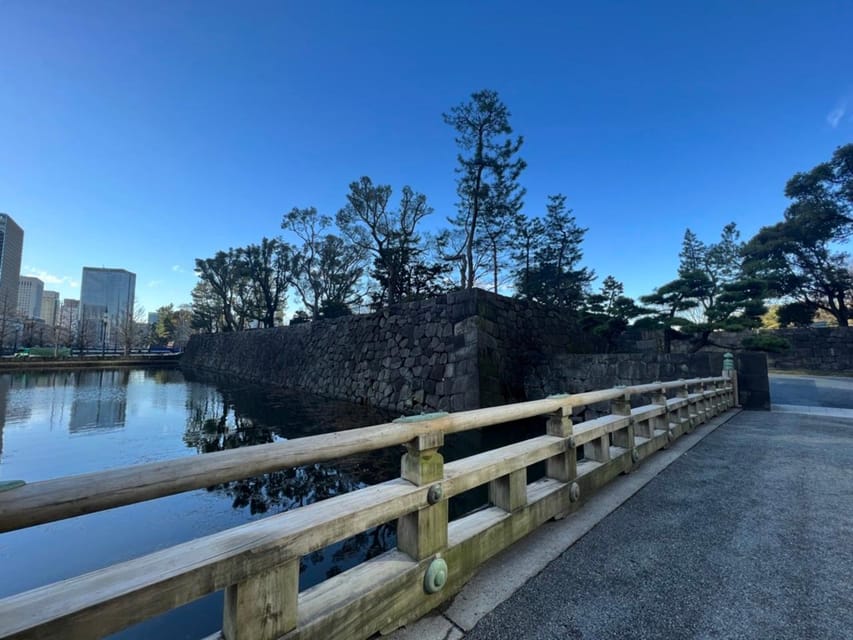
- Sakuradamon Gate brings a strong finish: The final stop adds a major palace gate and a direct link to Japan’s past.
- A four-person limit changes the feel: Guides can respond to your interests more easily than on a large walking group.
Why this short Tokyo walk works
This is not a broad tour of Tokyo. It is a compact introduction to one of the city’s most important central districts, where finance, government, imperial tradition, shopping, and transport meet within a short distance.
I like that the route does not treat Tokyo Station as an isolated attraction. You see the station, then move through the district that grew around it. The walk explains how Marunouchi was purchased and developed by Mitsubishi Corporation from 1890, giving the modern streets some useful context.
That connection matters. Without it, the area can look like a polished collection of office blocks. With a guide, you get a clearer sense of why the district has such a formal character and how its commercial identity sits beside the Imperial Palace grounds.
The tour costs $49 per person for two hours. That is fair if you want a guide to explain the setting and help you notice details you might otherwise pass without a second thought. It is less compelling if you are happy to walk from Tokyo Station to the palace on your own and read about the sights later.
Because the group is limited to four people, the price also buys a more personal format. You are not paying for a bus, a large headset group, or a long transfer between attractions. You are paying mainly for local explanation, route planning, and the chance to ask questions.
A few more Tokyo tours and experiences worth a look

Starting beside Tokyo Station’s Marunouchi South Exit
The meeting point is in front of the police box near Tokyo Station’s Marunouchi South Exit, at 1-9-1 Marunouchi, Chiyoda-ku. This is a practical place to begin, but Tokyo Station can be confusing, so allow time to find the correct exit.
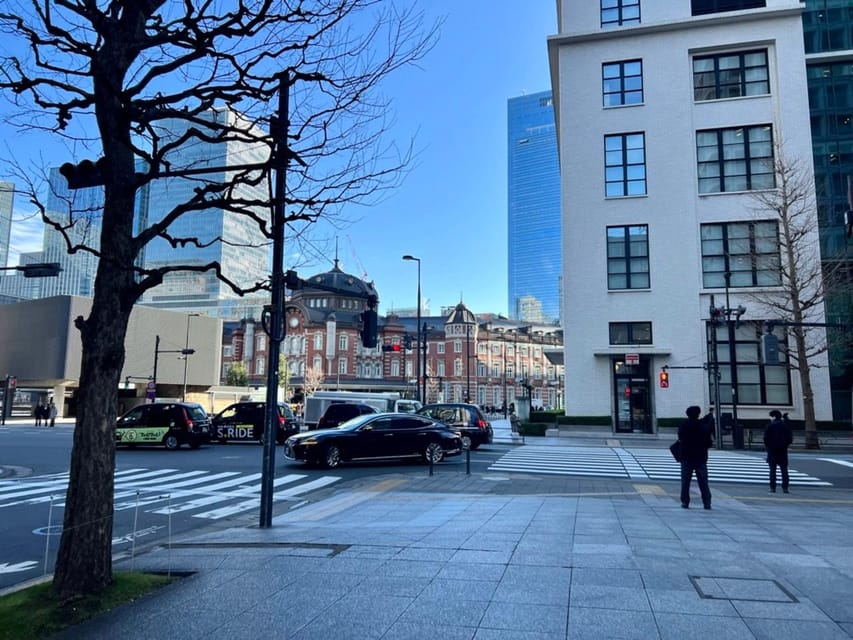
The tour starts with the station area and a guided look at Tokyo Station itself, scheduled for about ten minutes. The building is one of the clearest visual anchors in this part of Tokyo, and it gives the walk an immediate sense of place.
Your guide can help you read the station as more than a transport hub. From here, the route moves into Marunouchi, the district shaped by major business and insurance companies. You will begin to see the shift from railway architecture to wide streets, office buildings, formal façades, and high-end shopping.
Ten minutes is enough for an introduction and a few photographs, but not enough for a full station visit. If Tokyo Station is a major priority, plan to return on your own. This tour uses it as the opening chapter, not the whole subject.
Marunouchi Building and the Japan Post building
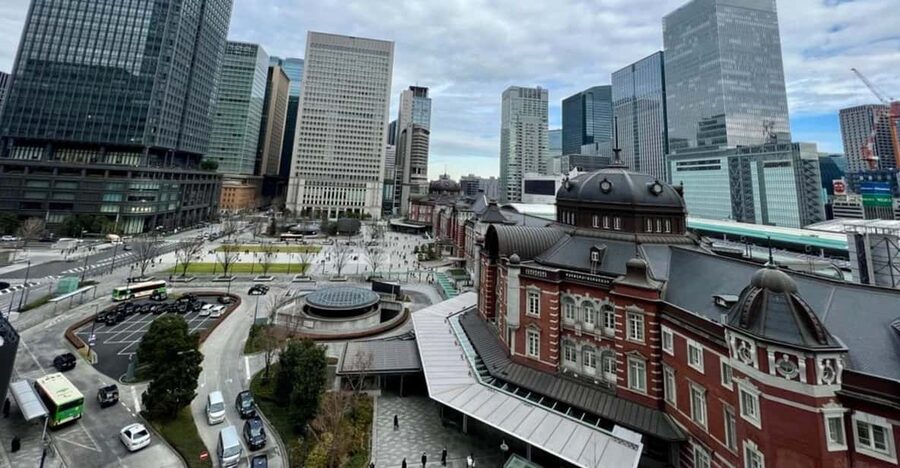
The next stop is Marunouchi Building, with about ten minutes of guided time. This is a useful pause because it shows the commercial side of the district and gives your guide a chance to explain how the area developed around the station.
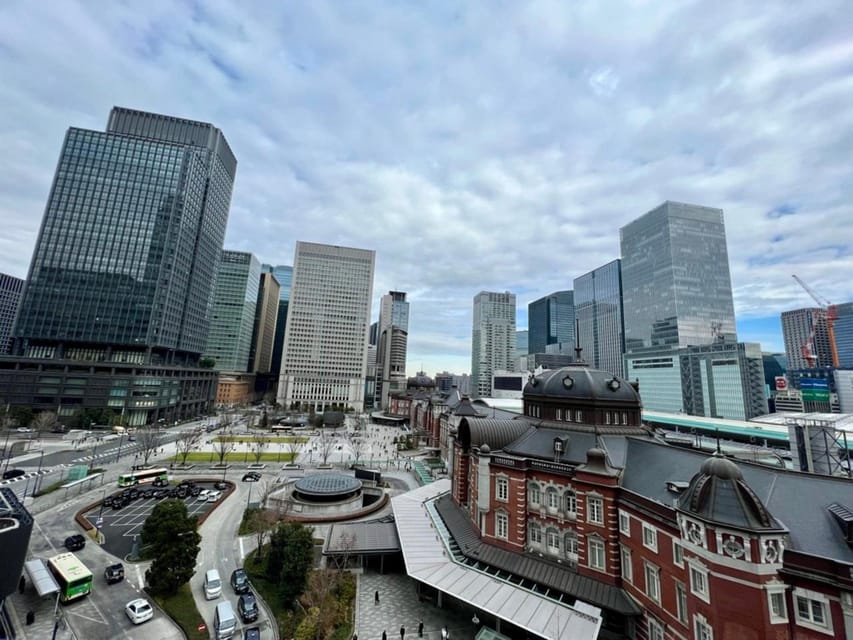
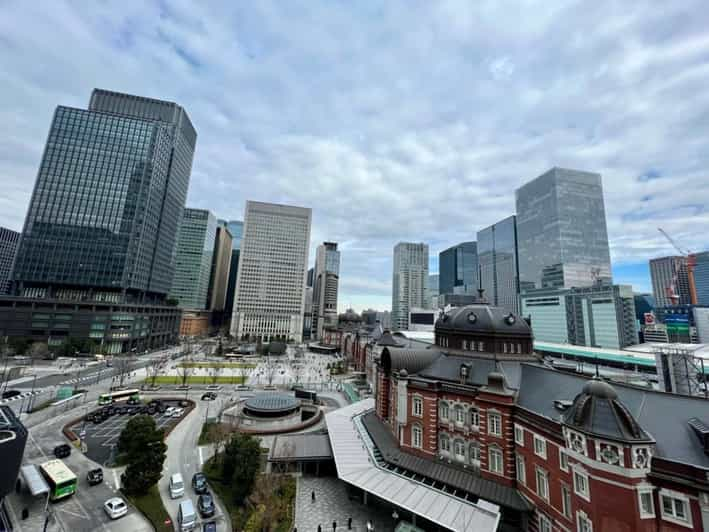
The route then continues to KITTE Marunouchi for about fifteen minutes. KITTE occupies the Japan Post building, and the stop includes a view of Tokyo Station from the building.
That viewpoint is one of the most useful details in the tour. Street level can make it hard to take in the station’s full façade, while a higher view helps you see its shape and position within Marunouchi. It is also a good place to take photographs without turning the entire tour into a photo session.
KITTE is connected to shopping and dining, so this stop can help you orient yourself for later independent exploring. The scheduled time remains short, though. You should see it as a planned viewpoint and district stop, not as free time to browse the building.
I especially like this part for first-time visitors staying near Tokyo Station. It gives you a quick sense of the area’s layout and shows how the station, Japan Post building, and office district relate to one another.
Meiji Seimei Kan and the older face of Marunouchi
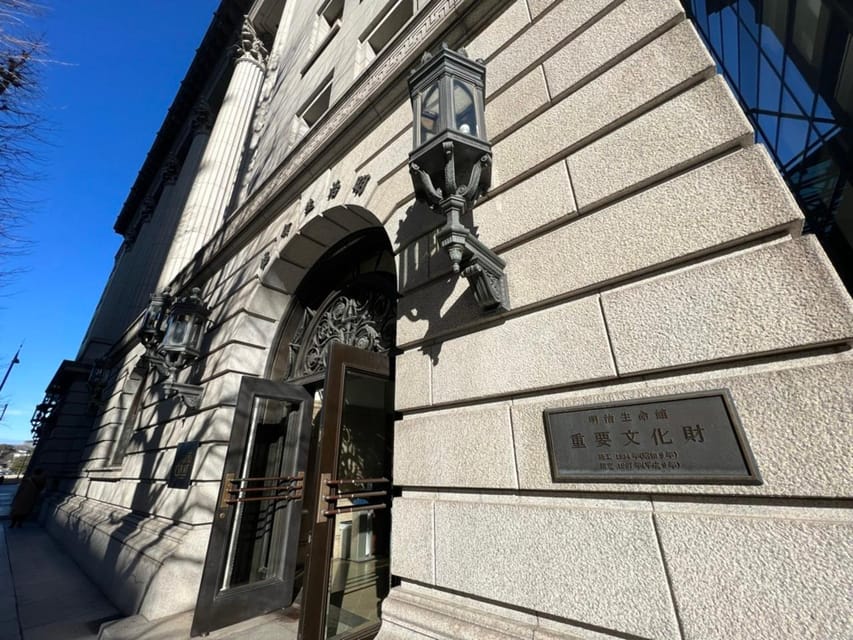
The longest single building stop is Meiji Seimei Kan, also called the Meiji Life Insurance Company building in the tour description. You spend about thirty minutes here, which signals that the architecture and background deserve more attention than a quick photograph.
The building provides a change from the modern commercial blocks around it. Its formal design helps you see Marunouchi as a district with several layers, not just a cluster of new offices and luxury shops.
This is where a good guide adds real value. A well-informed explanation can point out why the building looks different from its neighbors and connect it to Japan’s changing business and architectural traditions. The supplied tour details do not promise interior access, so you should expect an outside-focused visit unless your guide says otherwise.
Thirty minutes is a generous portion of a two-hour walk. If you enjoy architecture, business history, and city design, you will appreciate the time. If you mainly want palace views, this stop may feel long compared with the short visit to Tokyo Station.
The small group helps here. Mike from the United States said guide Mikio adjusted the plan and engaged two teenagers, turning the walk into a learning experience that still felt fun. That kind of flexibility is especially useful at a building stop, where your interest may depend on the questions your guide asks and answers.
Walking toward the Imperial Palace Outer Garden
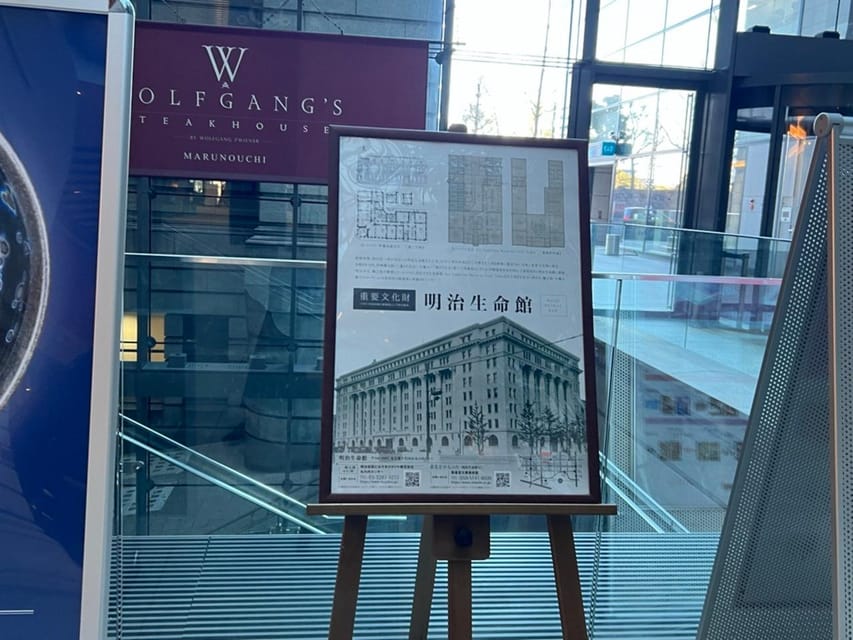
After Meiji Seimei Kan, the route heads toward the Imperial Palace Outer Garden. This transition is one of the tour’s strengths because you can feel the district change as the commercial center gives way to the palace surroundings.
The tour focuses on the outskirts of the Outer Garden, not a visit inside the Imperial Palace. That distinction matters. You are seeing the public areas and approach to the palace, with views of important gates and bridges, rather than touring private or restricted palace spaces.
The Outer Garden offers a more open setting after the dense architecture of Marunouchi. It also gives the walk a stronger connection to Japan’s imperial institution and ceremonial traditions.
Your guide can explain the meaning of the route toward the palace and help you understand why Nijubashi and Sakuradamon are important. Without that context, you might simply see a broad open area, a bridge, and a gate. With it, the sequence becomes easier to follow.
Wear comfortable shoes. The tour lasts two hours and covers several separate stops on foot. The schedule is not extreme, but there is no vehicle transfer to break up the walking.
Other walking tours we've reviewed in Tokyo




Nijubashi Bridge, the visual center of the tour
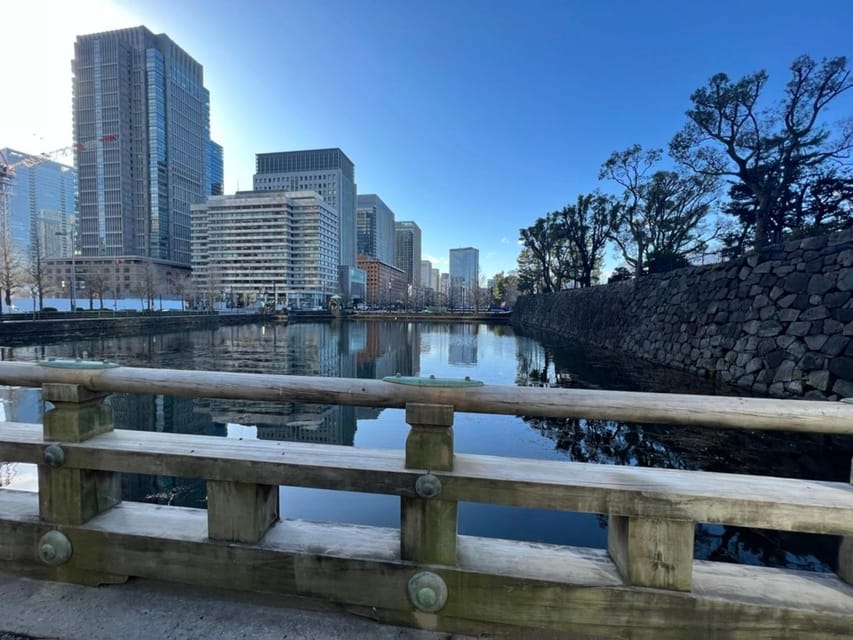
Nijubashi receives about thirty minutes, making it one of the two main stops. The bridge is associated with the front entrance of the Imperial Palace, and the tour includes both the stone and iron bridges in this area.
This is likely to be the visual center of your walk. The palace approach, bridge structures, and formal surroundings create a strong contrast with the glass-and-steel office district you have just left.
Your guide explains the bridge’s history and architectural features, along with the traditions tied to the palace entrance. That background helps you understand why this is more than a scenic bridge. It is part of the ceremonial face of the Imperial Palace.
Photography is an obvious reason to stop here, but do not rush through the explanation. The value lies in seeing how the bridge functions within the larger palace approach. A guide can also help you distinguish what you are looking at, especially if the area is busy or the sightlines are not immediately clear.
The half-hour allocation is sensible. It offers enough time for explanation and photographs, though not enough for a long pause or a broad exploration of the Outer Garden. If you want a leisurely palace-area walk, you may want to return later.
Sakuradamon Gate and the route’s final chapter
The final sightseeing stop is Sakuradamon Gate, with approximately twenty-five minutes of guided time. The tour ends at Kasumigaseki Station, so the gate provides a natural link between palace history and Tokyo’s government district.
Sakuradamon is a major historic gate, and its scale gives the ending some weight. After the refined streets of Marunouchi and the formal view at Nijubashi, the gate adds another kind of architecture: defensive, practical, and tied to the older organization of the castle grounds.
This is also a good place to ask final questions. The route has moved from transport and commerce to palace access and historic gates, so you can use the last section to connect those themes.
Maria from Colombia found guide Masahito especially good at asking about preferences early in the walk and taking the group to places she would not have reached without him. That is useful advice for you: explain your interests at the start. If you care most about architecture, palace traditions, photography, or Tokyo’s modern development, say so before the route gets underway.
The tour ends at Kasumigaseki Station. That is convenient if you are continuing into the government district or using the subway, but it is not a return to Tokyo Station. Keep the endpoint in mind when planning the rest of your day.
What the small group changes
A maximum of four participants is one of the strongest practical features. Small groups are not automatically better, but this route benefits from a guide who can stop for questions without holding up a crowd.
You can also tell your guide if the pace or emphasis needs adjusting. Mikio was described as flexible with the plan and able to keep two teenagers involved. Masahito asked about preferences and adjusted the experience to fit expectations. Miho was praised for providing a strong introduction to Tokyo and the area around the Imperial Palace.
Those details point to the same useful quality: the guides are not simply delivering a fixed speech. You can expect Japanese or English guiding, and the small group gives you a better chance to have an actual conversation.
Still, the experience depends on the guide assigned to your date. The tour lists Japanese and English, but it does not promise a particular guide. The names associated with the experience are Mikio, Masahito, and Miho, yet you should not book assuming one of them will lead your walk.
Who should book this walk
I would choose this tour for a first visit to Tokyo, especially if you are staying near Tokyo Station, Marunouchi, or the Imperial Palace. It gives you a clear two-hour orientation without asking you to commit to a full-day city tour.
It also suits families with older children or teenagers. The short route, varied sights, and small group can work better than a long lecture or a crowded bus tour. Mikio’s success at keeping two teenagers interested is a useful sign, though every family’s experience depends on the guide and the children’s interests.
Architecture fans should enjoy the progression from Tokyo Station to Marunouchi Building, KITTE, Meiji Seimei Kan, Nijubashi, and Sakuradamon. The tour is also a good fit if you want historical context but do not want a museum-heavy activity.
I would hesitate if you need extensive free time for shopping, want to enter every building, or expect an Imperial Palace interior visit. The schedule is focused and guided. It gives you a well-organized route, not an open-ended stroll.
Timing, price, and practical value
At $49 per person, this is a reasonable purchase for a small, guide-led introduction. The value is strongest when you want explanation, a carefully arranged route, and the freedom to ask questions in English or Japanese.
Two hours is long enough to cover the key sights but short enough to fit before lunch, after checking into a nearby hotel, or between other Tokyo plans. The pace should feel purposeful because the schedule assigns time to each stop.
You can cancel up to 24 hours ahead for a full refund, and the reserve-now, pay-later option keeps your plans flexible. Starting times depend on availability, so check the schedule before building the rest of your day around the walk.
Book with comfortable footwear and a charged phone for photographs. Meet at the police box near the Marunouchi South Exit, and remember that the finish is at Kasumigaseki Station, not back at the starting point.
Should you book this Tokyo walking tour?
Book it if you want a compact, personal introduction to Tokyo Station, Marunouchi, and the Imperial Palace approach. The best reasons are the four-person limit, the KITTE view of Tokyo Station, and the steady shift from modern business district to palace gates.
Skip it if you prefer to explore independently or want a longer palace visit. You can cover much of the route yourself, but you will lose the guide’s explanations and the chance to adjust the walk around your interests.
For most first-time visitors with two hours to spare, I see this as a practical way to get oriented. Tell your guide what interests you, keep an eye on the clock, and treat the tour as a strong introduction rather than a complete study of the Imperial Palace.
FAQ
Where does the tour meet?
The meeting point is in front of the police box near Tokyo Station’s Marunouchi South Exit, at 1-9-1 Marunouchi, Chiyoda-ku, Tokyo 100-0005.
Where does the tour finish?
The tour finishes at Kasumigaseki Station.
How long does the walking tour last?
The tour lasts two hours.
How much does the tour cost?
The listed price is $49 per person.
How many people can join the group?
The group is limited to four participants.
Which languages are available?
The tour is available in Japanese and English.
Does the tour visit the Imperial Palace?
The route visits the Imperial Palace Outer Garden area, Nijubashi, and Sakuradamon Gate. The provided details do not state that it enters the palace interior.
What buildings are included?
The route includes Tokyo Station, Marunouchi Building, KITTE Marunouchi in the Japan Post building, and Meiji Seimei Kan.
Can I see Tokyo Station from KITTE?
Yes. The tour includes a view of Tokyo Station from the JP building, KITTE Marunouchi.
Can I cancel for a refund?
Yes. You can cancel up to 24 hours in advance for a full refund.
Do I have to pay when I reserve?
No. The reserve-now, pay-later option allows you to keep your travel plans flexible and pay later.
More Walking Tours in Tokyo
More Imperial Palace & Shogun Tours in Tokyo

More tours in Tokyo we've reviewed












Imperial Palace & Shogun Tours, compared.
 ★ 4.9Tokyo: Imperial Palace Japanese History Walking TourFrom $32
 ★ 4.9Tokyo: Imperial Palace and Shogun Walking TourFrom $162 hours
 ★ 5.0Imperial Palace East Garden and Edo Castle Walking Tour in TokyoFrom $25
 ★ 4.8Tokyo: Imperial Palace East Gardens Walking TourFrom $192h 30m
 ★ 4.5Tokyo: Imperial Palace, Sensō-ji Temple, & Tokyo Tower TourFrom $404 hours
 ★ 5.0Tokyo Castle, Imperial Palace, Shogun & Garden Walking TourFrom $31