Reviewed · SHIBUYA TOURS
Tokyo Shibuya Crossing & Hidden Streets Walking Tour
Shibuya Crossing is the headline, but the best part of this walk comes after you cross it. In about two hours, you move from Taro Okamoto’s powerful Myth of Tomorrow mural to tiny drinking alleys, a rooftop-style urban park, shopping streets, and the Hachiko statue. It gives you a useful first look at Shibuya without leaving you to find its less obvious corners alone.
In This Article
- Key points at a glance
- Why this walk is more than Shibuya Crossing
- Starting with Myth of Tomorrow inside Shibuya Station
- Crossing Shibuya’s famous scramble
- Miyashita Park and the new face of Shibuya
- Nonbee Yokocho and Shibuya’s tiny bars
- Center-gai and the loud commercial core
- Maruyamacho, nightlife, and uncomfortable history
- Ending at Hachiko’s statue
- What the guides add to the experience
- Is $25 a fair price for two hours?
- Meeting point, walking demands, and booking advice
- Who should book this Shibuya walk?
- Should you book it?
- FAQ
- How long is the Tokyo Shibuya Crossing and Hidden Streets Walking Tour?
- How large is the tour group?
- Where does the tour begin?
- Where does the tour end?
- Are food, drinks, and guide tips included?
- Can I cancel for a refund?
I like two things here: the 12-person group limit, which keeps the walk personal, and the mix of famous sights with places you might pass without noticing. Guides such as Loc, Rio, Grey, Zach, and Daichi have been praised for clear explanations, humor, patience, and useful food and bar suggestions. The main caution is practical: the meeting point inside Shibuya Mark City can be hard to locate, and the route includes several uphill sections.
Key points at a glance
- The famous crossing is only one stop: You also see Miyashita Park, Nonbee Yokocho, Maruyamacho, Center-gai, and Hachiko.
- Taro Okamoto’s mural adds serious context: Myth of Tomorrow brings Japan’s postwar memory into a busy station area.
- The group is capped at 12 people: That makes it easier to ask questions and keep up in crowded streets.
- Expect hills and city walking: Humidity and uphill stretches can make the two-hour route more tiring than its length suggests.
- Guides shape the experience: Loc is praised repeatedly for his warmth and depth, while Rio, Grey, Zach, Daichi, and others have also led engaging walks.
- The price is modest: At $25 per person, the tour can be good value if you want orientation, history, and practical neighborhood advice in one outing.
Why this walk is more than Shibuya Crossing
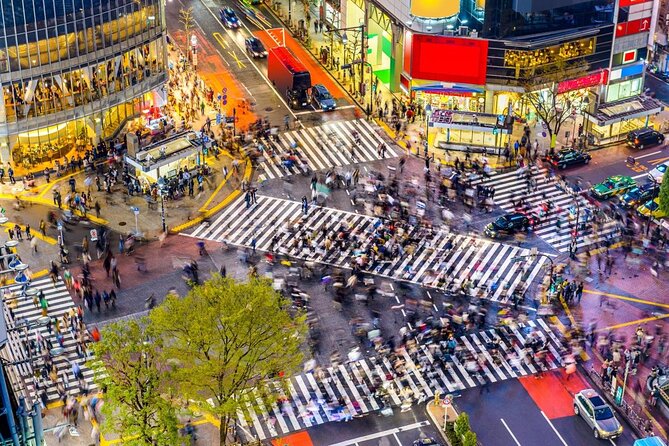
Shibuya Crossing is easy to find and easy to photograph. It is also easy to treat as a quick stop, take a few pictures, and move on. This tour gives the intersection a place within the wider district.
You begin near Shibuya Station and finish at Hachiko, but the route works through several different faces of Shibuya. You see commercial streets, public art, modern redevelopment, old drinking lanes, nightlife areas, and a neighborhood with a complicated past.
That variety is the real value. Shibuya is not just giant video screens and crowds. It is also small bars with only a few seats, narrow lanes, changing neighborhoods, and public spaces built above busy roads. A guide helps connect those pieces, especially when you are visiting Tokyo for the first time.
The tour lasts about two hours, which is long enough to get a feel for the area without taking over your day. I would schedule it early in your Tokyo stay. The advice about restaurants, bars, and shopping is more useful when you still have time to act on it.
A few more Tokyo tours and experiences worth a look


Starting with Myth of Tomorrow inside Shibuya Station
The first stop is Myth of Tomorrow, a large mural by Taro Okamoto inside Shibuya Station. It depicts the destruction caused by the atomic bombings of Hiroshima and Nagasaki. The work is startling in both subject and scale, especially in a station filled with commuters, signs, shops, and constant movement.
This is a smart opening stop because it shifts your attention away from the usual pop-culture image of Shibuya. The district is energetic and modern, but the mural introduces a serious part of Japan’s 20th-century story before the tour turns back toward shopping and nightlife.
You spend about 10 minutes here, with no separate admission charge. The short stop works well, though visitors wanting a long art discussion may find the time limited. The value comes from having someone point out the mural and provide context you could easily miss on your own.
Crossing Shibuya’s famous scramble
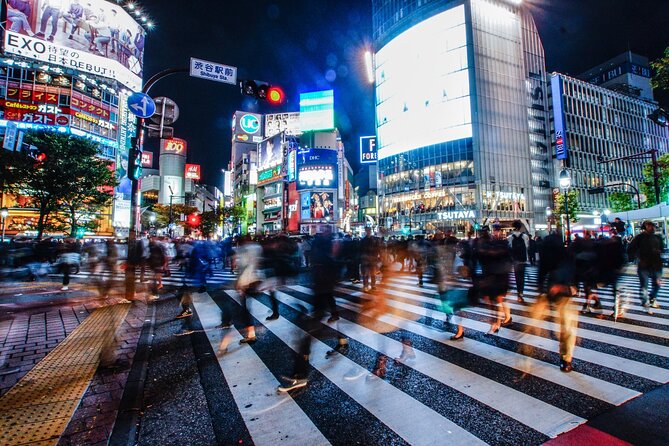
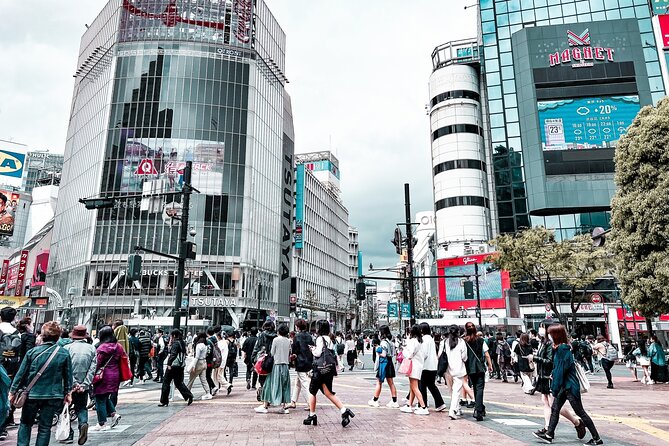
The tour then reaches Shibuya Crossing, often called the Scramble. When the signals change, pedestrians move across the intersection from several directions at once. It is controlled, polite, and remarkably efficient, even when the crossing feels packed.
You get to cross it rather than simply view it from a distance. That matters because the experience changes when you are part of the flow. The crossing takes only about 10 minutes on the schedule, so this is not designed as a long photography session.
If you want skyline or overhead pictures, you may need to arrange those separately. The walk focuses on experiencing the crossing and understanding its place in Shibuya, not on taking you to a particular observation deck.
A guide is especially useful here because the station exits and surrounding streets can be confusing. Shibuya is full of similar-looking signs and large commercial buildings. Keeping a group together around the crossing takes some work, and the small group limit helps.
Miyashita Park and the new face of Shibuya
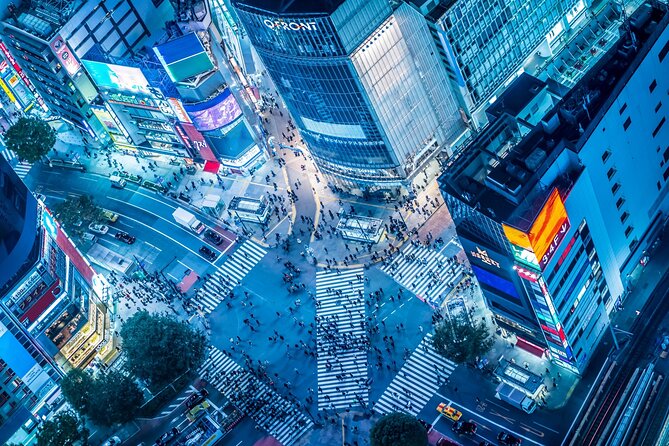
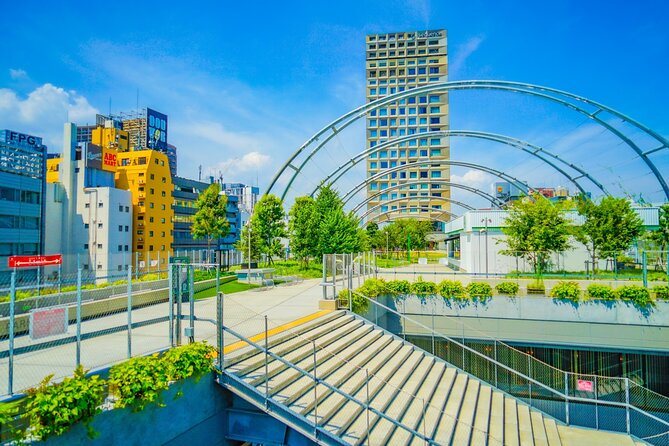
From the crossing, the walk continues to Miyashita Park, with about 20 minutes here. This is one of the route’s more distinctive stops because it combines a public park with a multi-level sports and recreation complex built over a commercial area.
Miyashita Park shows how Tokyo makes use of limited urban space. It is not a traditional quiet garden. Instead, it is a modern city park integrated with shopping, recreation, and pedestrian routes. The stop gives you a break from the tight streets while showing how Shibuya has changed.
This is also a good example of why the tour is useful for repeat visitors. One person who had already been to Tokyo four times found that the walk finally brought them into parts of Shibuya they had previously passed by. If you have visited the crossing before, Miyashita Park may be the kind of place that gives the tour its purpose.
The drawback is weather. There is little point in expecting a leisurely park visit during heavy rain, and the experience requires good weather. If poor weather cancels the tour, you can take another date or receive a full refund.
Nonbee Yokocho and Shibuya’s tiny bars
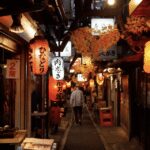
Nonbee Yokocho, or Drunkard’s Alley, is a narrow lane near Shibuya Station filled with very small traditional-style bars. Some venues seat only three or four people. That tight scale is the point, and it feels worlds away from the broad crossing nearby.
You do not pay admission here, but you also should not think of this stop as a bar visit. The scheduled time is about five minutes, so the guide is introducing the lane and explaining its character rather than arranging a drink.
This is one of the places where a guide adds real value. The lane can be easy to miss, and its future may be uncertain as Shibuya continues to change. You get a quick look at a fragile piece of old nightlife before it disappears or changes form.
If you want to eat or drink in the area later, ask your guide for suggestions. Food recommendations are a recurring strength of the guides, particularly Grey and Loc. Keep in mind that the tour does not include food or drinks, so those costs are separate.
Other walking tours we've reviewed in Tokyo



Center-gai and the loud commercial core
The walk continues through Shibuya Center-gai, a pedestrian shopping street known for youth fashion, entertainment, and strong commercial energy. This is the Shibuya many people expect: crowded sidewalks, shops, bright signs, and a fast pace.
The scheduled stop is about 10 minutes. That is enough to explain the street and point out useful areas, but not enough for serious shopping. I would treat this as an orientation pass. If you see a store you like, return later with more time and less pressure to keep moving.
Center-gai is also a useful contrast with Nonbee Yokocho. Within a short walk, Shibuya moves from tiny bars and old lanes to major retail streets. The tour makes that contrast clear instead of presenting the district as one uniform zone.
Maruyamacho, nightlife, and uncomfortable history
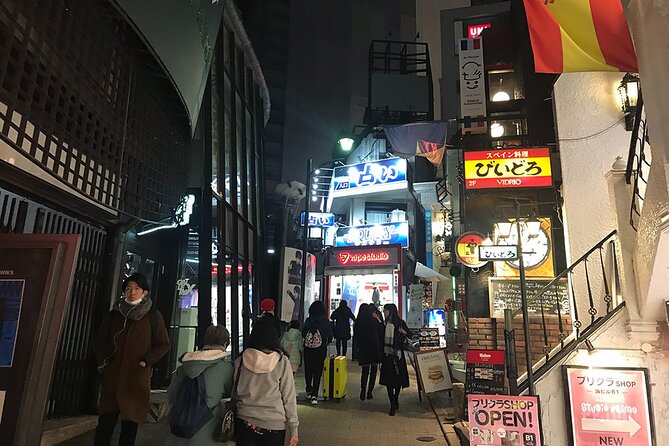
Maruyamacho takes the tour into an area formerly known as a red-light district. Today, it has a mix of older buildings, nightlife businesses, restaurants, and newer development. The area’s past is part of what makes it interesting, but the stop is brief, about 10 minutes.
This is where a good guide’s tone matters. The subject can easily become cheap entertainment. A thoughtful guide can explain how the area changed while pointing out what remains visible in its streets and buildings.
Several guides have been praised for answering questions about love hotels and the neighborhood’s nightlife without making the discussion feel forced. You can ask about the area if you want more detail, but the tour does not appear to promise entry into any venues.
Maruyamacho also includes some uphill walking. One participant found the route had quite a lot of climbing, while another noted that the guide adjusted the pace and added breaks during humid weather. I would wear comfortable shoes and allow extra energy for Tokyo’s slopes.
Ending at Hachiko’s statue
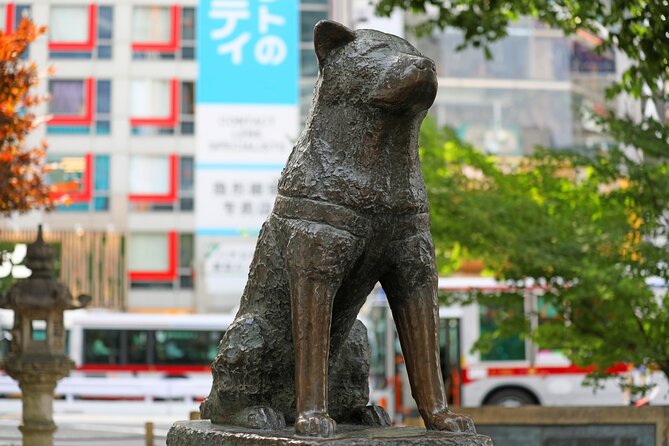
The final stop is the Hachiko Statue, outside Shibuya Station. The bronze statue honors Hachiko, the Akita dog remembered for his loyalty. The story has made the statue one of Tokyo’s most recognizable meeting points.
Ending here makes sense. Hachiko is easy to recognize, easy to photograph, and useful for getting your bearings after the walk. The tour begins in a large station complex and finishes at a clear public landmark.
The statue can be crowded, so you may need patience for a photograph. It is also a practical place to continue exploring, since you are already at the center of Shibuya’s transport and shopping network.
What the guides add to the experience
The guide can make or break a neighborhood walk, and the feedback here points to a strong range of personalities. Loc is praised several times for being friendly, upbeat, patient, and easy to talk with. His style seems to suit people who want a guide who explains things without giving a long lecture.
Rio has been described as warm and personal, especially when showing the area she considers home. Grey, also written as Gray in some comments, is praised for humor, patience, and adjusting explanations to questions. Zach or Zac is noted for clear English and useful historical detail.
Daichi brings an interest in city planning and regional development, which can give the modern parts of Shibuya extra meaning. Dixce is also praised for fitting a large amount of information into two hours while keeping the tone friendly.
Guide assignments can vary, so you should not book on the assumption that one particular person will lead your departure. The consistent strengths to look for are clear English, local area knowledge, humor, and willingness to answer questions.
One caution is worth noting. At least one person felt the cultural discussion was not as profound as expected and was disappointed that the guide was not Japanese. If having a Japanese-born guide is essential to you, confirm that before booking rather than assuming the description guarantees it.
Is $25 a fair price for two hours?
At $25 per person, this is a reasonably priced introduction to Shibuya. All fees and taxes are included, though tips for the guide are not. You are paying less for attractions than for navigation, interpretation, and saved time.
Every listed stop has free admission, so the value depends on how much you want a guide. If you are comfortable planning your own route, using station maps, and researching Shibuya’s history, you can see many of these places without paying. The tour earns its price by linking them into a sensible walk and adding context.
The group limit of 12 is important. A much larger group would be harder to manage at the crossing and in narrow alleys. In a group this size, you have a better chance of asking about restaurants, nightlife, Japanese history, or places you want to revisit later.
The tour is also a good deal if you are staying near Shibuya and want an easy first evening. Loc, in particular, has been praised for helping people begin a night out with practical ideas for food and drinks. You will still pay for anything you purchase afterward.
Meeting point, walking demands, and booking advice
The start is at SABON in the East Mall on the third floor of Shibuya Mark City, at 1-chome 12-3 Dogenzaka. This is the least convenient part of the arrangement. Shibuya Mark City is large, and finding a particular store inside it can take time.
I would arrive early and use the exact address in your confirmation. Do not assume that reaching Shibuya Station means you are already at the meeting point. One person spent about 20 minutes looking and eventually gave up, so this is a detail worth taking seriously.
The tour ends at Hachiko Statue, 2 Chome-1 Dogenzaka. Mobile tickets are accepted, and confirmation arrives when you book. The tour is near public transportation, service animals are allowed, and most people can take part, but the hills and two hours of walking deserve attention.
Free cancellation is available up to 24 hours before the start time for a full refund. Changes or cancellations inside that 24-hour window are not refunded, and the experience can be canceled for poor weather.
Who should book this Shibuya walk?
I would choose this tour if you are visiting Tokyo for the first time, staying around Shibuya, or tired of seeing famous districts only from the main road. It is particularly useful for anyone who wants a mix of history, street life, public art, shopping, and nightlife without planning every turn.
It also suits repeat visitors. Shibuya changes quickly, and the smaller lanes and newer public spaces can escape even a well-planned Tokyo schedule. The walk is short enough to fit before dinner or an evening activity.
You may want something else if you dislike hills, humid-weather walking, or brief stops. People who want a long cultural lecture, extensive shopping time, or a formal food tour may find this route too quick and broad.
Should you book it?
Book this tour if you want orientation with personality rather than a simple photo stop at Shibuya Crossing. At $25, the combination of a 12-person cap, varied route, guide commentary, and food recommendations makes it a solid introduction to the district.
Just plan carefully for the meeting point and wear good shoes. If you can handle some uphill walking and keep your expectations focused on neighborhood insight rather than museum-level history, this tour should help you see a more complete Shibuya.
FAQ
How long is the Tokyo Shibuya Crossing and Hidden Streets Walking Tour?
The tour lasts approximately two hours.
How large is the tour group?
The experience has a maximum of 12 people.
Where does the tour begin?
The meeting point is SABON Shibuya Mark City in the East Mall on the third floor, at 1-chome 12-3 Dogenzaka, Shibuya, Tokyo.
Where does the tour end?
The tour ends at the Hachiko Statue at 2 Chome-1 Dogenzaka, Shibuya, Tokyo.
Are food, drinks, and guide tips included?
All fees and taxes are included. Food, drinks, and tips for the guide are not included.
Can I cancel for a refund?
You can cancel at least 24 hours before the start time for a full refund. Cancellations or changes made less than 24 hours before the start time are not refunded, and poor-weather cancellations offer a different date or a full refund.
More Walking Tours in Tokyo
More Shibuya Tours in Tokyo


More tours in Tokyo we've reviewed












Shibuya Tours, compared.
 ★ 5.0Official Street Go-Kart in ShibuyaFrom $76
 ★ 5.0Shibuya Meltdown Nightlife Tour: All-You-Can-Drink Bar HoppingFrom $106
 ★ 4.9Tokyo: Street Kart Experience in ShibuyaFrom $99
 ★ 5.0Shibuya Official Street Go-Kart in Shibuya AnnexFrom $69
 ★ 5.0Tokyo: Shibuya Food Tour (13 dishes and 4 Eateries)From $77
 ★ 5.0Best of Shibuya Food TourFrom $217