Reviewed · CRAFT WORKSHOPS
Tokyo Japanese Calligraphy Experience with a Master Artist
Japanese calligraphy is more than writing pretty characters. In this quiet Tokyo studio, you learn how pressure, speed, and brush angle shape each mark. Master artist Eizuru Matsumura guides you through the tools and basic strokes, while an English-speaking interpreter helps you follow the lesson.
In This Article
- Key points to know
- Why shodo works well as a Tokyo activity
- Getting to the studio from Umeyashiki Station
- Inside Eizuru Matsumura’s small calligraphy studio
- What the lesson feels like in practice
- Why the interpreter matters
- A good choice for families and first-time artists
- Price, group size, and overall value
- Timing, booking, and the one concern to watch
- How this compares with other cultural activities
- Who should book this class
- Should you book the Tokyo shodo experience?
- FAQ
- Where does the calligraphy activity begin?
- How far is the studio from the station?
- How long does the experience last?
- Is English guidance included?
- What equipment is provided?
- What is the minimum age?
- Can I cancel for a refund?
I like two things right away: the hands-on format, and the personal scale. You work with real brushes, ink, and paper rather than simply watching a demonstration, and the group can be as small as two people. The experience also gives you a useful glimpse into both traditional and modern Japanese culture.
One point needs care: the advertised duration is about 1 hour 30 minutes, but the actual lesson may vary. One part of the supplied details lists a one-hour activity, and the provider has explained that longer time estimates are not guaranteed. If exact timing matters, ask for clarification before booking.
Key points to know
- Meet at Umeyashiki Station: Your guide meets you near the Keikyu Line station and walks you to the studio, about five minutes away.
- Learn from Eizuru Matsumura: The instructor is a practicing calligrapher, artist, lecturer, and creator of an official Kyokushin Karate World Tournament logo.
- A small, calm setting: The studio uses gentle music and a quiet atmosphere that suits focused brush work.
- English help is included: An interpreter accompanies you from the station and supports communication during the lesson.
- You make your own artwork: You practice characters and can keep the finished pieces as a Japanese souvenir.
- Suitable for children from age seven: Children must attend with an adult, and the booking requires at least two participants.
Why shodo works well as a Tokyo activity
Tokyo can fill your day with bright signs, crowded crossings, and fast train rides. Shodo gives you the opposite kind of hour: a seat, a brush, a sheet of paper, and a task that demands patience.
The word shodo means the way of writing. Japanese calligraphy grew from older writing traditions and was once closely linked with nobles, samurai, education, and formal culture. You do not need to know Japanese to take part. The lesson lets you approach the art through movement and form first.
That matters because Japanese characters are not just symbols to copy. The balance of a character depends on the order and weight of its strokes. A line may begin firmly, soften as the brush moves, and finish with a controlled lift. Even a simple character becomes a small exercise in rhythm.
I like this kind of cultural activity because you produce something rather than just collect information. You also get a better sense of why calligraphy remains valued in Japan. It can be formal and traditional, but Matsumura’s work and teaching background also connect it with contemporary art, workshops, events, and television programs.
A few more Tokyo tours and experiences worth a look

Getting to the studio from Umeyashiki Station

The meeting point is Umeyashiki Station on the Keikyu Line, in Ota City. Your guide meets you there and leads you on the roughly five-minute walk to the studio. That escort is useful if you are unfamiliar with the neighborhood or do not feel confident navigating Japanese station exits.
The guide’s role is more than simple directions. English interpretation is included, and the guide helps connect you with the calligrapher. Several named interpreters have assisted with this experience, including Michiko and Yoko. One guide made contact well ahead of time, while another was praised for being well prepared and helpful from the station to the studio and back.
You should allow enough time to find the meeting point without rushing. The activity does not include hotel pickup or private transport. A hotel pickup can be arranged for an additional 6,000 yen, but that cost is separate from the tour price. Taxi, private car, and bus transport are also not included.
Umeyashiki is reached by public transportation, so this is best suited to someone comfortable making their own way across Tokyo. The station-to-studio walk is short, but you still need to arrive at the stated meeting point on time.
Inside Eizuru Matsumura’s small calligraphy studio
The studio is a modest, quiet space rather than a large visitor center. That is part of the appeal. You are not being pushed through a crowded display or seated in a theater. You settle into a room designed for concentration, with gentle music helping create a calm mood.
Eizuru Matsumura has practiced calligraphy since the age of 31. He is also an artist and lecturer who teaches at workshops, events, and television programs. His professional work includes creating the official logo for a Kyokushin Karate World Tournament pamphlet, a detail that shows how calligraphy can reach beyond classroom exercises and into modern design.
The instruction is built around the basic tools of shodo:
- Brushes, with different amounts of control depending on how you hold and move them
- Ink, which must be handled with care because small changes affect the mark
- Paper, where each stroke remains visible and cannot simply be erased
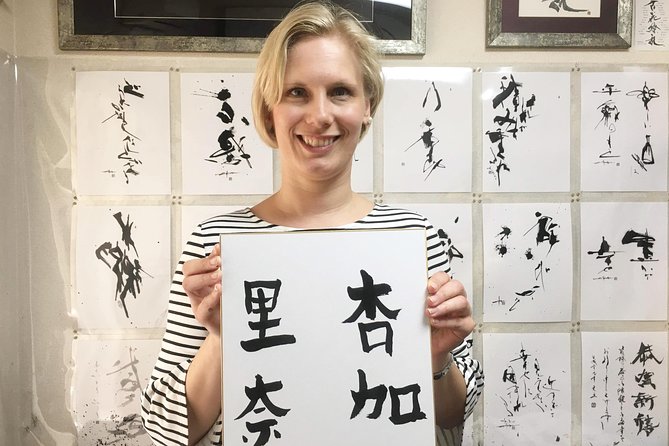
You practice brush strokes on paper under direct guidance. The point is not to produce perfect museum-quality calligraphy in one sitting. The point is to feel how the brush behaves and learn how a character is built.
That hands-on focus makes the activity accessible. You can be a complete beginner and still have something to work on. If you already draw, paint, or practice another form of lettering, you may notice more detail in brush angle and line weight, but you do not need an art background.
What the lesson feels like in practice
The lesson has a contemplative quality, but it is not described as a silent ceremony. The instructor is patient, kind, and funny, with a teaching style that helps keep the mood relaxed. English interpretation makes it easier to understand corrections and cultural explanations.
Expect to spend much of the session practicing rather than posing for photographs. You will handle the brush, place ink on paper, and repeat strokes as you learn. The work asks you to slow down, which can feel refreshing after several days of Tokyo sightseeing.
The best result may not be your most polished character. It may be the moment you understand that a heavier hand does not always create a stronger line, or that a pause in the wrong place can change the whole shape. That is where the activity becomes more than a craft class.
The lesson can also feel personal. An instructor once noticed that a participant was celebrating a birthday, sang happy birthday, and gave a gift. You should not book expecting a custom celebration, but the detail reflects the warm, attentive tone this small studio can provide.
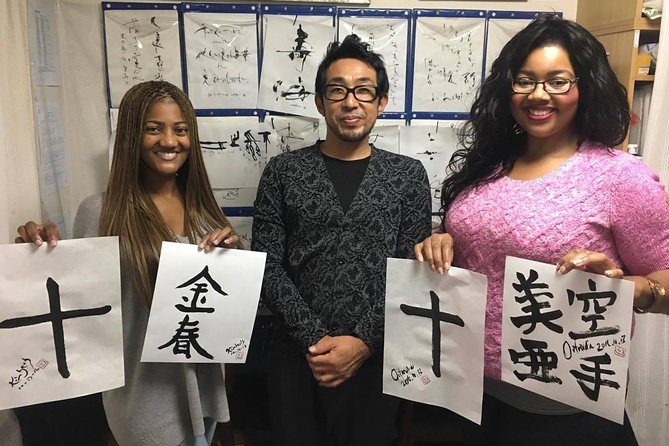
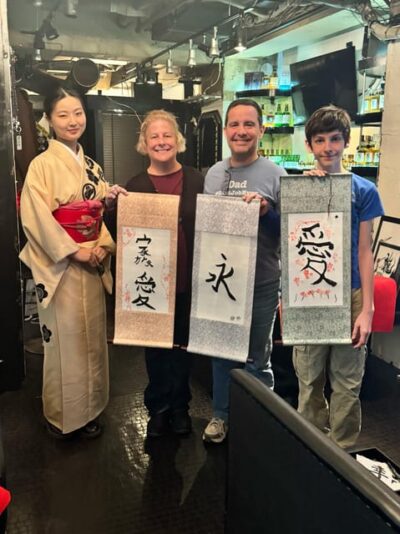
Your completed calligraphy is yours to keep. That gives you a better souvenir than a standard shop purchase because it records your own attempt at the art. It may be imperfect, but that is part of its value.
Why the interpreter matters

For an activity based on fine movements, translation is important. A short instruction about holding the brush or changing pressure can make a real difference. You are not left to guess what the master is demonstrating.
The guide also helps with the practical transition from station to studio. That can make the experience feel less awkward, especially if this is your first cultural class in Japan. Guides such as Yoko and Michiko have been singled out for being helpful and prepared, and the interpreter’s presence lets Matsumura focus on teaching.
Still, you should remember that this is an interpreted experience, not necessarily a one-on-one English lesson with the master. The guide supports communication, but some of the teaching rhythm will pass through translation. If you want an entirely English-led class, confirm the setup before booking.





A good choice for families and first-time artists

The minimum age is seven, and children must be accompanied by an adult. That makes this a workable family activity, especially for a child who enjoys drawing, crafts, or trying unfamiliar tools.
A child may not want a long lecture about the history of writing. The brush itself is the hook. They can work on their name or another selected character and leave with a piece of their own work. A nine-year-old participant, for example, worked on a name and other characters during the session.
Adults should set realistic expectations. Young children may need help with careful ink handling and brush control. The calm setting may suit focused children more than those who need constant movement. Because the group maximum is 10, the class should remain more manageable than a large workshop, though the exact group size depends on the booking.
Couples, families, solo art lovers, and people seeking a quieter final activity in Tokyo are the natural audience. It also suits anyone who wants a cultural souvenir made by hand rather than bought in a department store.
Price, group size, and overall value

The listed price is $92.24 per person. That is not a bargain basement activity, especially for a session lasting about 90 minutes. The value depends on what you want from your Tokyo schedule.
You are paying for several things at once: an English-speaking guide, a professional calligrapher, all equipment, instruction in a specialist art, and the use of a small studio. You also avoid the trouble of finding a class on your own and trying to communicate without support.
For two people, the minimum booking requirement, the cost is easier to justify if you treat this as a private-feeling cultural workshop rather than a simple sightseeing stop. Group discounts are available, which may improve the price for families or larger parties. The maximum is 10 participants, so you should not expect a huge class, but you also should not assume it will be exclusive.
The key value is the quality of the contact. You meet a working artist with a substantial teaching background, not simply a staff member handing out materials. If you care about making something, receiving guidance, and learning why the art works as it does, the price is reasonable.
If you only want a quick introduction or a decorative souvenir, the cost may feel high. You can see calligraphy in temples, shops, and museums for free or at little cost. This activity earns its price through participation and personal instruction.
Timing, booking, and the one concern to watch

The duration is listed as approximately 1 hour 30 minutes. The detailed stop information gives the studio visit as one hour, and the provider has noted that longer times are estimates. That difference is not automatically a problem, but it is worth understanding before you pay.
A participant who expected a longer option felt the experience did not match the selected duration. The provider explained that the two-hour figure was only an estimate and that the master may decide when the work is complete. If your schedule includes a train reservation, meal booking, or airport transfer, leave a generous buffer.
The activity is commonly booked well ahead, with an average lead time of 37 days. That suggests you should not leave it until the last minute if your dates are fixed. Confirmation arrives within 48 hours, subject to availability.
Free cancellation is available until 24 hours before the local start time. After that point, the payment is not refunded, and late changes are not accepted. These are ordinary rules for a scheduled class, but they matter in Tokyo, where a delayed train can quickly disrupt a tightly planned day.
How this compares with other cultural activities
A shrine visit gives you atmosphere. A museum gives you context. A food tour gives you flavors and conversation. This calligraphy class gives you a physical skill and a finished object.
I would choose it for a day when you want to slow down. It works particularly well near the end of a Japan trip, when your mind is full of new sights and you want one focused memory instead of another rush across town. It can also be a good break from major central Tokyo attractions.
The experience is not a full tour of Japanese calligraphy. You will not cover every style, historical period, or school of technique in 90 minutes. You will receive a practical introduction from a working artist, with enough instruction to understand the discipline and create your own work.
That limited scope is fine, as long as you book it for what it is. Think of it as a compact workshop, not an academic course.
Who should book this class
I would recommend it to you if:
- You want a hands-on cultural activity in Tokyo
- You enjoy drawing, painting, lettering, or traditional crafts
- You prefer small groups to large demonstrations
- You want English support from the station through the lesson
- You are traveling with a child aged seven or older
- You like souvenirs that show your own effort
- You need a calm activity after several busy sightseeing days
I would hesitate if you dislike sitting still, need a tightly fixed end time, or expect a long masterclass. The quiet studio and brush practice are the whole point. They will not suit everyone, and the approximate timing deserves attention.
Should you book the Tokyo shodo experience?
Book it if you want to do something rather than simply look at something. The combination of Eizuru Matsumura’s instruction, English interpretation, a small studio, and your own finished calligraphy makes this a thoughtful way to meet Japanese culture.
Before paying, check the expected duration and make sure the station meeting point works with your plans. If you accept that the session may run shorter or longer than an estimate, the class offers good personal value. I would especially choose it for couples, families with creative children, and anyone who wants a quiet, memorable final activity in Tokyo.
FAQ
Where does the calligraphy activity begin?
It begins at Umeyashiki Station on the Keikyu Line, at 2 Chome-28 Kamata, Ota City, Tokyo 144-0052, Japan.
How far is the studio from the station?
The studio is about a five-minute walk from Umeyashiki Station. An English-speaking guide meets you at the station and leads you there.
How long does the experience last?
The listed duration is approximately 1 hour 30 minutes. The studio activity is also described as one hour, and the provider notes that longer time estimates are approximate.
Is English guidance included?
Yes. A professional guide and English guide are included. The interpreter assists with the walk from the station and communication during the lesson.
What equipment is provided?
All necessary equipment is included, including brushes, ink, and paper.
What is the minimum age?
The minimum age is seven. Children must be accompanied by an adult.
Can I cancel for a refund?
Yes. You can cancel at least 24 hours before the local start time for a full refund. Cancellations and changes made less than 24 hours before the start time are not accepted for a refund.
More Craft Workshops in Tokyo

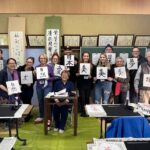
More tours in Tokyo we've reviewed












Craft Workshops, compared.
 ★ 4.8Chopstick Making Workshop in GinzaFrom $251 hour
 ★ 5.0Kintsugi Experience: Art of Golden Joinery in TokyoFrom $59
Tokyo: Shinjuku Chopstick Making ClassFrom $121 hour
★ 5.0Kintsugi Experience: Art of Golden Joinery in TokyoFrom $59
Tokyo: Shinjuku Chopstick Making ClassFrom $121 hour
 ★ 5.0Private Craft Your Own Ring Handmade Experience in Asakusa, TokyoFrom $21
 ★ 5.0Authentic Pure Gold Kintsugi Workshop with Master Taku in TokyoFrom $142
 ★ 5.0Tokyo: Calligraphy on Kanji Fan & Scroll with DrinkFrom $531h 20m
![[1 Group Only] Tokyo Shinjuku Food Tour for Family - Starting at Shinjuku 3 Chome with okonomiyaki](https://tokyoezine.com/wp-content/uploads/2026/08/1-group-only-tokyo-shinjuku-food-tour-for-family.jpg)