Reviewed · IMPERIAL PALACE & SHOGUN TOURS
Tokyo: Imperial Palace East Gardens and Tokyo Station Tour
The best part of this tour is the sharp change of scene: you begin beside quiet moats and old castle stones, then finish among Marunouchi’s glass towers and the red-brick face of Tokyo Station. It gives you a clear picture of how Edo became modern Tokyo without asking you to spend a whole day on your feet.
In This Article
- Key points to know before booking
- From Wada-kura Fountain Park to the palace grounds
- Ninomaru Garden and the design of a shogun’s grounds
- Ote-mon Gate and the Hyakunin Bansho Guardhouse
- Honmaru, the castle keep model, and Fujimi-yagura
- Nijubashi views and Kokyo Gaien National Garden
- The ten-minute walk into Marunouchi
- Marunouchi’s architecture and the final approach
- Tokyo Station’s red-brick finish
- What the $38 price gives you
- Who will get the most from this walk
- Practical details for a comfortable visit
- Should you book the Imperial Palace to Tokyo Station walk?
- FAQ
- How long does the tour last?
- Where does the tour start?
- Where does the tour finish?
- Is admission to the Imperial Palace East Gardens included?
- What sites are included in the Imperial Palace section?
- Is the tour offered in languages other than English?
- Is the tour wheelchair accessible?
- What should I bring?
- Can I cancel the booking?
I like the Edo Castle details, especially the guardhouse, watchtower, scale model, and garden design. I also like the way the route connects the Imperial Palace with Tokyo Station, rather than treating them as separate sights. Guide Yuki has earned praise for explaining the past with humor and vivid examples.
The main consideration is the walking. Two and a half hours is manageable for most people, but you will cover gardens, open plazas, city streets, and historic grounds. Bring water, sun protection, and good shoes, and remember that backpacks are not allowed.
Key points to know before booking
- See Edo Castle beneath the modern palace: Visit Ote-mon Gate, Hyakunin Bansho Guardhouse, castle ruins, the Fujimi-yagura watchtower, and a scale model of the former keep.
- Walk from gardens to skyscrapers: The route links the Imperial Palace East Gardens with Marunouchi’s modern architecture and public art.
- Hear the past explained clearly: Guide Yuki is singled out for humorous, easy-to-follow storytelling about the shogunate and Edo period.
- Finish at Tokyo’s famous station: The tour ends at the restored red-brick exterior of Tokyo Station, a useful point for continuing your sightseeing.
- Plan for an outdoor walk: Wear comfortable shoes, carry water, and dress for the weather. Flash photography and smoking are not allowed.
- Good value for a compact history tour: At $38 per person, the cost pays for a guided route through several major central Tokyo sights without an admission charge for the gardens.
From Wada-kura Fountain Park to the palace grounds
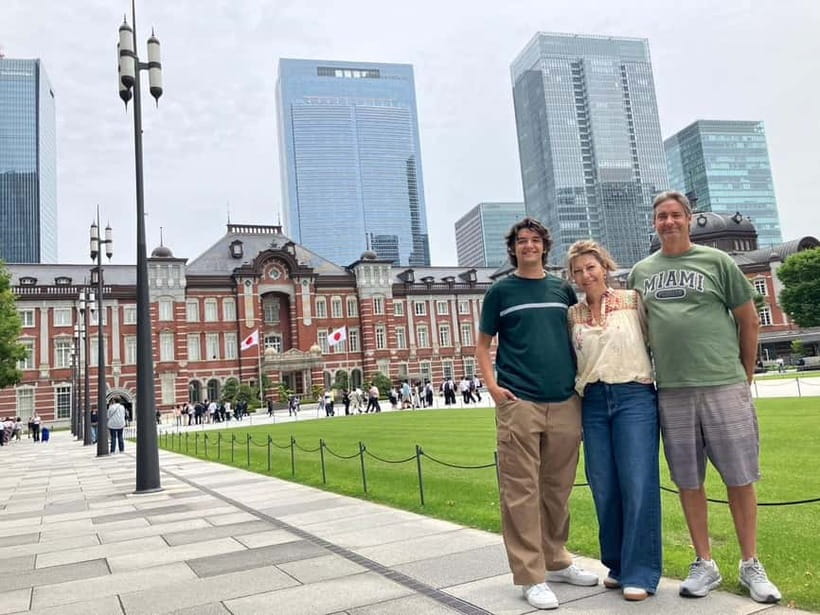
The meeting point is the Starbucks at Wada-kura Fountain Park, written in Japanese as Starbucks Coffee Kokyo Gaien Wadakura Fountain Park. This is a practical start because you meet near the Imperial Palace area rather than wasting tour time on a long transfer from a railway station.
The first stretch sets up the contrast that makes the whole walk work. Tokyo’s center can feel intensely modern, but the Imperial Palace grounds preserve traces of the old castle town that once controlled Japan. Moats, gates, stone walls, formal gardens, and broad open spaces give you a chance to slow down before the city’s office towers take over again.
Your guide leads you into the Imperial Palace East Gardens. Entry does not require an admission fee, so the $38 price is paying mainly for the route, interpretation, and structure. That matters here. The gardens are free to enter, but their history is not always obvious when you explore alone. A stone base may look like a ruin until someone explains what stood there and why the location mattered.
A few more Tokyo tours and experiences worth a look


Ninomaru Garden and the design of a shogun’s grounds
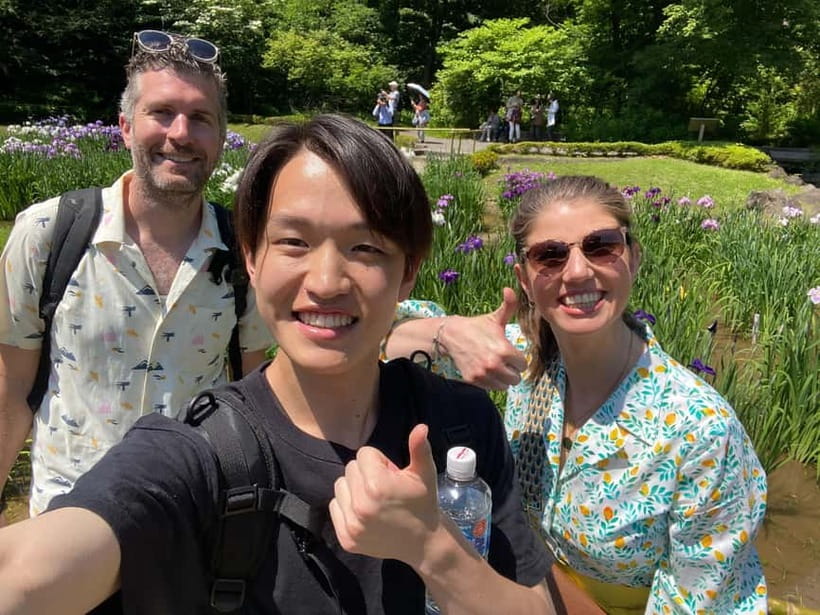
Ninomaru Garden is one of the early highlights. The garden offers a gentler view of the former castle grounds, with carefully planned planting and water features that reflect Japanese garden design. The tour uses this setting to explain how the shogunate shaped both politics and daily life.
I find this kind of stop useful because it keeps the tour from becoming a list of battles and dates. You get a sense of how power was presented through space. A castle was not only a fortress. Its gates, gardens, guard posts, and inner areas helped control who could approach the ruler and how they moved through the compound.
The garden is also a welcome pause during the walk. You can take photographs, but flash photography is not permitted. Bring a camera if you like taking pictures, and keep sunscreen and water close at hand. The provided information specifically advises against backpacks, so plan your day bag carefully and check the operator’s current instructions before setting out.
Ote-mon Gate and the Hyakunin Bansho Guardhouse
The route continues through key remains of Edo Castle, including Ote-mon Gate and the Hyakunin Bansho Guardhouse. These places help turn the broad idea of samurai rule into something you can picture.
Ote-mon was an important entrance to the castle grounds. A gate like this was a control point, not just a decorative entrance. The guardhouse adds another layer, showing how carefully movement around the castle was watched. Your guide explains the role of samurai guards and the systems used to protect the shogun’s compound.
This is where Yuki’s style appears to be especially useful. The strongest comments about her guiding focus on clear explanations, humor, and her ability to make the castle feel imaginable as it was 400 years ago. That is the right approach for this site. The walls and foundations are impressive, but a good explanation helps you understand the people, rules, and routines that once filled the area.
The East Gardens portion lasts about 30 minutes as a guided sightseeing segment, though the entire activity lasts 150 minutes. The garden time is only part of the experience, so you should not book this expecting a slow, half-day garden visit. It is a brisk introduction that then moves into the city.
Honmaru, the castle keep model, and Fujimi-yagura
The tour also passes through the Honmaru area, the former main compound of Edo Castle. The central keep no longer dominates the site, but the remains and layout still point to the scale of the old complex.
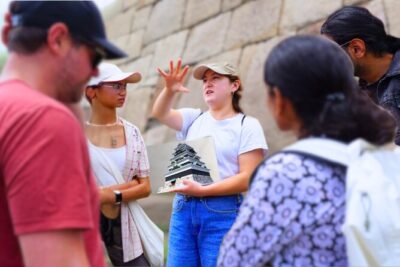
One particularly helpful feature is the Edo Castle main keep scale model. Models can be more useful than another stone wall because they give you a visual frame for the lost buildings. You can compare the model with the surviving foundations and understand how the castle once organized its courtyards and defensive spaces.
The Fujimi-yagura watchtower adds another strong visual point. A watchtower served a practical defensive role, yet it also had an elegant form that fits the surrounding grounds. The tour uses sites like this to connect samurai-era architecture with the garden setting, rather than presenting architecture and nature as unrelated subjects.
You will also hear about the transition from the Tokugawa shogunate to Japan’s imperial era. The palace grounds carry both stories, and that overlap is one of the tour’s main strengths. You are not simply visiting a former military site or a present-day imperial residence. You are following the change from shogunal Edo to the national capital of modern Japan.
Nijubashi views and Kokyo Gaien National Garden
The walk includes Kokyo Gaien National Garden and scenic views connected with Nijubashi. This open area gives you a different feeling from the enclosed garden sections. Instead of concentrating on individual plants or ruins, you get broader views across the palace approach and surrounding grounds.
Nijubashi is one of the best-known palace views in central Tokyo. The bridge and palace setting make a natural photo stop, though the tour is not presented as a dedicated photography outing. Your guide adds context about the imperial side of the palace area, which helps prevent the stop from becoming just another picture on your phone.
The open grounds can also mean more exposure to sun and weather. A hat, sunscreen, water, and clothing suited to the forecast are sensible choices. In warm weather, the lack of shade in some areas may make the walk feel harder than the mileage suggests. In rain or cold, the same open spaces can be less comfortable.
The tour is listed as wheelchair accessible, which is important for anyone checking physical access before booking. Still, the route includes historic grounds and city streets, so it is wise to confirm current route conditions and meeting details if you need specific assistance.





The ten-minute walk into Marunouchi
After the palace grounds, the group walks for about ten minutes toward Marunouchi. This short connection is more than a transfer. It shows how quickly central Tokyo changes from old walls and gardens to corporate towers, polished plazas, galleries, and public art.
Marunouchi is the business district beside Tokyo Station. The tour points out its modern architecture and art while keeping the earlier palace story in view. That pairing gives you a better understanding of Tokyo than a palace visit alone. The city did not erase its past in one clean sweep. Old sites remain close to new buildings, and the walk lets you see both within the same afternoon.
Your guide leads the sightseeing rather than simply walking the group from point to point. The available guide languages are English, Japanese, Spanish, Chinese, and French. If you want the fullest historical explanation, select your preferred language when booking and check which starting times offer it.
There is no stated group size, so you should not assume an intimate private walk. The experience is guided and organized, but the feel will depend on the number of people assigned to your departure. That is worth considering if you prefer quiet, unhurried visits at historic sites.
Marunouchi’s architecture and the final approach
In Marunouchi, the focus shifts from castle remains to the architecture and public life of present-day Tokyo. Modern buildings frame streets that lead toward the station, and the contrast gives the tour a strong narrative shape.
I like this section because it prevents the tour from becoming an isolated history lesson. You see how the area functions now, then connect it with the imperial and shogunal sites from earlier in the walk. For first-time visitors, that connection can make the city easier to read. Tokyo is not one single visual style. Its character comes from layers placed close together.
The pace is likely to be steady. The tour has several stops and ends after 150 minutes, so the guide needs to keep the group moving. If you like spending 20 minutes at every building or garden corner, this may feel too structured. If you want a useful overview before exploring independently, the timing works well.
The route also gives you an easy point for further sightseeing. Since the tour finishes at Tokyo Station, you can continue by train, meet someone in the station area, or explore Marunouchi on your own after the guide says goodbye. The end point is more practical than finishing in a less connected residential street.
Tokyo Station’s red-brick finish
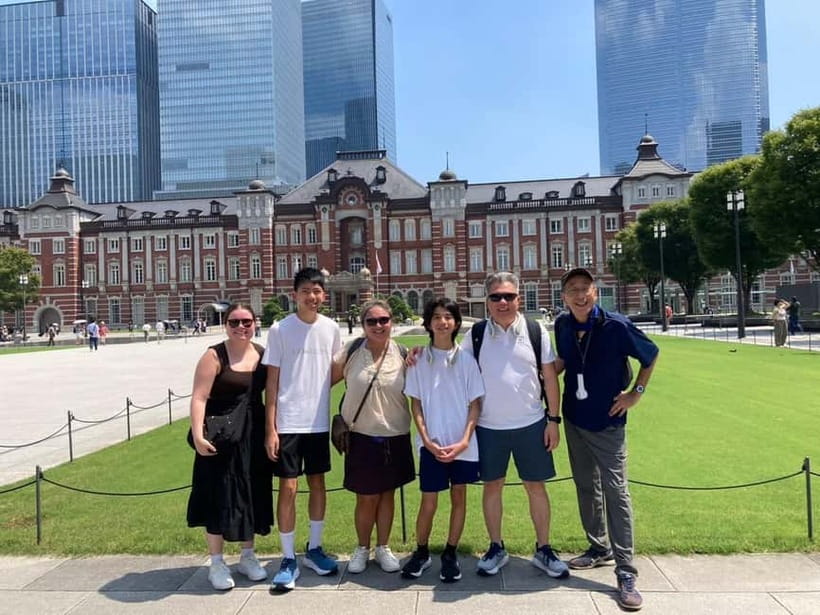
The final stop is Tokyo Station, especially its beautifully restored red-brick exterior. After the quiet palace grounds and the newer office district, the station gives the walk a clear closing image.
Tokyo Station represents the city’s transformation in a way that fits the tour’s theme. It is a working transport hub, but its historic exterior also has architectural weight. You finish by looking at a building that links Tokyo’s past with its present daily rhythm.
The experience focuses on the station exterior rather than promising a full indoor station tour. That distinction matters. If you want detailed information about platforms, underground shopping, railway history, or the station interior, you will need extra time after the activity.
The station is also a good place to orient yourself. By the end of the walk, you have moved from the Imperial Palace area through Marunouchi and arrived at one of Tokyo’s best-known central landmarks. You leave with a practical sense of how these areas fit together, not just a collection of separate photographs.
What the $38 price gives you
At $38 per person, this is a sensible price for a 150-minute guided walk if you value explanation more than exclusive access. The East Gardens do not require an admission fee, so you are not paying for a costly ticket. You are paying for a planned route, a live guide, and interpretation of places that can be easy to pass without understanding.
The value is strongest for first-time visitors, history buffs, and anyone who wants a compact introduction to central Tokyo. You see castle remains, gardens, palace views, modern architecture, public art, and Tokyo Station in one outing. Booking each part separately would take more planning, and you might miss the connections between them.
The price is less compelling if you already know Edo Castle well or prefer to wander independently. The gardens can be visited without admission, and Marunouchi and Tokyo Station are easy to explore on your own. In that case, the guide’s storytelling is the main reason to book.
Flexible booking also helps. You can cancel up to 24 hours ahead for a full refund, and the reserve-now-pay-later option lets you hold a place without paying immediately. Check the available starting times, since the duration is fixed at 150 minutes.
Who will get the most from this walk
I would recommend this tour to you if you want history explained in plain language, with enough modern Tokyo to keep the afternoon varied. The route suits adults and older children who can manage a moderate amount of walking and stay engaged through several short stops.
It is especially useful for:
- First visits to the Imperial Palace East Gardens
- People interested in the Edo period and Tokugawa shogunate
- Visitors who want to understand the link between Edo Castle and modern Tokyo
- Anyone who likes architecture, gardens, and city planning in the same outing
- Visitors seeking a guided introduction before exploring Marunouchi alone
I would think twice if you want a long, quiet garden visit, a private guide, or a tour built around food and shopping. The route is historical and architectural, not culinary. It also keeps moving, so comfortable shoes matter more than stylish ones.
Guide Yuki is worth noting if you see her name available. Her approach combines facts, hospitality, and jokes, and she explains the castle in a way that helps you picture the former buildings and daily life. Other guides may lead the walk, with English, Japanese, Spanish, Chinese, and French listed as available languages.
Practical details for a comfortable visit
Wear walking shoes. You will move through gardens, historic grounds, open plazas, and city streets, with a moderate amount of walking packed into two and a half hours.
Bring water, a hat, sunscreen, a camera, and clothing suited to the weather. The route is outdoors for much of its length, so a sunny day and a rainy day will feel very different.
Smoking and flash photography are not allowed. Backpacks are also listed as prohibited, which is an unusual rule for a walking tour. Do not arrive with a large pack and assume you can carry it throughout the route. Check the current instructions before you go if you need to bring more than a small set of essentials.
The tour is wheelchair accessible, but anyone with particular mobility needs should confirm the route details in advance. Historic sites can have different surfaces and access points, even when an activity is marked accessible.
Should you book the Imperial Palace to Tokyo Station walk?
Book it if you want a well-shaped introduction to Tokyo’s central history, especially if Edo Castle means little more to you than a name on a map. The route gives you the old gates, guardhouse, gardens, castle remains, watchtower, palace views, Marunouchi architecture, and Tokyo Station in one useful sequence.
The strongest reason to go is the guide’s explanation. Yuki’s clear, humorous style is repeatedly praised, and that matters because much of the site is made up of foundations, walls, and open spaces rather than complete buildings.
Skip it if you want to explore at your own pace or spend most of an afternoon in the gardens. At $38, the tour is good value for interpretation and orientation, not for admission savings or exclusive access. For most first-time visitors with comfortable shoes and an interest in Japan’s past and present, it is a practical choice.
FAQ
How long does the tour last?
The tour lasts 150 minutes, or two and a half hours.
Where does the tour start?
It starts at Starbucks Coffee Imperial Palace Gaien Wada-kura Fountain Park, written in Japanese as スターバックス コーヒー 皇居外苑 和田倉噴水公園店.
Where does the tour finish?
The tour finishes at Tokyo Station, written in Japanese as 東京駅.
Is admission to the Imperial Palace East Gardens included?
Entry to the Imperial Palace East Gardens requires no admission fee, and the guided visit is included in the activity.
What sites are included in the Imperial Palace section?
The route includes Ote-mon Gate, Hyakunin Bansho Guardhouse, Ninomaru Garden, the Honmaru area, Edo Castle ruins, the Fujimi-yagura watchtower, and a scale model of the Edo Castle main keep.
Is the tour offered in languages other than English?
Yes. Live guiding is listed in English, Japanese, Spanish, Chinese, and French.
Is the tour wheelchair accessible?
Yes, the activity is listed as wheelchair accessible.
What should I bring?
Bring comfortable shoes, a hat, a camera, sunscreen, water, and clothing suitable for the weather.
Can I cancel the booking?
You can cancel up to 24 hours in advance for a full refund. A reserve-now-pay-later option is also available.
More Imperial Palace & Shogun Tours in Tokyo

More tours in Tokyo we've reviewed






Imperial Palace & Shogun Tours, compared.
 ★ 4.9Tokyo: Imperial Palace Japanese History Walking TourFrom $32
 ★ 4.9Tokyo: Imperial Palace and Shogun Walking TourFrom $162 hours
 ★ 5.0Imperial Palace East Garden and Edo Castle Walking Tour in TokyoFrom $25
 ★ 4.8Tokyo: Imperial Palace East Gardens Walking TourFrom $192h 30m
 ★ 4.5Tokyo: Imperial Palace, Sensō-ji Temple, & Tokyo Tower TourFrom $404 hours
 ★ 5.0Tokyo Castle, Imperial Palace, Shogun & Garden Walking TourFrom $31