Reviewed · E-BIKES
Tokyo Deep Inside Cycle Tour~3 Hours E Bike Tour around Tokyo
Tokyo reveals itself best when you move between its grand avenues and small back streets. This three-hour e-bike tour links Tokyo Station, Kanda, Akihabara, the Imperial Palace, and several quieter corners that are easy to miss on foot.
In This Article
- Key points to know before you book
- Why this Tokyo ride is worth your afternoon
- Starting at Tokyo Station and the Kanda Bridge gate
- Kanda Matsuya and the old commoners’ quarter
- Akihabara, from black-market stalls to pop culture
- Kanda Shrine and the taiyaki break
- Hijiribashi Bridge and the student town of Ochanomizu
- Jinbocho bookshops and the approach to Yasukuni Shrine
- Kitanomaru Park and the old Edo Castle site
- The Imperial Palace and Sakuradamon Gate
- Finishing with Marunouchi art and city memory
- What riding in the group is really like
- Who should book this Tokyo e-bike tour
- Should you book it?
- FAQ
- How long does the Tokyo Deep Inside Cycle Tour last?
- What time does the tour begin?
- Where does the tour begin?
- Where does the tour finish?
- How many people can join the tour?
- Can I make the tour private?
- Is the bicycle included?
- Is food included?
- Is bottled water included?
- What happens if it rains?
I like the way the route connects old Edo with present-day Tokyo, and I like the small group size, capped at four people. The included taiyaki snack is a fine touch. The main drawback is that the tour follows city streets, so you need to feel comfortable riding near traffic and keeping pace with the group.
Key points to know before you book

- Cover about 10 kilometers without exhausting yourself: One participant reported riding 6.8 miles, making the electric assist useful after long days of walking.
- See old and new Tokyo in one ride: The route moves from postwar Akihabara and traditional Kanda to the Imperial Palace and Marunouchi offices.
- Expect a very small group: The maximum is four people, and booking four places turns the outing into a private tour.
- Meet at Tokyo Station at 1 p.m.: The starting point is the JTB Marunouchi Store, with the ride ending at Marunouchi Building.
- Enjoy taiyaki at Kanda Daruma: You choose either red bean paste or cream filling during the snack stop.
- Plan for weather changes: Rain may cancel the cycling route, but you can choose a walking route or a refund.
Why this Tokyo ride is worth your afternoon
At $83.23 per person, this is not the cheapest way to see central Tokyo. But the price includes the e-bike, helmet, bicycle insurance, guide, and snack. You are paying mainly for a carefully planned route and the chance to cover several districts without spending half the day changing trains.
I see the value most clearly if you have already spent days walking 15,000 steps around Tokyo. One participant with a knee replacement five months earlier said the ride felt safe and manageable, thanks in part to Micky’s careful pace. That does not mean this is a no-effort outing, but the electric assist takes much of the strain out of the distance.
The group limit matters, too. With only four people, your guide can keep an eye on the riders and adjust the pace. The pace may slow if another person in the group, especially a child, is new to cycling. That is sensible for safety, but it can make the route feel less brisk.
Guides named in the tour feedback include Micky, Kumiko, and Tussie. Their role is more than pointing out buildings. They explain how Edo became Tokyo, why neighborhoods changed, and how old customs still appear in daily life. The historical information is meant to be digestible, with enough context to make the stops meaningful without turning the afternoon into a lecture.
Other cycling tours in Tokyo
Starting at Tokyo Station and the Kanda Bridge gate

The tour begins at 1 p.m. in front of Tokyo Station, near the JTB Marunouchi Store. This is a convenient meeting point: the store is in the Marunouchi Eiraku Building, about a one-minute walk from the Marunouchi South Exit of JR Tokyo Station. It is also directly connected to Tokyo Station on the Marunouchi Line and Nijubashimae Station on the Chiyoda Line.
Your first stop looks across the grand central Tokyo district and asks how a former field became this city center. That opening gives you a useful frame for the rest of the ride. Tokyo is not one single old town. It is a city repeatedly rebuilt, reorganized, and reshaped.
From there, you ride toward the remains of the Kanda Bridge Gate’s stone wall. The stop brings you closer to the old Edo town that grew along the Nihonbashi River. Your guide also covers traditional festivals and the origin of the neighborhood’s name.
This is one of the tour’s better choices because it moves beyond famous photo spots. A stone wall may not grab you as quickly as a neon sign, but it helps explain how Tokyo developed before the modern railway network and office towers.
Kanda Matsuya and the old commoners’ quarter
Kanda offers a sharp change from the polished Marunouchi district. Narrow lanes and older buildings preserve traces of the neighborhood’s everyday culture. The route takes you toward Kanda Matsuya, where the guide explains the area’s decision to preserve older customs while the city around it changed.
The route through the lanes has a treasure-hunt quality. You are not simply riding along a major road from one attraction to another. You are looking into smaller corners, where the contrast between Tokyo’s office districts and its older communities becomes clearer.
The stop itself is brief, about 10 minutes. That is enough for an introduction, but not enough for a long visit or detailed exploration of the area. Think of Kanda as part of the story the guide is building, not as a separate sightseeing stop.
Akihabara, from black-market stalls to pop culture

Akihabara is introduced as a district that adapted to changing times. After the Second World War, it developed from a black market in the ruins of the city. It later became famous for electronics and then for anime, manga, games, and related pop culture.
The tour does not treat Akihabara as a shopping session. You will get a short explanation of how the district changed, then continue by bike. That is useful if you want context but do not want to spend your afternoon inside shops.
The stop lasts around 15 minutes. The main benefit is seeing Akihabara as a product of Tokyo’s postwar changes rather than just a district of bright signs. If you want extended shopping time, this tour will not provide it. Its aim is to connect the neighborhood to the larger story of urban change.
Kanda Shrine and the taiyaki break

Kanda Shrine is one of the central stops, with about 35 minutes allotted. It served as the chief Shinto shrine of Edo, and your guide explains its role in local culture, the Kanda Festival, and the shrine’s place in the city’s past.
This is the longest stop on the route, and rightly so. Kanda Shrine gives you a chance to pause the ride and focus on a major religious and cultural site. You also visit a souvenir shop nearby, which adds a practical chance to browse without setting aside a separate shopping block.
Next comes Kanda Daruma and a snack break. You receive taiyaki, a traditional fish-shaped cake filled with either red bean paste or cream. The choice is simple, but it gives the afternoon a pleasant rhythm: ride, listen, stop, eat, then continue.
The snack is included in the price. Bring your own drink, since bottled water is not included. Tokyo’s convenience stores make it easy to buy something before the ride, but the tour information specifically asks you to bring your own beverages if needed.
A few more Tokyo tours and experiences worth a look



Hijiribashi Bridge and the student town of Ochanomizu

At Hijiribashi Bridge, you look down toward Ochanomizu Station. The guide uses the view to explain Ochanomizu’s role as a student town.
This stop works because it follows Akihabara. The two districts represent different kinds of energy: one shaped by business and changing technology, the other by schools, students, and long-standing local life. You do not need to know Tokyo’s neighborhoods in advance to follow the comparison.
The stop is short, around 10 minutes. You will have time to take in the view and hear the explanation, but not to wander around Ochanomizu. The route is designed to give you many small pieces of central Tokyo rather than one long stay in a single area.
Jinbocho bookshops and the approach to Yasukuni Shrine

The bikes pass through Kanda Jinbocho, an antiquarian book district described as one of the largest of its kind in the world. The scheduled stop is listed as zero minutes, with about 10 minutes of travel through the area.
That timing tells you what to expect. You are seeing the district from the saddle, not browsing shelves or visiting individual bookstores. Still, cycling makes the area easier to grasp than a quick train ride. You can see the street continuing past bookshops and understand its scale.
The route then reaches Yasukuni Shrine. You ride beneath its enormous torii gate and enter the shrine grounds, with a short five-minute stop and a restroom break. The grounds provide a calmer change after the denser city streets.
The itinerary does not indicate a long visit inside the shrine complex. Your guide will provide the historical and cultural setting, while the ride keeps moving toward the Imperial Palace area. If Yasukuni is a major personal interest, you may want extra time there on another day.
Kitanomaru Park and the old Edo Castle site

Kitanomaru Park occupies the site of Edo Castle’s former northern compound. You cycle through the park and see the Nippon Budokan and nearby buildings.
The scheduled time here is short, about five minutes including travel. The point is not a full park visit. Instead, the route uses Kitanomaru to show how pieces of the former castle grounds became today’s public spaces and institutions.
This is where the e-bike helps most. The palace area is broad, and walking between its outer points takes time. You can cover the ground at an easy pace while still having enough energy for the stops and explanations.
The Imperial Palace and Sakuradamon Gate
At the Imperial Palace, the guide returns to the biggest question of the day: how did Edo Castle become the Imperial Palace? The discussion also touches on the transition from the samurai era to modern Japan, including why Japanese men no longer wore the traditional chonmage hairstyle.
The history is presented through the places around you rather than in isolation. That makes the Imperial Palace stop a useful payoff to the earlier explanations of Edo, Kanda, and the city’s repeated changes.
You then pass through Sakuradamon Gate, the largest gate of the Imperial Palace, and ride around the outer perimeter. The route allows about 10 minutes for this section, so expect a scenic pass-through rather than a formal palace tour.
No palace interior visit is included. That distinction matters. If you want gardens, museums, or a longer look at the palace grounds, plan a separate visit. This ride gives you the setting and the larger historical story.
Finishing with Marunouchi art and city memory
The bicycles are returned at Marunouchi Building. The experience then continues on foot to a floor where art is displayed around the theme of Time and Memory.
That final indoor stop gives the tour a thoughtful ending. The ride has moved through old gates, shrines, bookshops, parks, and office districts. The art display brings those ideas of change and memory back into focus.
It also means the tour does not end the instant you hand over the bike. Allow yourself enough time for the final walk and artwork viewing. The exact timetable may change during the day, so treat the stop lengths as a guide rather than a promise.
What riding in the group is really like
The electric bicycles are intended for riders of different experience levels, and bicycle insurance is included. Helmets are supplied. The small group helps the guide adjust the route and keep the ride together.
Still, you should be comfortable on a bicycle before booking. The route uses public city streets, and the tour includes about 10 kilometers of riding according to the itinerary and participant experience. Electric assistance reduces effort, but it does not remove the need to steer, stop, and pay attention.
The tour has a minimum height of 145 centimeters. Anyone below that height cannot participate. Most people can join, but the provider may cancel the cycling route for safety if the weather is poor.
If rain affects the ride, you may choose a Rain Day Limited Walking Route or request a refund. The walking alternative uses the subway while exploring Tokyo Station, an old shrine, Jinbocho’s secondhand book district, and a large park on the former Edo Castle site. That option preserves much of the cultural focus, but it will not provide the same reach or ease as the e-bikes.
Arrive early. If you are late without prior notice, the tour can be canceled with a full same-day charge. Normal cancellation is free up to 24 hours before the 1 p.m. start time. Changes made inside that window are not accepted.
Who should book this Tokyo e-bike tour
I would choose this ride if you want a guided introduction to central Tokyo and prefer seeing neighborhoods rather than checking off one major attraction. It suits an active couple, a small family group with suitable riders, or anyone who wants a break from long walking days.
It is also a good fit if you enjoy history in short, clear portions. Micky, Kumiko, and Tussie are named guides associated with the experience, and the strongest praise centers on friendly explanations, careful riding, and useful historical detail.
I would think twice if you dislike cycling in cities, need a slow independent schedule, or want long visits inside shrines, bookshops, or palace grounds. The route covers a lot, but several stops are brief.
Should you book it?
Book this tour if you want to connect Tokyo’s old and modern sides in one compact afternoon. The combination of Kanda Shrine, Akihabara, Jinbocho, the Imperial Palace, and a taiyaki break gives you far more range than a walking tour, while the electric assist keeps the physical demand reasonable.
At $83.23, the value depends on how much you prize a small group, a guide, bicycle use, insurance, and an organized route. For most first visits, I think the price is fair, especially after a few days of heavy walking. Just arrive on time, bring water, confirm the weather plan, and book four places if you want the outing to be private.
FAQ
How long does the Tokyo Deep Inside Cycle Tour last?
The tour lasts approximately three hours.
What time does the tour begin?
The scheduled start time is 1 p.m.
Where does the tour begin?
It begins at the JTB Marunouchi Store in the Marunouchi Eiraku Building, near Tokyo Station.
Where does the tour finish?
The e-bikes are returned at Marunouchi Building, where the final art viewing takes place.
How many people can join the tour?
The maximum is four people.
Can I make the tour private?
Yes. Booking four people automatically makes the tour private.
Is the bicycle included?
Yes. Bicycle use, a helmet, and bicycle accident insurance are included.
Is food included?
Yes. The tour includes one taiyaki snack, with a choice of red bean paste or cream filling.
Is bottled water included?
No. You should bring your own drinks if you need them.
What happens if it rains?
The cycling route may be canceled for safety. You can choose the Rain Day Limited Walking Route or receive a refund if the plan cannot operate because of rain.
More 3-Hour Experiences in Tokyo

More E-Bikes in Tokyo
More Cycling Tours in Tokyo
More tours in Tokyo we've reviewed












E-Bikes, compared.
 ★ 5.0Tokyo Top Highlights 3h Guided E-bike TourFrom $63
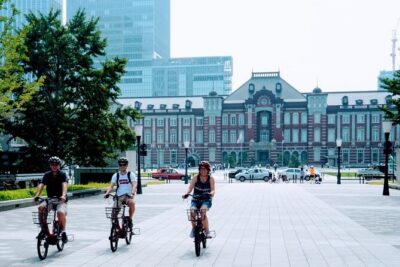 ★ 5.03h Tokyo E-Bike Tour: Hidden Gems, and Local Life with guideFrom $63
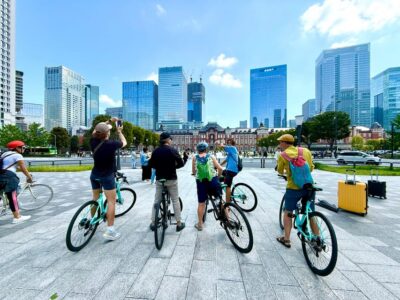 ★ 4.8Tokyo: 3-Hour Bike or E-Bike City Highlights TourFrom $453 hours
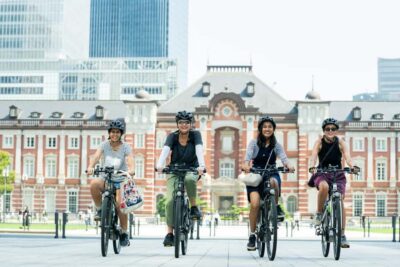 ★ 4.8Tokyo: 3-hour Guided E-Bike Tour of the City’s Hidden GemsFrom $65
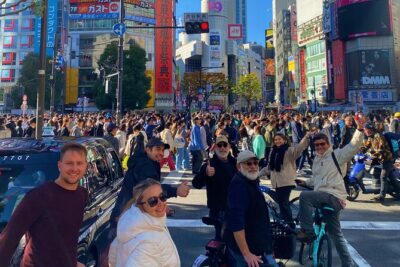 ★ 5.0Tokyo: 3-Hour Bike/E-Bike Tour of the City’s HighlightsFrom $63
 ★ 5.03-Hour Tokyo Private E-Bike Tour Starting from Your HotelFrom $145