Reviewed · TOKYO FOOD TOURS
Shinjuku: Food Tour – 15 Dishes & 3 Drinks at 4 Eateries
Shinjuku after dark is best understood one small plate at a time. This three-hour food tour takes you through Omoide Yokocho, Kabukicho, and Golden Gai, stopping at four eateries for up to 15 Japanese dishes and three drinks. You may try yakitori, gyoza, sushi, kushikatsu, grilled vegetables, fried tofu, and several kinds of sake.
In This Article
- Key points to know before you book
- Why this Shinjuku food tour works
- Omoide Yokocho: a first taste of old Shinjuku
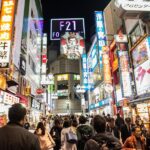
- Kabukicho: food in Tokyo’s famous night district
- Golden Gai: tiny bars and an easy social evening
- The food: a broad sample rather than one long dinner
- What the guides add to the night
- Is $112.75 good value?
- Practical details that affect your evening
- Who should book this Shinjuku food tour?
- Should you book it?
- FAQ
- How long does the Shinjuku food tour last?
- How many eateries are included?
- How many dishes are included?
- How many drinks are included?
- Where does the tour meet?
- Where does the tour end?
- What is the maximum group size?
- Do I need to remove my shoes?
- Can I cancel for a refund?
I like the way the tour combines food with a guided walk through some of Tokyo’s most famous nightlife lanes. I also like the social setup, especially if you want an easy evening with other English-speaking visitors and a guide such as Ayaka, Naoto, Shun, or Midori. The main caution is organization: one poor account describes a group too large to hear the guide and delays between restaurants, so group size and guide performance may affect the evening.
Key points to know before you book
- Four eateries, 15 dishes, and 3 drinks: The price includes a full tasting route rather than one restaurant meal.
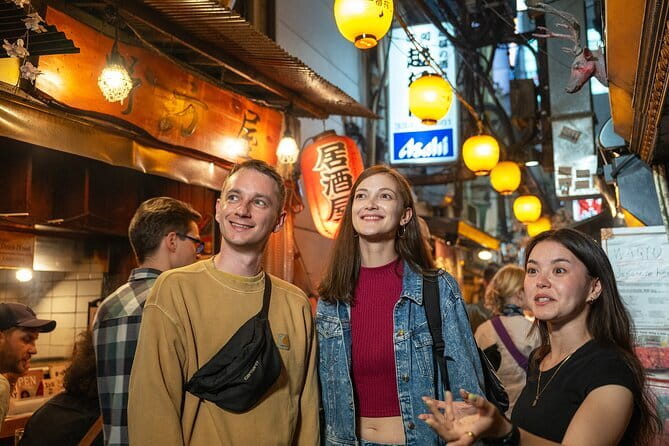
- Three classic Shinjuku areas: Omoide Yokocho, Kabukicho, and Golden Gai give you three very different nightlife settings.
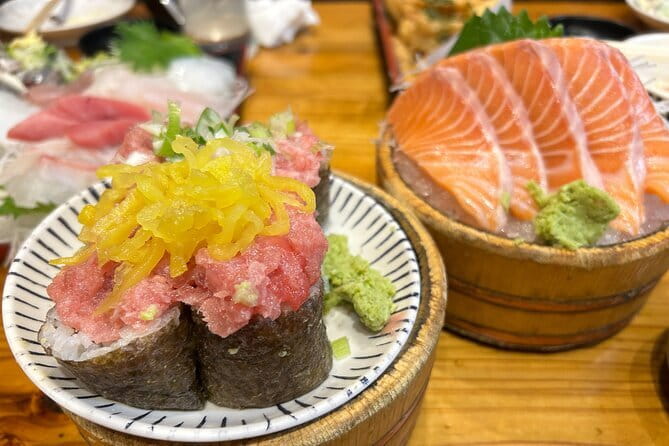
- Local-style food: Expect dishes such as gyoza, yakitori, sushi, kushikatsu, fried tofu, grilled vegetables, and custard-filled fish.
- Sake is part of the fun: The tour includes a sake selection, and some sessions offer a flight of different styles.
- A small-group promise: The stated maximum is 15 people, though one account raises concern about larger groups on some departures.
- Bring easy footwear: At least one restaurant requires you to remove your shoes.
Why this Shinjuku food tour works
Shinjuku can feel like three cities packed into one station district. Neon shopping streets, narrow restaurant lanes, tiny bars, and old drinking alleys all sit within walking distance, but the best places are not always obvious from the main road.
That is where a guided food walk earns its keep. You do not have to choose between a crowded yakitori stall, an unfamiliar izakaya, and a tiny Golden Gai bar while trying to read a menu or work out the ordering system. The guide leads you from place to place and handles the basic flow of the evening.
The structure also helps you pace yourself. Instead of eating one large dinner, you receive a series of smaller dishes over roughly three hours. That gives you room to try foods you might otherwise skip, and it lets you compare different restaurant settings in one night.
I especially like the balance of food, drinks, and neighborhood context. This is not only a meal with a walk attached. It is an introduction to how Shinjuku changes after sunset.
A few more Tokyo tours and experiences worth a look
Omoide Yokocho: a first taste of old Shinjuku
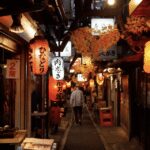
The tour begins at Omoide Yokocho, a narrow area near Shinjuku Station known for its old-fashioned food stalls and compact izakaya. The name is often translated as Memory Lane, and the setting has a very different feel from the broad commercial streets outside the station.
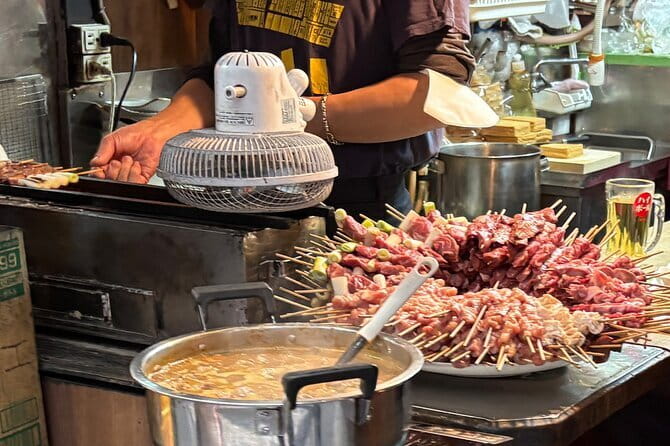
Your first hour includes local favorites such as yakitori, fried tofu, gyoza, grilled vegetables, craft beer, and sake. These foods make sense as an opening course because they are familiar enough for first-time visitors, but still give you a feel for Japanese pub cooking.
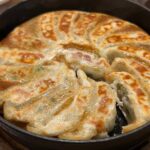
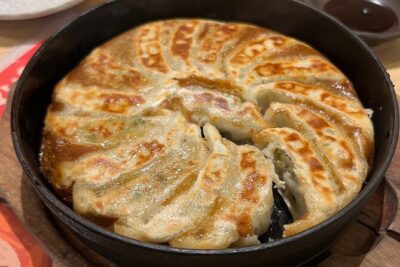
Yakitori is particularly suited to this setting. Skewered chicken and vegetables are cooked quickly and served in small portions, making them easy to share. Gyoza adds a crisp, savory contrast, while fried tofu and grilled vegetables keep the first stop from becoming an all-meat meal.
This area is also a good place to get your bearings. The lanes are tight, the eateries are small, and the signs can be hard to interpret if you are walking alone. A guide can help you move through the area without spending the first part of your evening wondering where to sit.
The practical drawback is space. Omoide Yokocho is not designed for long explanations in the middle of the lane, and small restaurants can feel close together. Stay near your guide and listen for instructions about where to stand or sit.
Kabukicho: food in Tokyo’s famous night district
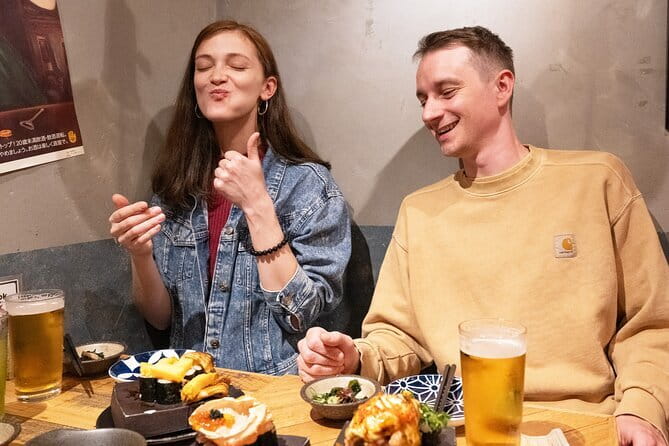
From Omoide Yokocho, the route continues into Kabukicho, one of Shinjuku’s best-known nightlife districts. This part of the evening is built around a local izakaya that can be difficult to enter without a reservation.
That detail matters. Many visitors can find a major restaurant chain or a large dining hall on their own. The harder part is finding a small place where seating is limited and the menu may not be designed for first-time foreign visitors.
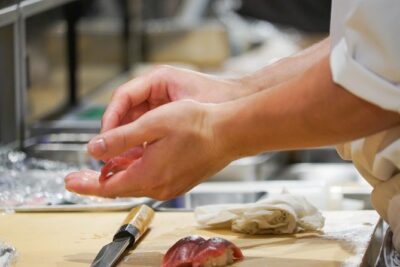
The exact dishes at this stop can vary, but the stated selection includes Japanese food across the full route, with sushi, juicy gyoza, kushikatsu, and other local specialties. Kushikatsu, deep-fried skewers, gives the evening a different texture from the grilled foods at Omoide Yokocho.
You may also encounter dishes that are less familiar. One especially well-liked item in the feedback was custard-filled fish, a sweet snack that shows how varied the food can be. That kind of surprise is part of the value here. You are not simply ticking off famous dishes. You are allowing the guide to choose some items you may not spot by yourself.
Kabukicho can be stimulating, and the streets are easy to confuse once you leave the main route. One highly negative account described the group getting lost between stops and waiting outside restaurants for about 15 minutes at a time. I would not treat that as the normal outcome, since the overall rating is very high, but it is a fair warning to keep expectations realistic. The tour depends heavily on the guide’s navigation and group management.
Golden Gai: tiny bars and an easy social evening

The final named area is Shinjuku Golden Gai, a maze of narrow lanes filled with very small bars. The tour uses this part of the route for conversation and bar hopping with local people and other participants.
Golden Gai is not the place to expect a large dining room or a quiet, formal meal. The attraction is the intimate scale. A bar may have only a handful of seats, so the setting encourages conversation and makes the group feel connected quickly.
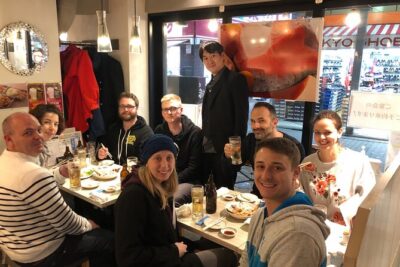
For solo visitors, this can be the most useful part of the experience. You have an immediate group for the evening, and a guide can help smooth over language gaps. Several of the strongest accounts praise guides for being friendly, patient, social, and attentive to the needs of the group.
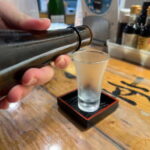
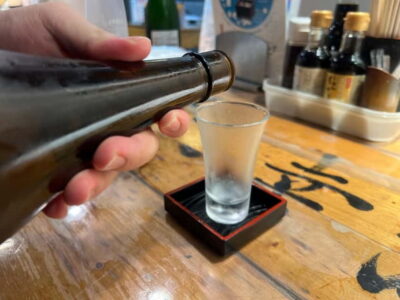
The drinks are an important part of the route. Three drinks are included, with sake among the highlights. One account specifically enjoyed a sake flight, while another praised the quality of the sake tasting. The tour may also include beer or other drinks, but the supplied details do not promise a fixed drink menu.
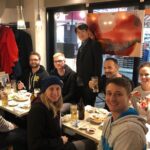
Golden Gai is also where the social side can be strongest. You can talk with fellow participants, try a drink you might not order alone, and get a small look at Tokyo’s bar culture. The trade-off is that personal space is limited, and a large group would be awkward in a tiny bar. That makes the advertised maximum of 15 people important.
The food: a broad sample rather than one long dinner
The headline number is up to 15 dishes. That sounds like a great deal, but you should read it as a tasting meal, not 15 full-size servings.
The advantage is range. In one evening you can move from grilled food to fried food, dumplings, sushi, vegetables, sweets, and sake. If you are curious about Japanese cuisine but unsure where to begin, this format lets you sample widely without committing to a full plate of one unfamiliar item.
The route also gives you useful comparisons. You can notice how a dish changes from one setting to another, or how the atmosphere affects your impression of the food. A compact izakaya course feels different from a Golden Gai drink, even when both are casual.
Several foods are specifically identified as part of the experience:
- Yakitori
- Fried tofu
- Gyoza
- Grilled vegetables
- Sushi
- Kushikatsu
- Custard-filled fish
- Japanese sake
- Craft beer
The exact order and final menu may change. The description says up to 15 dishes, so you should not assume every listed food will appear on every departure. Still, the range is broad enough to make this more than a standard sushi outing.
If you have serious dietary restrictions, ask before booking. The supplied information does not provide a detailed allergy, vegetarian, or substitution policy. Most participants can take part, but that general statement is not the same as a guarantee that every dish can be adjusted.
A few more Tokyo tours and experiences worth a look
What the guides add to the night
The guide can make or break a walking food tour. A good guide does more than point toward the next restaurant. The guide keeps the group together, explains what you are eating, helps with the social rhythm, and makes unfamiliar places feel manageable.
Ayaka receives especially warm praise for navigating Shinjuku and introducing the different areas. Naoto is praised for taking a group to four different spots with distinct atmospheres. Shun is described as adapting a private tour with extra historical stops, while Midori is praised for combining food with information about Shinjuku’s past.
Other named guides include Luna, Yuki, and Nono. The strongest descriptions share the same themes: patience, friendliness, flexibility, and care for the group. One guide was praised for adjusting the pace and checking that everyone was comfortable with the setting.
That last point is worth noting. Shinjuku can be a lot to take in, especially on a first visit. A guide who notices when people are lost or unsure can turn a confusing night into an enjoyable one.
At the same time, guide quality appears to vary. One one-star account says the guides gave little information about the area or food, while another describes a group that could not hear the guide and became separated. The overall score of 4.9 from 323 ratings is excellent, but the negative reports point to a real issue: the experience is not identical on every departure.
Is $112.75 good value?
At $112.75 per person, this is not a budget dinner. The value depends on what you want from the night.
If you only want to eat Japanese food as cheaply as possible, you can spend less by choosing individual restaurants. The tour price includes a guide, a three-hour walking route, four eateries, up to 15 dishes, and three drinks. You are also paying for access to places that may be hard to select or enter on your own.
The included drinks improve the calculation. Sake, beer, and other drinks can add noticeably to a restaurant bill, especially when you are visiting several places. The price also covers the convenience of not having to make four separate decisions about where to eat.
I think the tour is strongest value early in a Tokyo visit. You get an introduction to Shinjuku, learn which areas interest you, and may discover restaurants or bars you can revisit later. It is less compelling if you already know Shinjuku well or prefer to plan every meal yourself.
The maximum group size is listed as 15, which is reasonable for a walking and food tour. Because one poor account describes a much larger group, I would confirm the expected group size if that matters to you. A small group is much better suited to Golden Gai’s tiny bars.
Practical details that affect your evening
The meeting point is the police box at the East Exit of Shinjuku Station, at 3-chome-38-1 Shinjuku. The tour ends back at the same meeting point, which makes planning your evening simpler.
You receive a mobile ticket, and confirmation is provided when you book. The meeting point is near public transportation, though Shinjuku Station itself is famously large. Give yourself time to reach the East Exit and find the police box without rushing.
Wear shoes that are easy to remove. One restaurant requires you to take off your shoes, and this is the sort of small detail that can matter after a long day of sightseeing.
The activity lasts approximately three hours. Plan it as an evening meal, not as a quick snack before another fixed appointment. Delays can happen when a small restaurant is busy, and a relaxed pace is part of the experience.
Most people can participate, and the tour is capped at 15 according to the supplied details. Free cancellation is available if you cancel at least 24 hours before the local start time. Inside that window, the payment is not refunded and changes are not accepted.
Who should book this Shinjuku food tour?
I would recommend it to first-time visitors who want help making sense of Shinjuku at night. It is also a good match for solo visitors, couples, and anyone who enjoys trying many small dishes instead of ordering one safe meal.
You will get the most from it if you are curious, flexible, and happy to share a social evening. The route includes narrow eateries and small bars, so it is not designed around privacy or a quiet fine-dining atmosphere.
I would be more cautious if you need a precise menu, have strict food restrictions, dislike alcohol, or want a fully private experience. The food count is broad, but the final dishes and drinks are not itemized in the information provided.
Should you book it?
Book this tour if you want an easy, food-led introduction to Shinjuku and value access to four local-style eateries more than absolute control over the menu. The combination of Omoide Yokocho, Kabukicho, Golden Gai, 15 dishes, and three drinks gives you a lot to experience in three hours.
The main thing to check is group size. The advertised limit of 15 is suitable for the route, but one very poor account raises concerns about oversized groups and weak navigation on a particular departure. If you confirm a small group and receive a guide with the warmth and care praised in accounts about Ayaka, Naoto, Shun, Midori, Luna, Yuki, or Nono, this should be a memorable way to begin your Shinjuku nights.
FAQ
How long does the Shinjuku food tour last?
The experience lasts approximately three hours.
How many eateries are included?
The tour visits four eateries across Omoide Yokocho, Kabukicho, and Shinjuku Golden Gai.
How many dishes are included?
Up to 15 Japanese dishes are included. The food can include gyoza, yakitori, sushi, kushikatsu, grilled vegetables, fried tofu, and custard-filled fish.
How many drinks are included?
Three drinks are included. Sake is part of the experience, and some sessions include a sake flight. Craft beer is also listed among the possible drinks.
Where does the tour meet?
The meeting point is the Shinjuku Station East Exit Police Box at 3-chome-38-1 Shinjuku, Shinjuku City, Tokyo 160-0022, Japan.
Where does the tour end?
The activity ends back at the meeting point.
What is the maximum group size?
The stated maximum is 15 participants.
Do I need to remove my shoes?
Yes, at least one restaurant on the route requires you to remove your shoes.
Can I cancel for a refund?
You can receive a full refund if you cancel at least 24 hours before the experience start time. Cancellations or changes made within 24 hours are not accepted and are not refunded.
More Food Experiences in Tokyo
More Tokyo Food Tours in Tokyo
More Shinjuku Tours in Tokyo
More tours in Tokyo we've reviewed












Tokyo Food Tours, compared.
 ★ 5.0Tokyo: Shinjuku Food Tour (13 Dishes at 4 Local Eateries)From $86
 ★ 4.9Tokyo: Shinjuku Food Tour (13 Dishes and 4 Eateries)From $97
 ★ 5.0Tokyo Night Foodie Tour in Shinjuku – Seasonal Sushi, Wagyu BeefFrom $111
 ★ 5.0Eat and Drink Like a Local: Tokyo Ueno Food Tour-Taverns&RamenFrom $95
 ★ 5.0Tokyo: Shibuya Food Tour (13 dishes and 4 Eateries)From $77
Tokyo: Shinjuku Food Tour – 15 Dishes, 3 Drinks, 4 EateriesFrom $723 hours
★ 5.0Tokyo: Shibuya Food Tour (13 dishes and 4 Eateries)From $77
Tokyo: Shinjuku Food Tour – 15 Dishes, 3 Drinks, 4 EateriesFrom $723 hours