Reviewed · CRAFT WORKSHOPS
Calligraphy & print your calligraphy on a T-shirt.
Your brushwork becomes a wearable souvenir in this hands-on Japanese calligraphy class. You learn how characters developed, make ink from water and a Sumi ink stick, then print your chosen design on a T-shirt.
In This Article
- Key points at a glance
- Turning brushwork into a T-shirt souvenir
- Finding the red brick building
- A short lesson in Japanese characters
- Making ink with a Sumi stick and inkstone
- Thirty minutes of practice on thin paper
- Choosing the design and its position
- Green tea, a postcard, and a short wait
- Why Mana’s teaching matters
- The class pace and what it is not
- Fitting it into a day in Asakusa
- Is $48 a fair price?
- Who should book this calligraphy class?
- Should you book it?
- FAQ
- Where does the calligraphy and T-shirt activity take place?
- How long does the activity last?
- Is the class taught in English?
- What is included in the price?
- What should I wear?
- When will the printed T-shirt be ready?
I like the patient teaching and the useful souvenir: you get real practice before committing your design to clothing. I also like the calm pause for green tea and postcard writing, which gives the class a pleasant cultural rhythm.
The main thing to consider is the short timetable. You have about 30 minutes to practice, and the full session lasts only 60 to 90 minutes, so this is an introduction rather than a full calligraphy course. Wear clothes you do not mind getting ink on.
Key points at a glance
- Make your own Sumi ink: Grind an ink stick with water on a traditional inkstone before writing.
- Practice before printing: Work on thin paper with a Fude brush and receive guidance from an English-speaking instructor.
- Take home a wearable souvenir: Choose a design and placement, then collect your printed T-shirt after about 10 minutes.
- Meet Mana, the instructor: Her patient, flexible teaching suits first-timers, families, and curious older children.
- Enjoy a slower cultural break: Green tea and postcard writing add a quiet finish to the brushwork.
- Allow time around the class: The red brick meeting building is on the third floor, and your shirt needs about 10 minutes for printing.
Turning brushwork into a T-shirt souvenir
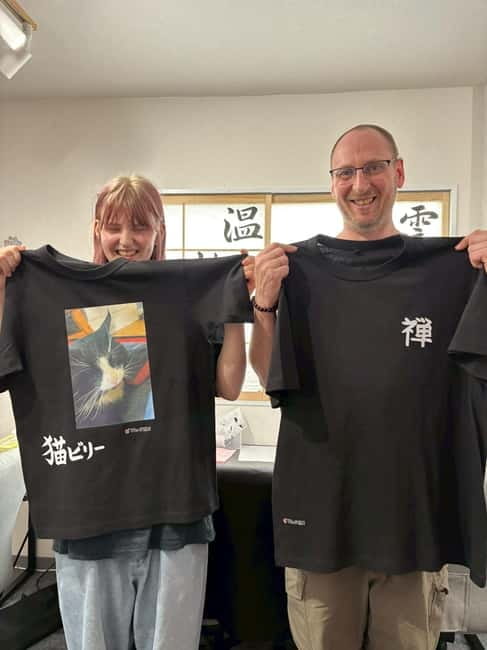
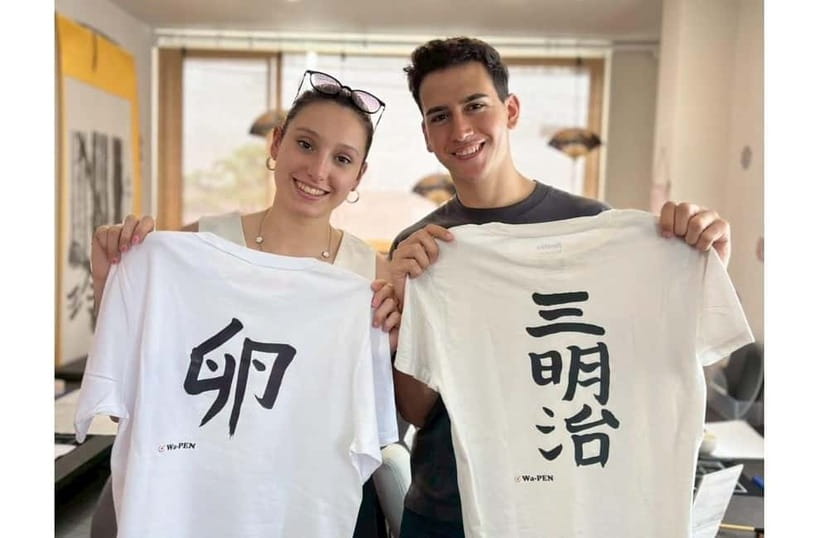
Many Japan souvenirs are bought in a shop and packed into your suitcase. This experience gives you something more personal: your own calligraphy design, printed on clothing after you have practiced making it by hand.
That order matters. You do not simply select a Kanji character and watch someone else do the work. You first learn how the writing tool behaves, make your ink, copy designs on thin paper, and receive corrections. The final T-shirt is still a souvenir, but it carries some of your own effort.
The session takes place in Honshu and is taught in English. The instructor is Mana, and the class introduces both the physical craft and the cultural background of Japanese characters. You do not need to arrive with calligraphy experience. The activity is designed to take you from a first brushstroke to a finished piece of clothing in one sitting.
At $48 per person, this is not the cheapest way to buy a T-shirt in Japan. The value comes from the guided lesson, the traditional materials, the green tea, the postcard, and the custom printing. If you want only inexpensive clothing, shop elsewhere. If you want an activity and a keepsake in one, the price is easier to justify.
A few more Tokyo tours and experiences worth a look

Finding the red brick building
The meeting point is a red brick building. Look for the sign on the first floor, where a restaurant is located, then take the stairs to the right of the restaurant to reach the third floor.
This is the sort of arrival detail worth taking seriously. Give yourself at least 10 minutes before the scheduled start so you can find the entrance, climb upstairs, and settle in before the ink and paper come out. The supplied information does not identify a station or a travel route, so check the exact meeting point on your booking confirmation before setting off.
Comfortable clothes are best. Ink is part of the activity, and you are specifically advised to wear something you do not mind getting stained. Bring the same attitude you would bring to a pottery class: focus on the work, not on keeping your sleeves perfectly clean.
A short lesson in Japanese characters
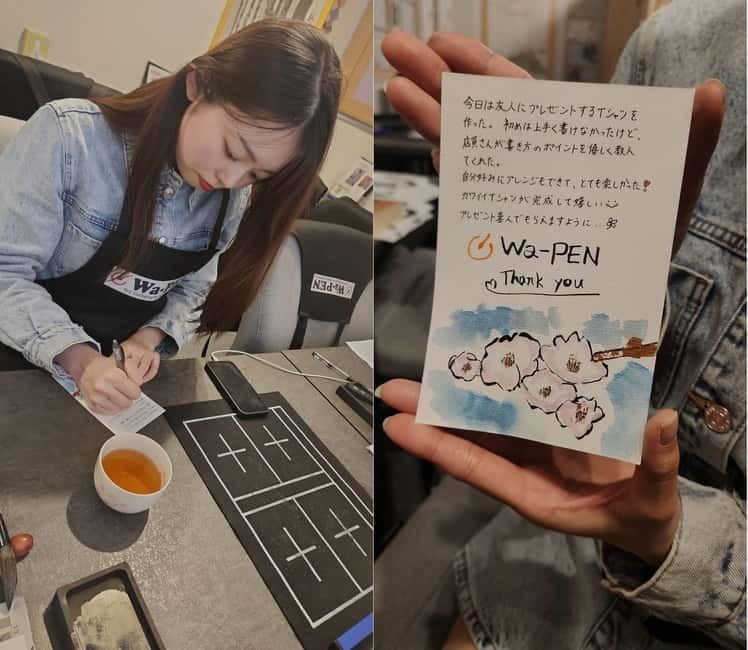
Mana begins with the background of Japanese writing and culture. This opening gives the brushwork a purpose. You are not simply tracing attractive symbols without context, and you get a basic explanation of what you are practicing before putting ink on paper.
The class is an introduction, not an academic lecture. That suits the format. With only 60 to 90 minutes available, the useful goal is to understand the role of the characters, learn the basic handling of the tools, and create something you can use or display.
I especially like this part for people who have seen Japanese calligraphy in temples, shops, signs, or artwork but have never tried it. A short explanation helps you look at those characters differently for the rest of your trip.
Making ink with a Sumi stick and inkstone
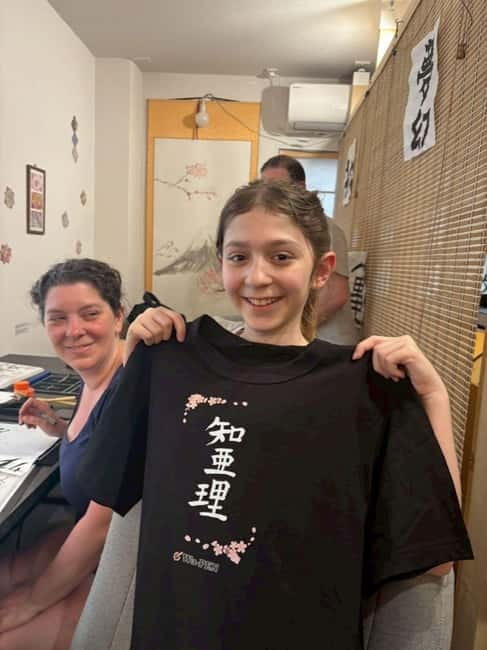
One of the most unusual parts of the class is making your own ink. You use water and a Sumi ink stick on an inkstone, rather than starting with a ready-made bottle of liquid ink.
This slows the activity down in a good way. You get a direct connection with the materials before the writing begins. The process also helps explain why the ink has the look and feel it does, instead of treating it as just another supply on a table.
All the required materials are provided:
- Fude brush, the Japanese calligraphy pen
- Thin practice paper
- Sumi ink stick
- Inkstone
- Paper-stopper
- Under pad
- T-shirt
- Postcard
- Green tea
You will be shown how to use the Fude and traditional ink. The under pad and paper-stopper help set up a proper writing surface, which is useful for a beginner who has no idea how to arrange a calligraphy table.
Thirty minutes of practice on thin paper
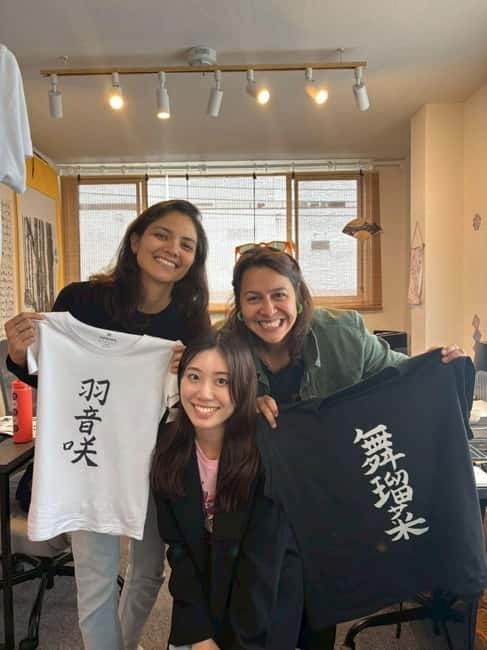
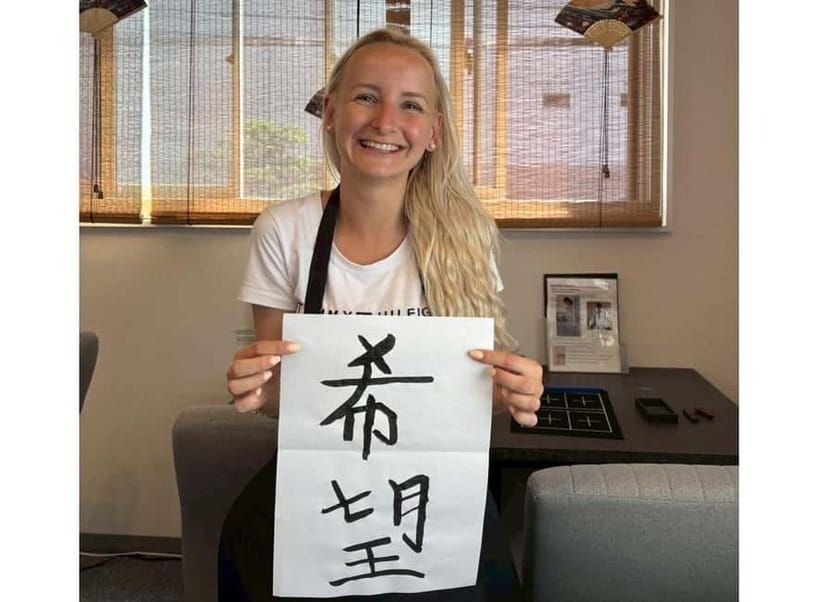
The main working period lasts about 30 minutes. You practice on thin paper while Mana guides you through the strokes and helps you adjust your technique.
This is where the class earns much of its value. A printed character can look simple, but brush pressure, speed, and the order of the strokes all affect the result. You get time to try, make uneven marks, and improve before choosing the design that will go on your shirt.
Past participants have found Mana generous with practice time and pointers. That is important because beginners need permission to make imperfect marks. One class member said the first stage of copying Kanji stencils was especially memorable, and that is a good description of what you are doing: learning through repeated attempts rather than chasing a perfect first try.
Do not expect to produce museum-quality calligraphy in half an hour. The better way to judge the lesson is by how much you learn about the brush and how confidently you can make a design of your own. The finished shirt is meant to be a personal souvenir, not a professional artwork.






Choosing the design and its position
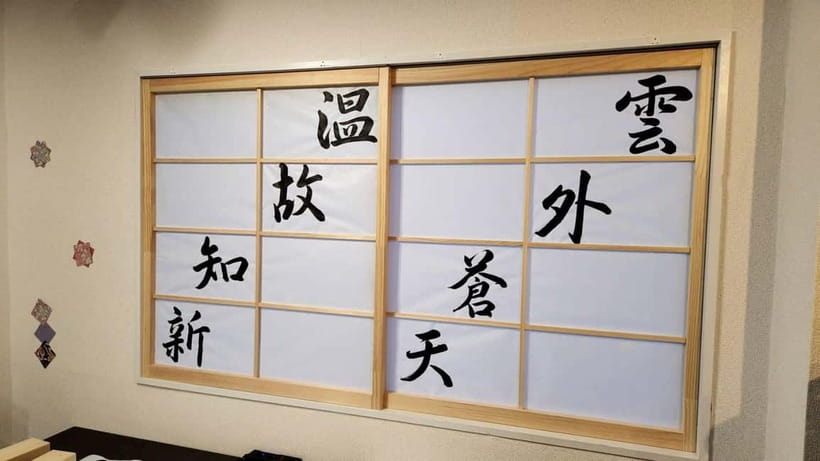
After practicing, you select your favorite design and decide where it should be printed on the clothing. This choice gives you control over the final souvenir.
The provided T-shirt is included in the $48 price. One person was also allowed to use a shirt brought from home, but you should confirm that option before relying on it. The standard arrangement is the supplied T-shirt, which keeps the activity simple and avoids the risk of bringing a fabric that may not work with the printing process.
Think about placement before you decide. A front design is easy to show, while another position may create a quieter, more personal look. The important point is that you are not handed a fixed product at the end. You choose both the design and where it goes.
This is also the moment when your practice matters. You have already worked with the characters on paper, so the final selection is based on something you have tried rather than a random design picked at the beginning.
Green tea, a postcard, and a short wait
Once your design is chosen, the clothing takes about 10 minutes to print. During that wait, you enjoy a cup of green tea and write a postcard to take home.
That pause makes the class feel less rushed. You have just finished concentrating on brush strokes, and the postcard gives you a simple way to record the experience while it is fresh. It also adds another physical souvenir besides the shirt.
The postcard is included, as is the tea. The activity does not give you a long break, but 10 minutes is enough to relax, finish your writing, and wait for the clothing to be ready.
The printed T-shirt should be ready to take home after the class. If you have a busy schedule, this timing is useful because you are not waiting for a later delivery. One family even received their creations through personal delivery when they were ready, but that was a special courtesy from Mana, not something you should assume is part of every booking.
Why Mana’s teaching matters
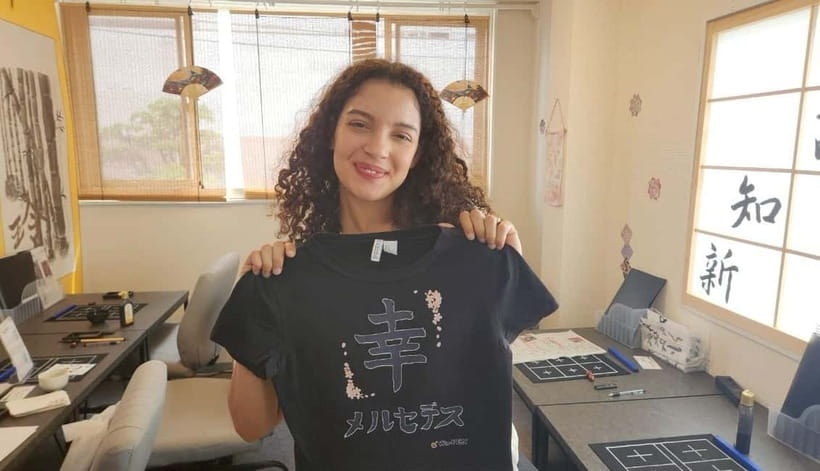
A craft class can be difficult if the instructor moves too quickly or treats beginners as if they already understand the tools. Mana’s approach appears particularly well suited to first-timers. She has been described as patient, kind, generous with pointers, and able to keep children involved.
That makes this a good choice for families with older children. Two children, aged 10 and 14, were kept engaged during the session. The class is not labeled as a private lesson, and you may share it with other participants. Still, one family happened to be alone in its session, so the atmosphere can sometimes feel more personal than the booking type suggests.
Mana has also shown some flexibility by offering an additional fan calligraphy activity for a small extra fee in one session. Treat that as an optional possibility rather than a guaranteed part of this class. The standard experience is focused on calligraphy, postcard writing, and T-shirt printing.
The instructor teaches in English, which removes a major barrier for visitors who cannot read Japanese instructions. You can ask questions as you work and receive help with the practical details of the brush, ink, and design.
The class pace and what it is not
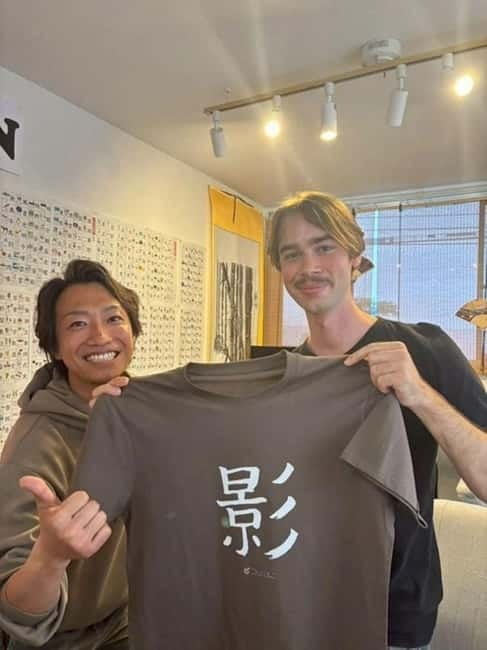
The advertised duration is 1 to 1.5 hours. That is enough time for an introduction and a finished souvenir, but it leaves little room for long explanations or repeated design changes.
I would book this if you want a compact cultural activity that fits into a sightseeing day. I would not book it if your main goal is serious study of Shodo, the traditional art of Japanese calligraphy. For that, you would need a longer course with more sustained practice.
The pace is also worth considering if you have young children. The activity worked well for children aged 10 and 14, but the supplied information does not give a minimum age. Children need to be comfortable sitting, listening, handling ink, and practicing for part of the session.
The short format is one of the strengths for many people. You get a real introduction without spending half a day indoors. The tradeoff is that you will leave with a beginning-level understanding, not mastery.
Fitting it into a day in Asakusa
One useful way to plan this is to schedule the class in the morning and use the waiting period, or the time around it, to explore Asakusa. The T-shirt takes about 10 minutes to print, so you will not need to give up a whole afternoon for the finished item.
Keep your schedule a little open around the start and end. Arriving early is required, and the total duration can run toward 90 minutes. If you have a timed train, meal, or attraction immediately afterward, allow extra room rather than treating the one-hour estimate as exact.
The activity is also a good contrast to a day of temples and shopping. You are still learning about Japanese culture, but through your hands rather than by standing in front of another display. That change of pace can be welcome during a busy Japan visit.
Is $48 a fair price?
The answer depends on what you count as the product. If you compare the price with a basic T-shirt, it is high. If you compare it with a guided cultural workshop that includes all materials, instruction, green tea, a postcard, and custom printing, it is reasonable.
You receive more than one finished object. The shirt is the main souvenir, while the postcard records the moment and the calligraphy practice gives you a skill you can continue at home. One participant said the class inspired continued Shodo practice, which is a sign that the lesson can have value beyond the printed clothing.
The personal guidance is the key part of the price. You are not paying only for ink and fabric. You are paying for an English-speaking teacher to explain the background, prepare the materials, guide your strokes, and help you choose a design.
Free cancellation is available up to 24 hours before the activity for a full refund. You can also reserve and pay later, which helps if your Japan schedule is still changing.
Who should book this calligraphy class?
I would recommend it to first-time visitors who want a souvenir with a story attached. It also suits couples, families with older children, and solo visitors who enjoy making things rather than only photographing them.
It is a particularly good fit if you like small creative projects, Japanese culture, or practical souvenirs that you can use. The lightweight T-shirt is easy to pack, and the postcard takes almost no luggage space.
You may want to skip it if you dislike the possibility of ink on your clothes, want a long formal lesson, or have no time to arrive early and wait for printing. The class also may not satisfy someone seeking a detailed study of every Japanese writing system.
Should you book it?
Book this class if you want an approachable introduction to Japanese calligraphy and a T-shirt that reflects your own choices. Mana’s patient instruction, the traditional ink-making step, and the chance to practice before printing make the $48 price more than a simple clothing purchase.
Plan for 60 to 90 minutes, arrive 10 minutes early, wear casual clothes, and keep a little flexibility around the end. If you want a calm, hands-on break from sightseeing in the Asakusa area, this is a strong pick. If you want advanced calligraphy training, choose a longer course instead.
FAQ
Where does the calligraphy and T-shirt activity take place?
It takes place in Honshu, Japan, inside a red brick building. The class is on the third floor, with a sign on the first floor. Go up the stairs to the right of the restaurant.
How long does the activity last?
The activity lasts between 1 hour and 90 minutes. The exact starting times depend on availability.
Is the class taught in English?
Yes. The instructor teaches in English, and the activity includes guidance on Japanese writing, calligraphy tools, and cultural background.
What is included in the price?
The $48 price includes expert instruction, the Fude brush, paper, Sumi ink, inkstone, paper-stopper, under pad, a T-shirt, a postcard, and green tea.
What should I wear?
Wear comfortable clothing that you do not mind getting ink on. Ink is used during the practice and calligraphy work.
When will the printed T-shirt be ready?
Your clothing should be ready to take home after about 10 minutes of printing. During that wait, you can enjoy green tea and write the included postcard.
More Craft Workshops in Tokyo

More tours in Tokyo we've reviewed







Craft Workshops, compared.
 ★ 4.8Chopstick Making Workshop in GinzaFrom $251 hour
 ★ 5.0Kintsugi Experience: Art of Golden Joinery in TokyoFrom $59
Tokyo: Shinjuku Chopstick Making ClassFrom $121 hour
★ 5.0Kintsugi Experience: Art of Golden Joinery in TokyoFrom $59
Tokyo: Shinjuku Chopstick Making ClassFrom $121 hour
 ★ 5.0Private Craft Your Own Ring Handmade Experience in Asakusa, TokyoFrom $21
 ★ 5.0Authentic Pure Gold Kintsugi Workshop with Master Taku in TokyoFrom $142
 ★ 5.0Tokyo: Calligraphy on Kanji Fan & Scroll with DrinkFrom $531h 20m