Reviewed · ASAKUSA TOURS
【Tokyo/Asakusa】Traditional Japanese Washi Papermaking experience
Tosa Washi turns a short Asakusa workshop into something you can hold in your hand. At Watashino, you watch a brief film about this 1,000-year-old craft, put on traditional samue workwear, and make four postcards from Japanese paper fibers.
In This Article
- Key points about the Asakusa washi workshop
- Making paper in the middle of Asakusa
- A short lesson on Tosa Washi
- Put on samue and start the hands-on work
- The Plain Paper Plan: four simple postcards
- The Colored Paper Plan: add four Rakusuishi designs
- Why the small group makes a difference
- The drying pause and the one-hour schedule
- Is $31.18 fair for the experience?
- Who will enjoy this most?
- Planning your visit to Watashino
- My advice on choosing a plan
- Should you book this Asakusa washi experience?
- FAQ
- Where does the washi papermaking experience take place?
- How long does the workshop last?
- How many people can join each workshop?
- What do I make during the activity?
- Do I wear traditional Japanese clothing?
- Is the experience suitable for beginners?
- Is the shop near public transportation?
- What happens if I need to cancel?
I like the small groups, capped at eight, because the instructor can guide each person through the work. I also like the useful souvenir: your finished postcards are made by you, not pulled from a shop shelf. The main drawback is the price, $31.18 per person, which may feel high for an activity lasting about an hour, especially when part of the time can be spent waiting for the paper to dry.
Key points about the Asakusa washi workshop
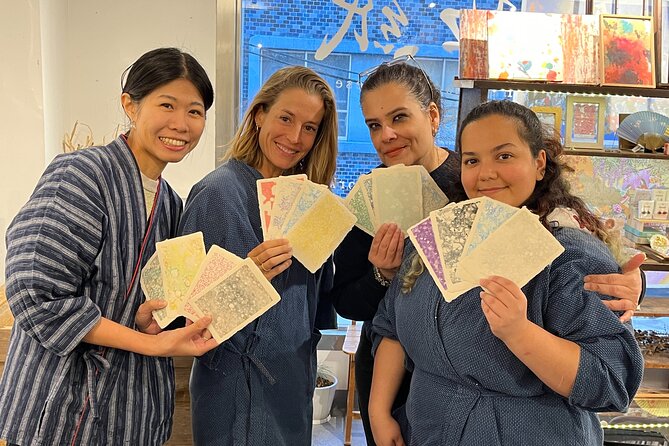
- Four postcards made by hand: Both plans include four plain washi postcards to take home.
- Optional Rakusuishi decoration: The Colored Paper Plan adds lace-like decorative paper in four colors you choose.
- Small class size: Workshops are limited to eight people, allowing for direct help.
- Traditional Japanese setting: The shop is on Asakusa Kannon Street, a handy location for pairing with sightseeing.
- Friendly English guidance: The instructors explain the process and help you handle the tools and paper.
- Short, family-friendly format: The one-hour session suits families, couples, craft fans, and visitors with a packed Tokyo schedule.
Making paper in the middle of Asakusa
Watashino is at 1-chome 32, Asakusa, on the second floor of a handmade Japanese paper goods shop along Asakusa Kannon Street. The activity begins and ends at this same point, so you do not need to manage transport between separate parts of the workshop.
That location matters. You can fit the session into a morning or afternoon around Asakusa sights, rather than giving up half a day for a remote craft village. The workshop itself is compact, with room for no more than eight people at a time. That is a useful limit for a hands-on class. You are not simply watching a demonstration from the back of a large room.
The shop does not have a restroom, so plan ahead before you arrive. The location is near public transportation, and most people can take part. Service animals are allowed.
A few more Asakusa tours and experiences worth a look
A short lesson on Tosa Washi
The class starts with a short video about Tosa Washi, including its background and how it is made. Tosa Washi comes from Tosa, the historic name for Kochi Prefecture, and is recognized as one of Japan’s top three types of washi.
You will learn why the paper is prized for its strength and warm feel. The opening lesson also gives meaning to the physical work that follows. Without this context, scooping paper pulp can seem like a simple craft exercise. With it, you begin to see the connection between plant fibers, water, patience, and the finished sheet.
The introduction also covers the early stages of papermaking, including the use of mulberry bark. One of the most useful parts of the explanation is seeing how a plant becomes a smooth, flexible sheet. The process links the finished postcard to a long chain of skilled work, rather than treating paper as a disposable everyday object.
The video is short, which keeps the workshop moving. You will not sit through a long lecture before making anything. The class gives you just enough background to understand what your hands are doing.
Put on samue and start the hands-on work
Before making the postcards, you put on samue, traditional Japanese work clothes. This is a small touch, but it changes the mood of the session. You are not just standing beside a craft table in ordinary sightseeing clothes. You get a simple sense of the clothing used for practical work in Japan.
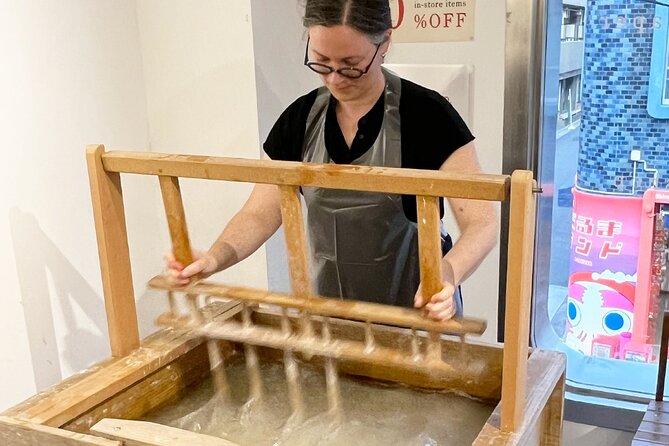
The instructor then guides you through the papermaking steps. The teaching style is friendly and patient, with help available as you work. The instructors named in the feedback include Kazu and Kenzo, and the experience is designed to work for people with no previous paper-making skills.
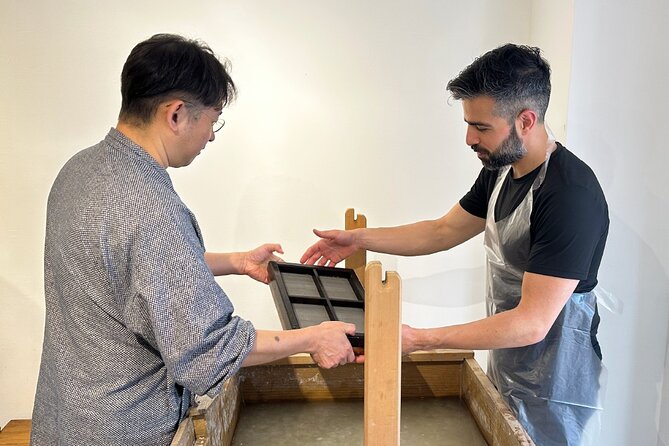
The hands-on part is the reason to book this rather than simply buying washi at the shop. You make the paper yourself, with the instructor showing you how to handle the materials and tools. The method combines old techniques with some newer tools, giving you a glimpse of how traditional craft can be taught in a modern city shop.
You should expect a simple creative activity, not a full apprenticeship. The workshop compresses a complex craft into about an hour. That makes it accessible, but it also means you will not cover every stage of commercial washi production in detail.
The Plain Paper Plan: four simple postcards
The Plain Paper Plan includes four plain postcards. You make each one under the instructor’s direction, then wait for the sheets to dry before taking them home.
The repeated practice is useful. Your first attempt may feel unfamiliar, but by the next sheet you have a better sense of the movement and the amount of material needed. Four postcards also give you enough pieces to keep one, share some with family, or use them as small gifts.
Plain does not mean ordinary. The appeal is the surface and texture of handmade paper itself. Tosa Washi is known for being strong, and the finished pieces have a feel that differs from mass-produced stationery. You can see small variations because the sheets are made by hand.
This plan is the better choice if you want the core craft at the lowest available price. It also keeps the activity focused. If your children, partner, or friends prefer making things over decorating them, four plain postcards provide plenty to do in a short session.
The Colored Paper Plan: add four Rakusuishi designs
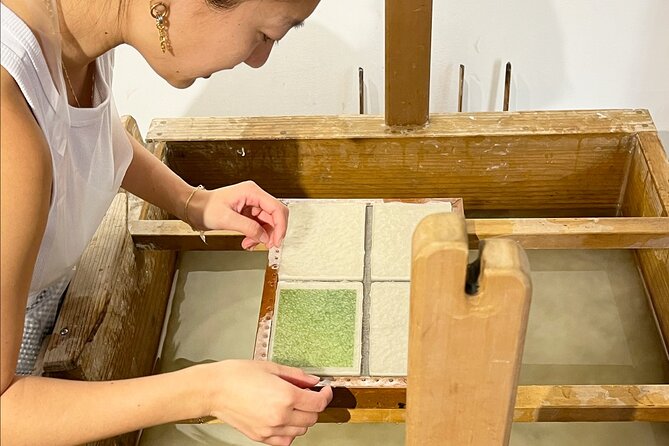
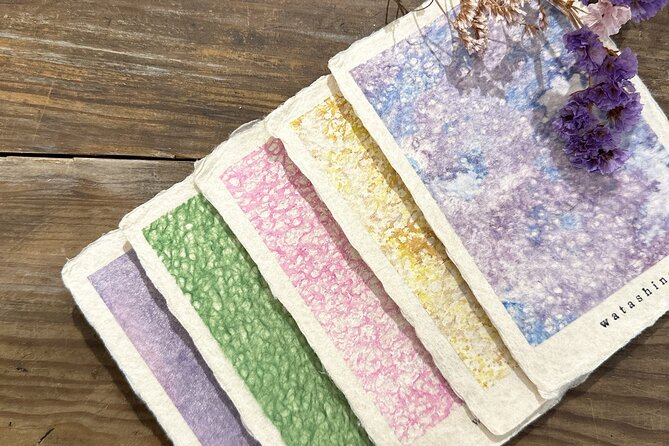
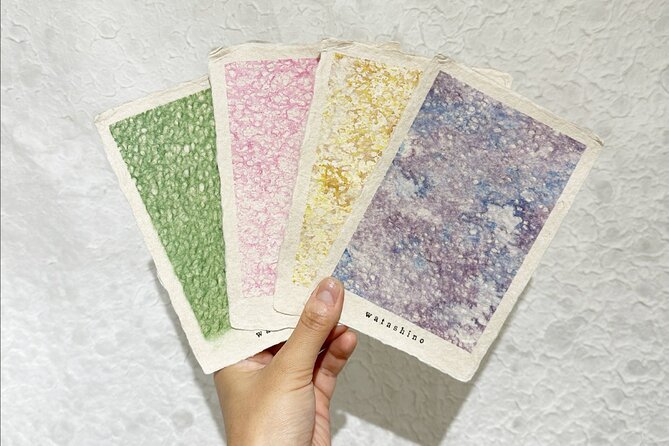
The Colored Paper Plan includes the same four plain postcards, then adds a decorative step. You layer Rakusuishi on top of the paper. Rakusuishi is a delicate, lace-like decorative washi that gives each postcard more visual detail.
You choose four colors, allowing each postcard to look different. This option suits anyone who enjoys design, color, or making a more personal souvenir. It may also be a good pick for families who want a little more choice during the activity.
The colored plan costs extra, according to the available booking information and feedback. The surcharge is described as small, but the exact amount is not provided here, so check the price shown when you book. I would choose it if the decorative paper is a major reason you are interested in washi. If your main goal is to understand the basic process, the plain option may offer better value.
The extra decoration also makes the finished postcards feel more gift-ready. Still, the charm of washi comes from the handmade sheet underneath, so you are not missing the central experience by choosing plain paper.


Why the small group makes a difference
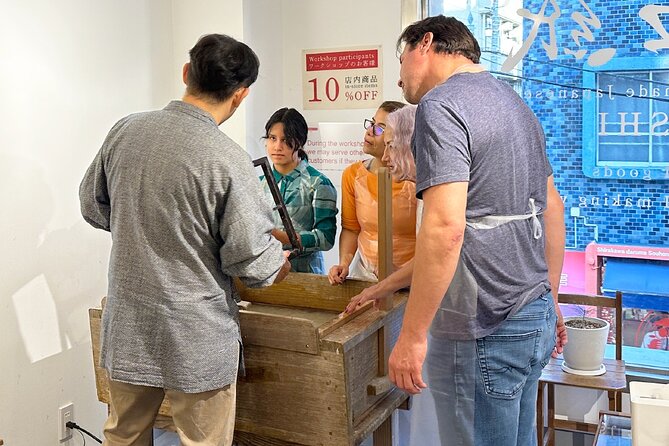
A maximum of eight people is one of the strongest features of this class. Papermaking involves wet materials, tools, and several small movements that are easier to understand when the instructor can watch what you are doing.
In a large class, you might spend more time waiting for help or watching someone else work. Here, the format is intended to give everyone time to create their own paper. That makes the session more personal and reduces the chance that you will leave feeling like you only observed a demonstration.
The instructors are described as friendly, patient, and encouraging. They answer questions about both technique and the background of the craft. English guidance is available, which helps if you want to understand the process rather than simply copy a movement.
The class is also forgiving for beginners. You do not need to arrive with an artistic background. The point is to try the method, learn how the fibers behave, and enjoy the surprise of seeing a sheet form.
The drying pause and the one-hour schedule
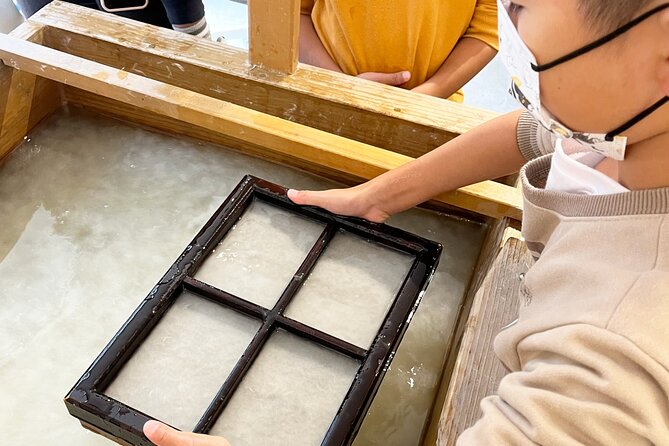
The advertised duration is about one hour. Most sessions fit into a short sightseeing plan, but you should understand what that hour includes. After forming the paper, the pieces need time to dry. One account describes roughly 15 minutes of waiting during a shorter-than-expected session.
That pause is part of the craft, but it can feel slow if nothing is happening. The provider has acknowledged that the drying period can be unavoidable and that explanations during this wait could be improved. I would treat this as a practical consideration, especially if you are booking the activity for restless young children.
The short duration remains a benefit for most people. You can learn the basic process, make four pieces, and finish without committing a full morning. Just avoid scheduling a tight appointment immediately afterward. You must arrive on time, and arriving more than 10 minutes late may mean you cannot participate.
Is $31.18 fair for the experience?
At $31.18 per person, this is not a bargain souvenir activity. You are paying for instruction, materials, a small class, traditional clothing, and the chance to make four postcards. You are also paying for the setting and the time of an instructor who guides you through a craft that would be difficult to reproduce on your own in Tokyo.
The value improves if you care about Japanese culture, handmade goods, or a personal keepsake. The postcards are not merely something you receive. You take part in making them, and that gives them a story you can remember later.
The value is less clear if you want a long workshop or a large finished product. The class is short, and part of the time may involve drying. One family found the cost a little high for a simple activity, and that is a fair concern.
I would compare it with the cost of buying a high-quality handmade paper item in Asakusa. If you would happily spend money on Japanese stationery, the workshop adds an experience to the purchase. If you are counting every yen and mainly want a low-cost activity, you may prefer to browse the shop instead.
Who will enjoy this most?
I think the workshop works best for people who want a calm, creative break from temple visits, shopping, and crowded city streets. The process is hands-on but not physically demanding, and the finished postcards give you a compact souvenir that fits easily in your luggage.
Families are a good match. Several teenagers can each make their own paper, choose colors in the colored plan, and take home something personal. The activity is also short enough for children who may not manage a long museum visit.
Couples and solo visitors can enjoy it for the same reason. You get a shared task, but you are not competing or performing. The work has a quiet, steady quality, and the drying period can provide a natural pause.
Craft fans will get the most from the background on mulberry fibers, traditional methods, and the use of both older and newer tools. If you already make paper, you may find the workshop introductory rather than advanced. It is made for first-time participants.
Planning your visit to Watashino
Book a session that leaves room around it. The workshop lasts about an hour, but you should allow extra time for finding the second-floor shop, changing into samue, and finishing the paper. Arrive at least 10 minutes early if possible, since late arrival may prevent participation.
The meeting point is Watashino, Handmade Japanese Paper Goods and Papermaking Experience, at 111-0032 Tokyo, Taito City, Asakusa, 1-chome 32, 2F. The experience ends there as well.
A mobile ticket is provided, which is convenient if you are already using your phone for Tokyo transport and sightseeing. Confirmation is received when you book. Free cancellation is available if you cancel at least 24 hours before the local start time. Cancellations or changes made later are not accepted for a refund.
Wear something comfortable. You will be given samue for the activity, but the work involves paper materials and water, so practical clothing makes sense. The shop has no restroom, so use one before you arrive.
My advice on choosing a plan
Choose the Plain Paper Plan if you want the clearest introduction to the craft and four handmade postcards without an added decorative charge. It is also the sensible option for anyone unsure whether the activity will hold their interest.
Choose the Colored Paper Plan if you like making visual choices and want to add four colors of Rakusuishi. The lace-like decorative washi gives the postcards a more finished design, but remember that it costs extra.
I would not book this expecting a large, polished art project. The result is a set of small postcards, and handmade paper naturally has variation. That variation is part of the appeal, but it means your pieces may not look perfectly uniform.
Should you book this Asakusa washi experience?
Book it if you want a personal Japanese souvenir, enjoy making things, or need a one-hour cultural activity near Asakusa. The small group, friendly instruction, traditional clothing, and four finished postcards give the class more substance than a quick shop visit.
Think twice if $31.18 feels steep for a short activity, if you dislike waiting for materials to dry, or if you want an advanced craft lesson. For most people who value an authentic, hands-on memory over a cheap purchase, Watashino offers a worthwhile slice of Japanese paper culture in a manageable format.
FAQ
Where does the washi papermaking experience take place?
The workshop takes place at Watashino, Handmade Japanese Paper Goods and Papermaking Experience, on the second floor at 1-chome 32, Asakusa, Taito City, Tokyo 111-0032.
How long does the workshop last?
The activity lasts approximately one hour.
How many people can join each workshop?
Each workshop has a maximum of eight participants.
What do I make during the activity?
You make four plain washi postcards in both available plans. The Colored Paper Plan adds Rakusuishi decoration in four colors of your choice.
Do I wear traditional Japanese clothing?
Yes. Participants wear samue, traditional Japanese work clothes, during the papermaking activity.
Is the experience suitable for beginners?
Yes. Most people can participate, and the instructor provides guidance throughout the process.
Is the shop near public transportation?
Yes. The shop is near public transportation and is located on Asakusa Kannon Street.
What happens if I need to cancel?
You can receive a full refund if you cancel at least 24 hours before the experience start time. Cancellations or changes made less than 24 hours in advance are not accepted for a refund.
More Asakusa Tours in Asakusa

More tours in Asakusa we've reviewed


Asakusa Tours, compared.
 ★ 4.8Tokyo: Japanese Dance Cabaret Theater Asakusa-Kaguwa TicketFrom $492 hours
 ★ 4.7Tokyo: Meiji Shrine, Asakusa, Skytree Bus Tour and CruiseFrom $12210 hours
 ★ 4.9Tokyo: Roll and Authentic Sushi Making Class in AsakusaFrom $581h 40m
 ★ 4.8Tokyo: Asakusa Walking Tour with Sensoji Temple VisitFrom $222 hours
 ★ 5.0Tokyo Asakusa Rickshaw TourFrom $42
 ★ 4.5Tokyo Panoramic 1 Day: Meiji Shrine, Asakusa, Odaiba and SKYTREE®From $85