Reviewed · GO-KARTS
Official Japan Go-Kart Through Tokyo Bay / Ginza (IDP Required)
Tokyo is a city made for trains and walking, so seeing it from a small go-kart is wonderfully odd. You roll through Ginza, Asakusa, Akihabara, and the Tokyo Bay area on public roads, with the city passing at eye level rather than through a coach window.
In This Article
- What this Tokyo go-kart tour is really like
- The documents you must get right
- Costumes, karts, and the first safety briefing
- Toyosu and the Tokyo Bay start
- Ginza, Tokyo’s polished center
- Nihonbashi and the old road center
- Akihabara and Ueno on the same run
- Asakusa and the Tokyo Skytree view
- Driving after sunset
- Safety, group size, and comfort
- Who will enjoy it most
- Booking advice and cancellation terms
- Should you book JAPANKART?
- FAQ
- How long does the Tokyo go-kart experience last?
- Where does the tour start and finish?
- What driving documents do I need?
- Are 1968 Vienna Convention permits accepted?
- Is there an exception for certain nationalities?
- What should I wear?
- What happens if bad weather cancels the experience?
I like two things in particular: the route covers a wide sweep of East Tokyo, and the lead and follow vans help keep the group together. The supplied costumes and tour photos add a playful touch. The main catch is serious: you need the correct International Driving Permit, and arriving without it can mean losing your payment.
- A broad East Tokyo route: See Toyosu, Ginza, Nihonbashi, Akihabara, Ueno, Asakusa, and Tokyo Skytree in one outing.
- A proper road-safety briefing: You receive instructions on kart operation and Japanese road rules before setting off.
- Lead and follow vehicles: Guide vans help the group handle traffic, turns, and traffic lights.
- Costumes and photos included: Choose a costume before the drive and receive tour photos afterward.
- A short photo stop: The route includes a rest break, including a popular view near the Rainbow Bridge.
- Strict driving documents: Most participants need a 1949 Geneva Convention IDP, home-country license, and passport.
What this Tokyo go-kart tour is really like
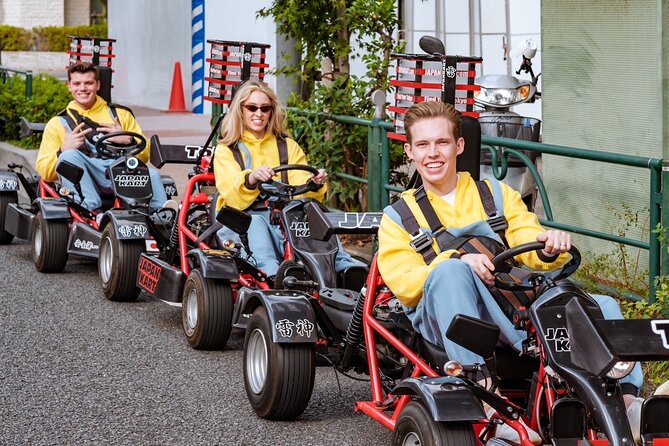
This is not a sightseeing tour with a running commentary. Once you leave the shop, the focus is driving. You follow the guide vehicle through Tokyo streets, obey traffic signals, and keep pace with the group.
That distinction matters. If you want a guide explaining temples, department stores, and city history at every turn, choose a walking tour or bus tour. If you want a memorable way to move through Tokyo, this experience offers something a conventional tour cannot.
The drive lasts about two and a half hours, though the actual time on the road can vary. You will stop for a rest and photos, and the group may pause at traffic lights or regroup after an intersection. The maximum group size is 20, but the exact number of karts depends on availability.
You return to the starting point at JapanKart, 2-chōme-18-15 Azumabashi, Sumida City. Plan to arrive 15 minutes early. The operator can wait no more than 10 minutes after the reserved time, so a delayed train or a hard-to-find address can become an expensive problem.
The documents you must get right
This is the most important part of the booking. You must present your home-country driving license and an International Driving Permit, along with your passport.
The IDP must be issued under the 1949 Geneva Convention. It must be a booklet, not a paper printout or A4 document. A permit issued under the 1968 Vienna Convention is not accepted in Japan.
The permit must also come from an approved issuer in your country. Common examples include AAA or AATA in the United States, AAA in Australia, AA or RAC in the United Kingdom, and CAA in Canada.
There is an exception for licenses from Switzerland, Germany, France, Taiwan, Belgium, and Monaco. In those cases, you need your original driving license and a Japanese translation issued by the Japan Automobile Federation, also called JAF. Do not assume that an ordinary international license translation will be enough.
I would check this before paying. Several unhappy customers arrived without the required permit and were refused participation. The operator’s policy places responsibility on you, and the payment is not refunded if your documents are wrong. Watch the instructional video sent with your confirmation, too.
A few more Tokyo tours and experiences worth a look

Costumes, karts, and the first safety briefing
The $85.89 price includes the go-kart, fuel, costume, and photos. For Tokyo, that is a fair price if you value the unusual part of the experience rather than simply counting sightseeing stops.
You are not paying for a private car, a museum admission, or a long guided talk. You are paying for the kart, staff support, fuel, route management, and a chance to drive on Tokyo’s public roads. The included photos help preserve the memory, especially since you should not assume you will be able to film the entire drive yourself.
Before departure, staff explain how to operate the kart and review Japanese road rules. This is especially useful if you normally drive on the right side of the road. Japan drives on the left, and some participants arrive with no experience of that system.
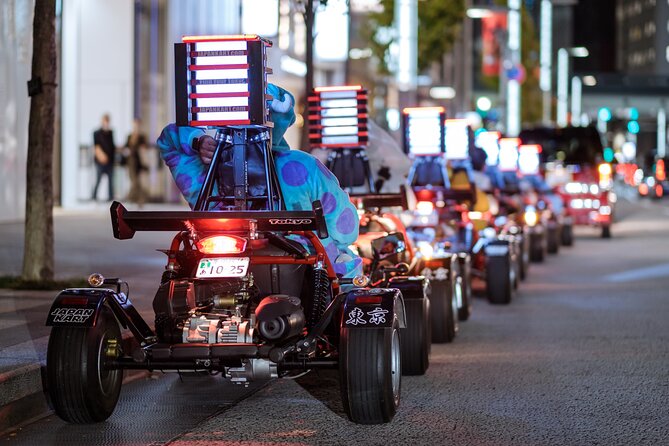
Past groups have been led by a van and followed by another van. That setup gives the guide a way to control the pace and protect the rear of the group. It cannot remove every traffic problem, though. Traffic lights may split the line briefly, so you need to watch the guide and follow instructions rather than race ahead.
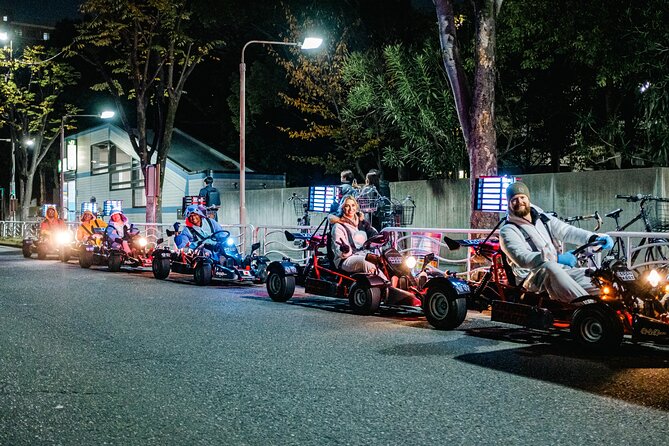
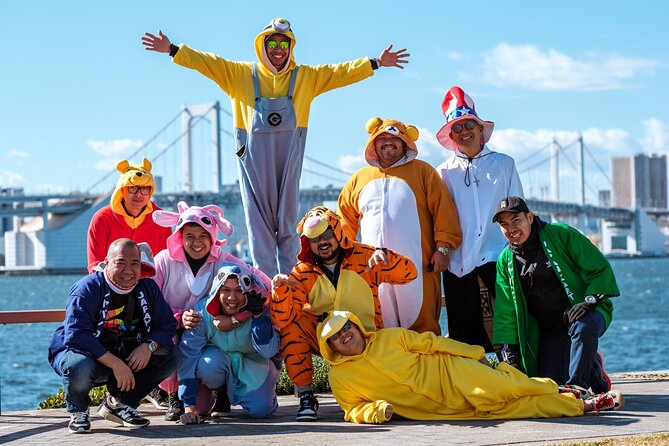
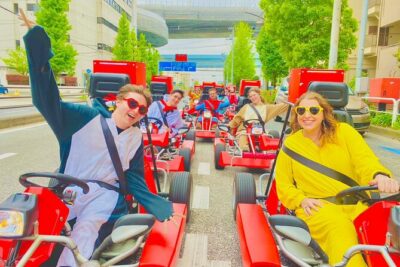
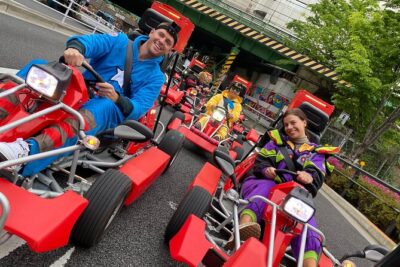
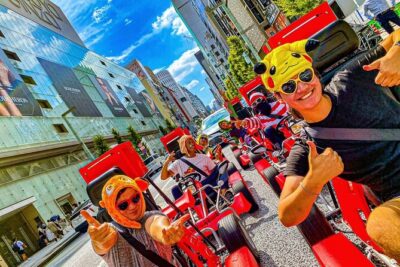
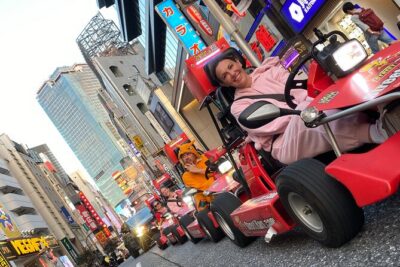
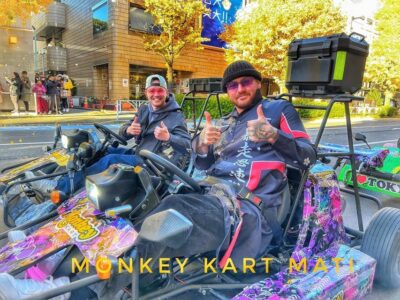
You may choose a costume supplied by the operator. Popular character-style outfits have included Pikachu and a Minion. The costumes are part of the fun, and people on the street may smile, wave, or take pictures as you pass.
Wear practical clothes. Long skirts, high heels, and sandals are not allowed. Alcohol before the tour is prohibited.
Toyosu and the Tokyo Bay start
Toyosu gives the route a modern waterfront opening. The district is known for the Toyosu Fish Market and its newer buildings, broad roads, and open feel.
The listed stop here is about 10 minutes, with no admission charge. That makes it a quick orientation point rather than a full market visit. You will not have time to explore the fish market in depth, so plan a separate morning if the seafood auctions and market halls are high on your Tokyo list.
The bay area works well for a go-kart route because the roads feel less cramped than some central shopping streets. You get a taste of Tokyo’s newer side before moving toward its older commercial and cultural districts.
Ginza, Tokyo’s polished center
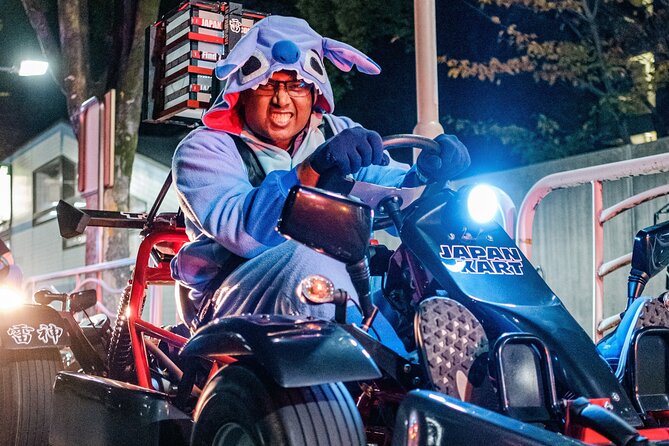
Ginza supplies the most glamorous part of the drive. Its wide streets, designer shops, department stores, and bright signs make it a natural place to be seen in a costume-clad kart.
You will pass through the district rather than stop for shopping or dining. That is both the strength and the limitation. The drive gives you a quick visual hit of Ginza, but it does not replace time on foot among the department stores and historic storefronts.
Still, this is one of the route’s best sections for atmosphere. You are close to the traffic, buildings, and people, and the contrast between Ginza’s polished image and your small open kart is hard to miss.
Nihonbashi and the old road center
Nihonbashi Bridge connects the modern city with Tokyo’s Edo-era past. It was once the starting point for Japan’s major roads, and the stone bridge remains an important marker in the city center.
From a kart, you get a moving glimpse rather than a long look. The nearby high-rises can make the bridge easy to miss, so pay attention to the route and listen to staff instructions. This section is valuable because it adds historical character to what could otherwise be only a neon-and-traffic outing.
I like the change of mood here. Ginza feels sleek and commercial. Nihonbashi feels more rooted, even though modern Tokyo surrounds it.
A few more Tokyo tours and experiences worth a look

Akihabara and Ueno on the same run
Akihabara brings the bright, noisy side of Tokyo. Multi-story arcades, anime shops, gaming stores, and electronic retailers give the district a visual identity unlike anywhere else on this route.
You pass through the area rather than stopping to browse. That means you see the signs and streets, but you will need another visit if you want games, collectibles, or electronics. The kart gives you a fun preview and helps you decide if the district deserves more time later.
Ueno changes the tone again. The area is known for Ueno Park, museums, a zoo, temples, and seasonal cherry blossoms. The route gives you a look at one of Tokyo’s cultural quarters, but the park itself is better explored on foot.
This variety is one of the strongest reasons to book. In a single ride, you move from luxury retail to old bridge, pop culture, and museums. You do not study any one district closely, but you get a useful first impression of several.
Asakusa and the Tokyo Skytree view
Asakusa is the historic-feeling highlight. Senso-ji Temple, Nakamise Street, food stalls, and craft shops draw visitors here for a slower, more traditional side of Tokyo.
The kart route passes nearby, but it is not a temple tour. You will not have time to walk through Senso-ji or shop along Nakamise Street during the drive. I would save a separate visit for Asakusa, ideally when you can explore at street level.
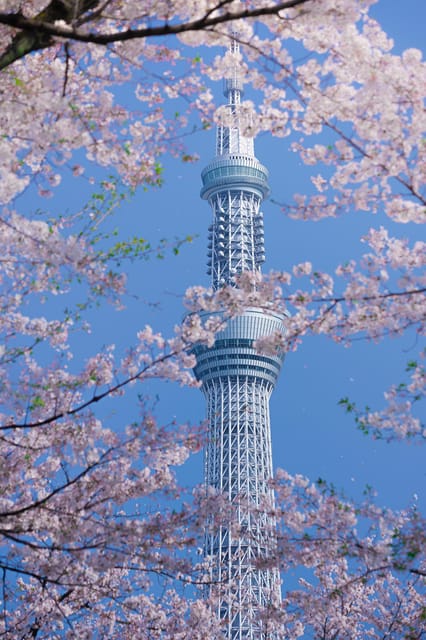
The route also takes you near Tokyo Skytree, the 634-meter tower that dominates the eastern skyline. Seeing it from a small kart gives you a striking sense of scale. The tower is especially photogenic, and the included photos can capture the group with this part of Tokyo behind you.
A rest and photo stop is built into the ride. One popular stop offers a view toward the Rainbow Bridge. It is a short pause, not a long sightseeing break, so use it for quick photos and a drink rather than expecting a full waterfront visit.
Driving after sunset
Departure time affects the mood. An evening outing can begin in daylight, continue through sunset, and finish with Tokyo’s city lights. That gives you three different looks at the same streets.
Night driving also brings more visual energy, especially around Ginza and Akihabara. The trade-off is that you need to stay alert in changing light and traffic. The safety briefing and guide vans matter even more then.
The kart is described as easy to handle once you understand the controls. It is not a racing session, and the pace is controlled by road conditions and the group. You should expect a guided road drive, not a competition.
Safety, group size, and comfort
The safety setup is a real part of the value. Staff explain the controls and traffic rules before departure, while guide vehicles lead and follow the group. This helps prevent people from getting lost and gives the rear of the line extra support.
The vans cannot guarantee that every traffic light will keep the group together. You may wait briefly for others, especially at larger intersections. That is normal for a group road activity, not a sign that the tour has gone wrong.
Most people can participate, and service animals are allowed. The experience operates near public transportation, but you still need to leave time for the walk to the shop and for finding the correct entrance.
The booking can be changed by the operator if kart availability becomes an issue at maximum capacity. That is uncommon practical fine print, but it is worth knowing before you build a tightly timed day around the activity.
Who will enjoy it most
I would recommend this to confident drivers who want an unusual view of Tokyo. It suits couples, families with older children who meet the driving requirements, and friends who like playful photo opportunities.
It also works well for someone returning to Tokyo who has already seen the major sights. You can cover many districts without spending the day underground on trains.
I would hesitate if you dislike public-road driving, feel uneasy in traffic, or want detailed cultural explanations. The route gives you sights, but the activity is about operating the kart. You need to stay focused, follow the guide, and accept that traffic controls the pace.
Age alone is not the deciding factor. One participant aged 70 described the experience as a highlight after decades of driving, but you should judge your own comfort and fitness. The operator says most participants can take part, subject to the driving documents and practical clothing rules.
Booking advice and cancellation terms
Book only after confirming your IDP format. This is not a small technicality. A wrong permit can mean no ride and no refund.
Free cancellation is available until 24 hours before the start time. Cancellations or changes inside that 24-hour window are not refunded. The experience also requires good weather, and a weather cancellation offers either a full refund or a new date, depending on availability.
The confirmation arrives at booking, and the ticket is mobile. Save the confirmation and instructional video where you can reach them quickly.
Should you book JAPANKART?
Book it if you want a playful, hands-on way to connect several parts of Tokyo in one outing. The strongest features are the wide East Tokyo route, the careful briefing, the lead and follow vans, the costumes, and the chance to see Tokyo from road level.
Skip it if you mainly want history, shopping time, or a relaxed sightseeing ride. Also skip it until you have confirmed the exact driving documents accepted for your nationality.
At $85.89, I see solid value for the right person. You receive about two and a half hours of organized driving, fuel, costume, and photos. Just treat the IDP rule and the 15-minute arrival requirement as essential, not optional.
FAQ
How long does the Tokyo go-kart experience last?
The experience lasts approximately 2 hours and 30 minutes, including the drive, briefing, stops, and return to the meeting point.
Where does the tour start and finish?
It starts and ends at JapanKart, 2-chōme-18-15 Azumabashi, Sumida City, Tokyo 130-0001, Japan.
What driving documents do I need?
Most participants need a driving license from their country of origin, a passport, and a booklet-form International Driving Permit issued under the 1949 Geneva Convention.
Are 1968 Vienna Convention permits accepted?
No. International Driving Permits issued under the 1968 Vienna Convention are not accepted in Japan for this activity.
Is there an exception for certain nationalities?
Yes. Participants with licenses from Switzerland, Germany, France, Taiwan, Belgium, or Monaco need their own license and a Japanese translation from the Japan Automobile Federation.
What should I wear?
Do not wear long skirts, high heels, or sandals. Alcohol consumption before the activity is prohibited.
What happens if bad weather cancels the experience?
You can receive a full refund or reschedule, depending on availability. For personal cancellations, you must cancel at least 24 hours before the start time for a full refund.
More Go-Kart Tours in Tokyo
More Ginza Tours in Tokyo


More tours in Tokyo we've reviewed












Go-Karts, compared.
 ★ 5.0Flagship 2-Hours Official Street Go-Kart Tour – Tokyo Bay ShopFrom $642 hours to 2 hours 30 minutes (approx.)
 ★ 5.0Official Street Go-Kart in ShibuyaFrom $76
 ★ 5.0Official Street Go-Kart Tour – AkihabaraFrom $61
 ★ 5.0Tokyo Go Kart: Asakusa, Skytree, and Akihabara **IDP MUST**From $99
 ★ 5.0Shibuya Official Street Go-Kart in Shibuya AnnexFrom $69
 ★ 4.6Tokyo: Asakusa and Skytree Go-Kart Tour and Photo ShootFrom $67