Reviewed · WALKING TOURS
Gotokuji and Setagaya Walking Tour: Home of the Lucky Cat Statue
Gotokuji Temple is famous for its rows of white lucky cat statues, but this private walking tour shows you that the neighborhood is more than a single photo stop. You’ll connect the temple to Setagaya’s old castle site, local shrines, a shopping street, and the friendly little Tokyu Setagaya Line.
In This Article
- Key points to know before booking
- Why this Setagaya walk is worth your morning
- Gotokuji Station begins the local Tokyo experience
- Setagaya Hachimangu and the sumo connection
- Gotokuji Temple and the rows of lucky cats
- Shoin Shrine and the lessons of Yoshida Shoin
- Shoin Jinja Shopping Street gives the tour a local pause
- Setagaya Castle Ruins Park adds a forgotten layer
- A ride on the Tokyu Setagaya Line after the walk
- What $84.70 means in practical terms
- Who should book this private walking tour
- Should you book the Gotokuji and Setagaya walk?
- FAQ
- Where does the tour start?
- What time does the tour begin?
- Where does the tour end?
- How long does the tour last?
- Is this a private tour?
- What is included in the price?
- Are meals included?
- Do I need to be physically fit?
- Can I cancel for a full refund?
I like the personal format, especially because guides such as Mitsuko, Yumi, Emiko, Yoshimi, and Kyoko have been praised for explaining shrine rituals, helping with navigation, and adjusting the pace. I also like the included drink, worth up to ¥800, which gives you time to pause at Shoin Jinja Shopping Street instead of rushing from one sight to the next.
The main consideration is walking comfort. The route lasts about three and a half hours and includes mountain paths, so easy walking shoes are important. Lunch, transport costs, and hotel pickup are not included, and the $84.70 price is easier to justify for a private group than for a solo guest.
Key points to know before booking
- Hundreds of lucky cats at Gotokuji Temple: Learn how the familiar raised-paw figure became linked with this Setagaya temple.
- A private tour for your group: You get direct time with one guide rather than joining a large shared party.
- Four different sides of Setagaya: The route combines Gotokuji, Setagaya Hachimangu, Shoin Shrine, castle ruins, and a local shopping street.
- A useful ¥800 drink stop: Coffee or tea at Shoin Jinja Shopping Street is included.
- A walking route with some uneven ground: Mountain paths make supportive shoes a sensible choice.
- A local train finish: The tour ends near Shoin-jinja-mae Station, with the Tokyu Setagaya Line available for continuing your day.
Why this Setagaya walk is worth your morning
Tokyo can feel like a city of giant stations, tall buildings, and packed sightseeing districts. Setagaya offers a different rhythm. This western Tokyo ward has quiet residential streets, small shrines, temple grounds, local shops, and a short railway line used by residents going about their day.
That change of pace is the real point of the tour. You are not simply collecting another Tokyo attraction. You are learning how several places fit together, with a guide to explain the customs and stories that are easy to miss on your own.
The tour starts at Gotokuji Station at 10:00 a.m. and ends at Shoin-jinja-mae Station. The route takes about three and a half hours, though it can be extended for ¥5,000 per group, per hour, paid in cash. Since this is a private activity, your group has the guide’s attention throughout.
That private format matters here. A temple visit can be quick and confusing if you do not know what you are looking at. Guide Yumi, for example, has been noted for showing visitors how to approach a shrine and follow its purification and prayer customs. Guides such as Emiko and Yoshimi have also been praised for helping people find their way around the neighborhood.
Other walking tours we've reviewed in Tokyo


Gotokuji Station begins the local Tokyo experience
Meeting at Gotokuji Station keeps the start simple. You do not need to arrange a hotel transfer unless you pay the extra ¥5,000 group fee available for hotels in the Tokyo and Yokohama area.
From the station, you begin on foot. That is useful for getting a feel for Setagaya before reaching the main temple. You can expect the route to mix streets with religious sites and green spaces, rather than moving from one major attraction to another by vehicle.
This is also where a private guide can make the biggest difference. If your group has questions about the neighborhood, Japanese shrine manners, or where to eat afterward, you can ask as you go. Advice on food and additional things to see in Setagaya is part of the practical value of the experience.
Setagaya Hachimangu and the sumo connection
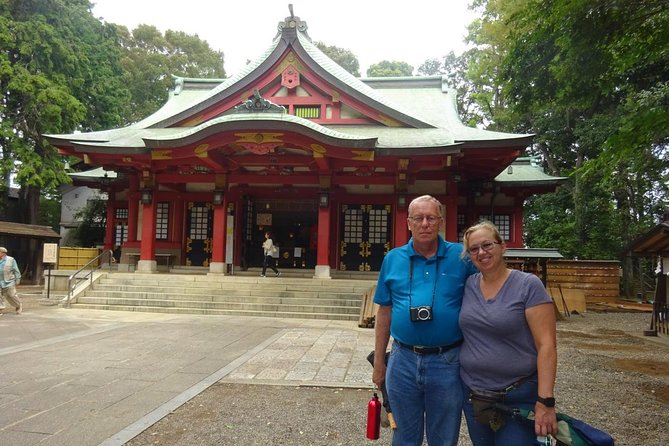
One of the early stops is Setagaya Hachimangu, one of the larger shrines in Setagaya Ward. Its most unusual feature is the dohyo, or sumo ring, set up on the shrine grounds.
The shrine is associated with honosumo, a sumo event held as an offering. An autumn matsuri is also held here. You may not see the festival or an active sumo event during your tour, but the ring gives the grounds a detail that separates this shrine from a standard city visit.
You’ll have about 20 minutes here, enough for an introduction and a look around without making the stop feel drawn out. A guide can explain the basic approach to the shrine and the meaning of its features, which is especially helpful if this is your first visit to a Japanese shrine.
The stop is free, as are the other scheduled temple and shrine visits. Still, remember that free admission does not mean free transport to the meeting point or back from the final station.
Gotokuji Temple and the rows of lucky cats
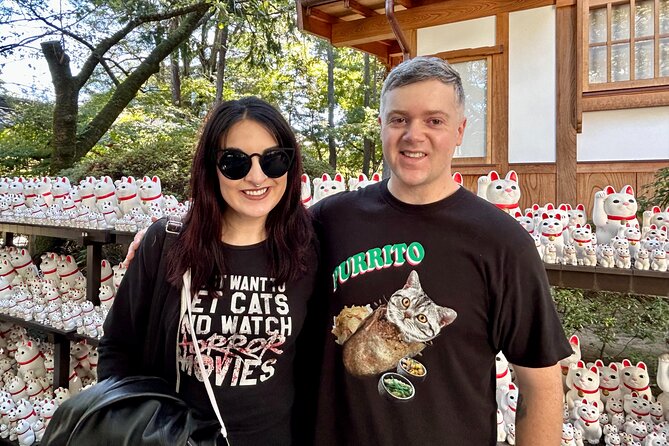
Gotokuji is the centerpiece of the tour. The temple began as the Kotokuin hermitage, built by Kira Masatada, the man associated with Setagaya Castle in 1480. It was first connected with the Rinzai sect and became a Soto sect temple in 1584.
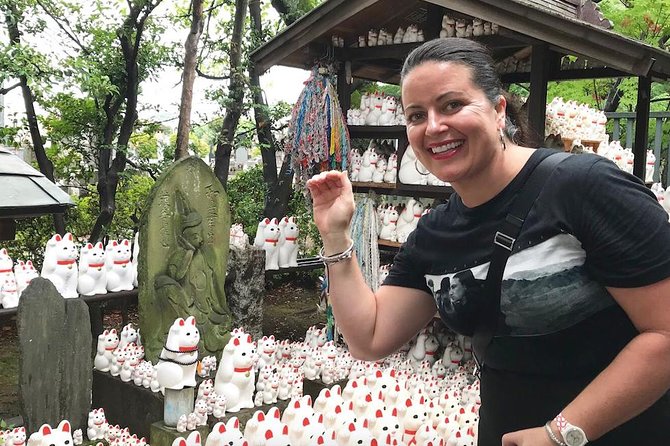
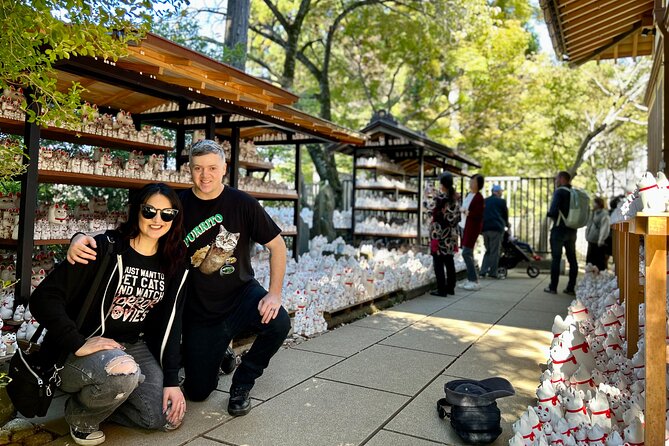
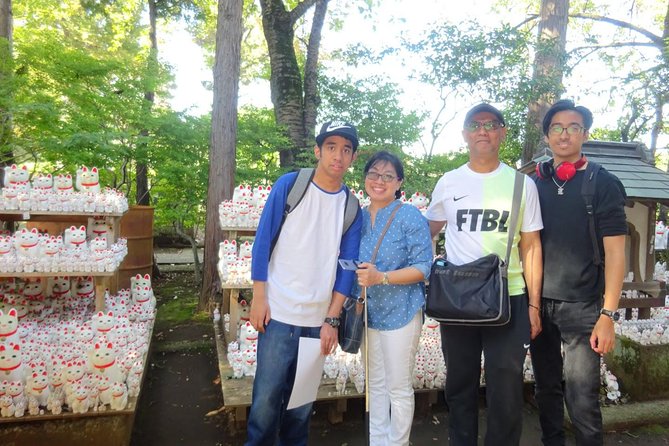
The temple’s best-known feature is its collection of maneki-neko, the raised-paw lucky cat figures familiar from shops and restaurants across Japan. Here, you can see hundreds of them displayed together. The sight is memorable because the cats are not presented as one large commercial installation. They are connected to the temple’s own tradition and make the origin story easier to understand.
Your scheduled time here is about 35 minutes. That should allow time for the guide’s explanation, photographs, and a calm look at the cat displays. If you are visiting mainly for pictures, the private format lets you ask for a little more time, though the full walk has several stops to cover.
I like that the tour does not treat the lucky cats as a novelty detached from the place. The guide explains the origin of the figure and places Gotokuji within Setagaya’s past. That gives the temple more meaning than simply finding the most photogenic row of statues.
The temple grounds may include mountain paths, so wear shoes that are easy to walk in. The supplied information calls for moderate physical fitness. Nothing suggests a strenuous hike, but this is not a fully flat, pavement-only outing.
Shoin Shrine and the lessons of Yoshida Shoin
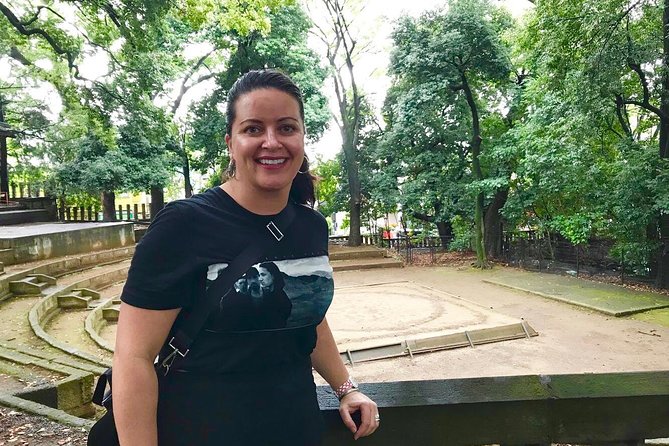
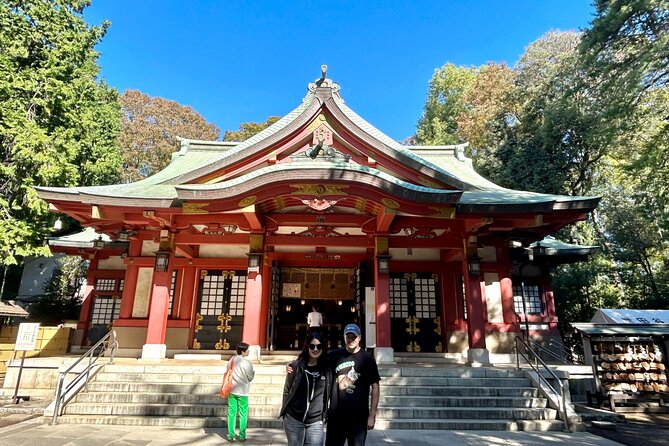
Shoin Shrine, also called Shoinjinja, was founded in 1882 with the teacher Yoshida Shoin at its center. The grounds include tombs connected with students of the Shoka Village school, including Yoshida Shoin, as well as a reproduced building.
This stop lasts about 25 minutes. Compared with Gotokuji, it offers a different kind of interest. The cat temple is visual and immediately recognizable. Shoin Shrine asks you to pay attention to the people, school, and political setting connected with the site.
You do not need to arrive already familiar with Yoshida Shoin. The value of having a guide is that the story can be explained in plain terms while you are standing in the grounds. Guide-led context also helps you notice why the shrine is here, rather than treating it as one more stop on a list.
As with Setagaya Hachimangu, the tour can show you how to behave at a shrine. That practical instruction is one of the strongest reasons to choose this experience over exploring alone. You leave with a better sense of the basic purification and prayer process, not just a collection of photographs.




Shoin Jinja Shopping Street gives the tour a local pause
The included drink is a small detail, but I think it improves the outing. You receive one coffee or tea valued up to ¥800 at Shoin Jinja Shopping Street.
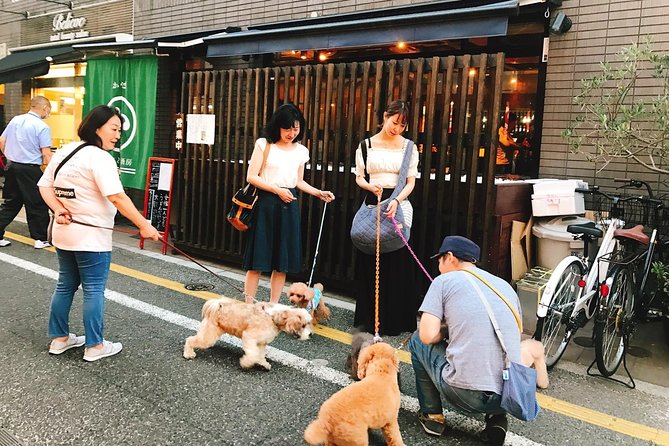
This is not lunch, and you should not treat it as a meal stop. It is a chance to sit or pause, look around the shopping area, and ask your guide what else is worth seeing or eating nearby. The tour describes the street as a place where local people gather, so it adds everyday Setagaya to a route otherwise focused on temples and shrines.
That balance is important. Many sightseeing walks show you historic buildings but little of how a neighborhood functions now. Here, the shopping street gives you a practical follow-up point. You can use the guide’s suggestions to continue exploring after the official tour ends.
The drink has a clear limit of ¥800, so anything beyond that amount would not be covered. Lunch is not included, making this a morning tour rather than a food tour.
Setagaya Castle Ruins Park adds a forgotten layer
Setagaya Castle is tied to the history of Gotokuji, since Kira Masatada built the castle in 1480. The castle ruins park helps connect the temple’s story with the older political life of the area.
Do not expect a grand standing castle or a large reconstructed fortress. The attraction is the chance to see the site as part of the neighborhood’s past, with a guide filling in what is no longer visible. This is a good example of why a walking tour works well here. Without context, a ruin can look like an ordinary patch of ground. With context, it becomes part of the story linking the castle, hermitage, and temple.
The supplied route information places the park among the tour’s main highlights, although the stop is not assigned a separate time in the schedule. Your guide controls the precise pace, so the actual time at each place may vary.
A ride on the Tokyu Setagaya Line after the walk
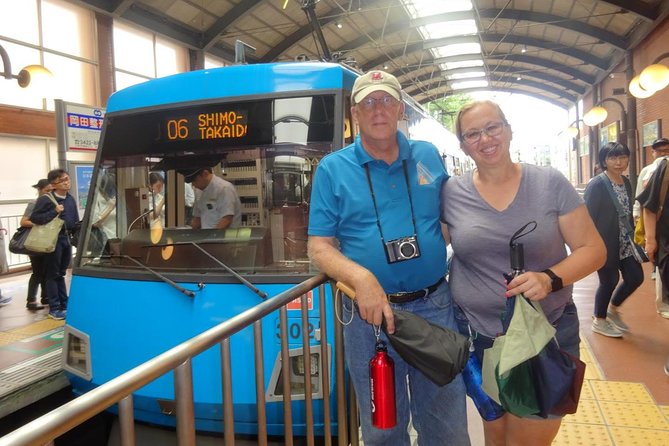
The tour finishes near Shoin-jinja-mae Station, and the Tokyu Setagaya Line is introduced as a local line used by people in the area. The listed transport segment takes about 10 minutes and is not a separate included attraction ticket.
You can use the station to continue your Tokyo plans after the walk. Since transportation to and from the attractions is not included, plan for your own train fares. The meeting point is Gotokuji Station, while the end point is near Shoin-jinja-mae Station, so the route does not return you to the start.
That one-way layout is convenient if you want to keep exploring Setagaya, but it is worth noting before you book. If you need to return to your hotel immediately, allow time and money for the onward journey.
What $84.70 means in practical terms
At $84.70 per person, this is not the cheapest way to see Gotokuji Temple. You can visit the temple and nearby shrines independently without paying an admission fee.
The price makes more sense for a private group that wants explanation, navigation help, and a flexible conversation with the guide. If you are curious about Japanese religious customs, local history, or the story behind maneki-neko, the guide adds the main value. The included drink helps, but it is not what justifies the cost.
Group discounts are available, though the exact discount depends on the booking. Because the activity is private, the per-person value improves as more people share the group cost. A solo visitor pays more for the same private attention, while a family or small group may find the arrangement more reasonable.
You should also budget for local transport and lunch. Hotel pickup is optional at an additional ¥5,000 per group for hotels in Tokyo and Yokohama. The tour is confirmed within 48 hours of booking, subject to availability.
Who should book this private walking tour
I would choose this experience if you have already seen Tokyo’s main central sights and want a quieter neighborhood with a clear local focus. It also suits first-time visitors who want help with shrine manners and prefer a guide to handle the route.
It is a good fit for:
- Small groups who want a private guide
- Visitors interested in the history behind Gotokuji’s lucky cats
- People who enjoy walking through residential districts
- Anyone who wants help using a local train line and finding nearby food
- Visitors comfortable with moderate walking and some mountain paths
I would think twice if your main goal is only a quick photograph of the lucky cats. You could visit Gotokuji independently for less money. I would also avoid booking this route if your group has difficulty walking for three and a half hours or needs a fully flat route.
The tour is not designed around lunch, shopping bags, or major museum interiors. Its appeal comes from connecting small places and understanding them as part of one neighborhood.
Should you book the Gotokuji and Setagaya walk?
Book it if you want more than a cat-themed photo stop. The strongest parts are the private guide, the shrine instruction, the link between Gotokuji and Setagaya Castle, and the chance to see a quieter side of Tokyo.
The guide names associated with the experience include Mitsuko, Yumi, Emiko, Yoshimi, and Kyoko, though your assigned guide may be different. The most useful qualities to look for are clear explanations, help with navigation, and a willingness to adjust the pace.
Skip it if you want a cheap, self-guided temple visit or if the mountain paths would be uncomfortable. For a small group that values local context and a personal route, the price can be fair. For a solo visitor focused only on the cats, it is harder to justify.
FAQ
Where does the tour start?
The tour starts at Gotokuji Station, at 1 Chome-43 Gotokuji, Setagaya City, Tokyo 154-0021, Japan.
What time does the tour begin?
The scheduled start time is 10:00 a.m.
Where does the tour end?
The tour ends near Shoin-jinja-mae Station, at 4-chome-21-16 Wakabayashi, Setagaya City, Tokyo 154-0023, Japan.
How long does the tour last?
The tour lasts approximately three hours and 30 minutes.
Is this a private tour?
Yes. Only your group participates in the activity.
What is included in the price?
A professional guide and one coffee or tea at Shoin Jinja Shopping Street, with a value of up to ¥800, are included.
Are meals included?
No. Lunch is not included.
Do I need to be physically fit?
You should have moderate physical fitness. The route includes mountain paths, so shoes that are easy to walk in are recommended.
Can I cancel for a full refund?
Yes, if you cancel at least 24 hours before the experience’s start time. Cancellations made less than 24 hours in advance are not refunded, and late changes are not accepted.
More Walking Tours in Tokyo

More tours in Tokyo we've reviewed


Walking Tours, compared.
 ★ 5.0Tokyo Tsukiji Fish Market Food and Culture Walking TourFrom $99
 ★ 4.9Tokyo: Shinjuku Local Bar and Izakaya Guided Walking TourFrom $343 hours
 ★ 5.0Tokyo: Tsukiji Fish Market Food and Walking tourFrom $30
 ★ 4.8Tokyo: Asakusa Walking Tour with Sensoji Temple VisitFrom $222 hours
 ★ 4.9Tokyo: Tsukiji Fish Market Guided Walking TourFrom $222 hours
 ★ 4.7Tokyo Castle & Imperial PalaceーShogun Walking TourFrom $232 hours