Reviewed · TOKYO
Tokyo Ikebana, Japanese Traditional Flower Arrangement Experience
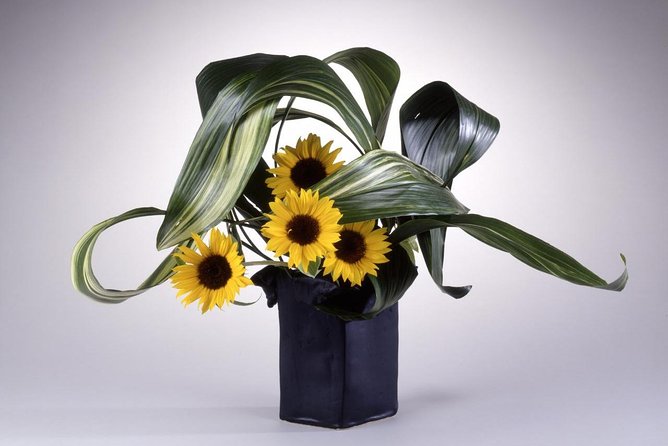
Ikebana is not simply putting flowers in a vase. It is the art of showing a plant’s line, angle, movement, and character. In this Tokyo class, you first learn the principles, then use seasonal local flowers to make your own arrangement. I like the hands-on format and the chance to study a Japanese art once practiced by samurai families.
In This Article
- Key points to know before booking
- What makes this Tokyo ikebana class different
- Arriving at the Nakano flower school
- The opening lesson: form, angle, and meaning
- Working with seasonal Japanese flowers
- Making your arrangement step by step
- Why the photography time matters
- What you receive for $67.28
- Who will enjoy this experience most
- Practical details that affect your decision
- How it fits into a Tokyo itinerary
- Should you book this ikebana experience?
- FAQ
- Where does the ikebana class take place?
- How long does the experience last?
- Is the class suitable for beginners?
- What age can participate?
- Are flowers and equipment included?
- How many people can join the class?
- Can I cancel or change my booking?
I also like that instructors such as Naohiro Kasuya and Mrs. Shimakawa teach beginners with patience, explaining both the practical shapes and the ideas behind them. The main drawback is the short 1-hour-10-minute session. You will make one arrangement and receive advice, but this is an introduction, not a full course in ikebana.
Key points to know before booking
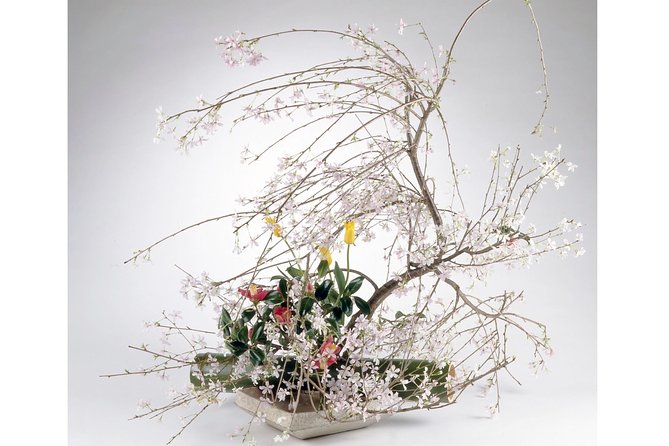
- You make your own arrangement: This is a working class, not a demonstration where you only watch.
- Seasonal flowers are supplied: The materials are local flowers in season, along with the vase and equipment needed for the lesson.
- The teaching goes beyond flower placement: You learn about form, angle, shape, movement, geometric ideas, and the philosophy of ikebana.
- The class suits first-timers: The instructor adjusts the lesson to your level, so no previous flower-arranging skill is expected.
- The group is limited to 10 people: You may receive more direct help than in a large workshop, and the class can sometimes be very small.
- You return to the same meeting point: The class takes place at the 一葉式いけ花本部 in Nakano, Tokyo, and ends there.
What makes this Tokyo ikebana class different
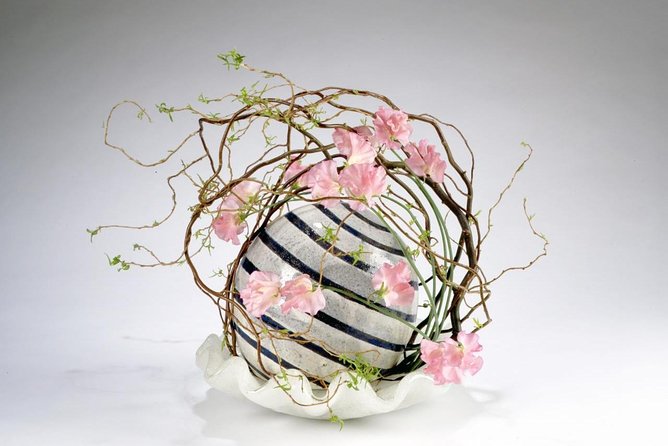
Many cultural activities in Tokyo ask you to watch a craft being made. This one puts the clippers, flowers, and vase in your hands. That change matters. You are not only learning what ikebana means. You are seeing how a small turn of a branch can alter the entire arrangement.
The central idea is to bring out the charm of every material. That includes the flowers, the branches, the empty spaces, and the container. A beginner may first see a loose collection of plants. After a little instruction, you begin to notice the line of a stem, the direction of a leaf, and the balance between height and width.
The class also presents ikebana as a living tradition rather than a decorative trick. The teaching covers the geometric and philosophical principles behind the art. You learn why an arrangement looks pleasing, which angles draw the eye, and how the parts work together.
This is a good choice if you want a quiet cultural activity with something tangible to show for it. Your finished piece becomes the subject of photographs, and the ideas can be used later with flowers in your own country.
If you're still narrowing it down, here are other tours in Tokyo we've reviewed.


Arriving at the Nakano flower school
The meeting point is 4-chōme-20-5 Nakano, Nakano City, Tokyo 164-0001. The venue is near public transportation, and the school is described as easy to find. You should still allow enough time to reach Nakano, since Tokyo addresses can be confusing when you are watching the clock.
The activity begins and ends at the same place. That makes the logistics simple. You do not need to follow a guide through several parts of the city, and you can plan a meal or another activity in Nakano after class.
The setting is 一葉式いけ花本部, the headquarters of the Ichiyō school of ikebana. The school’s connection to an established ikebana tradition gives the lesson more weight than a casual tourist craft session. You are learning in a place dedicated to the art, with instructors who teach its forms and methods directly.
The class can have as many as 10 participants. That is small enough for individual guidance, though the exact size may vary. One person has attended alone, which meant receiving very direct instruction. Do not count on a private lesson, but a small class is possible.
The opening lesson: form, angle, and meaning
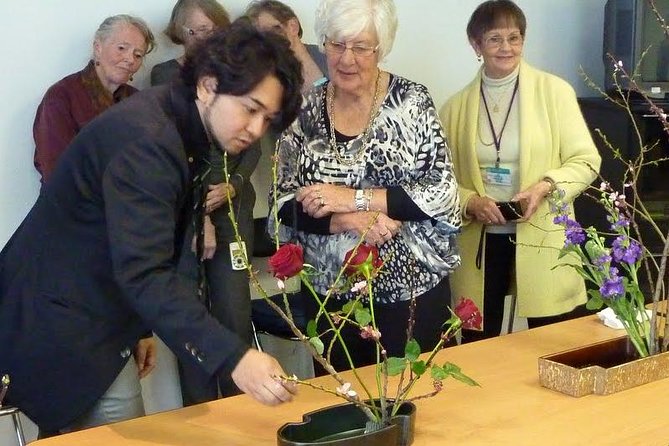
The first part explains the basics before you start cutting and placing flowers. This is important because ikebana has its own visual language. The goal is not to fill a vase evenly or create a round bouquet.
You learn to look at the materials before arranging them. The instructor explains which shapes work well, what angle is attractive, and how different combinations create a pleasing result. The lesson also covers movement, form, and proportion.
A useful point for beginners is that there is no need to arrive with a clear artistic style. The instructor works at your level and guides you toward an arrangement that suits the materials. You are given a structure to follow, but there is still room for an individual result.
The class connects practical choices with larger ideas. The geometric principles help you understand balance. The philosophy gives meaning to the open space and the uneven lines. In this art, an arrangement can feel complete without being symmetrical or crowded.
That may be the biggest adjustment for anyone used to Western bouquets. Empty space is not a mistake. A single branch can be as important as several flowers. The instructor helps you see why one position works better than another.
Working with seasonal Japanese flowers
The flowers used in the class are local and in season. The exact selection is not specified in advance, so your arrangement will depend on the time of year. That uncertainty is part of the appeal. You work with what nature is offering rather than choosing from a fixed menu.
Seasonal materials also make the class feel tied to Japan. The arrangement is not a generic souvenir project. Its shape and colors reflect the moment in which you take the lesson.
The materials and equipment are provided. You do not need to bring flowers, a vase, or arranging tools. That makes this an easy activity to add to a busy Tokyo schedule, especially if you are packing light.
You should wear or bring nothing special based on the stated requirements. Still, keep in mind that you are handling plant material and equipment, and you are responsible for your own belongings. The school is not responsible for lost items.
Making your arrangement step by step
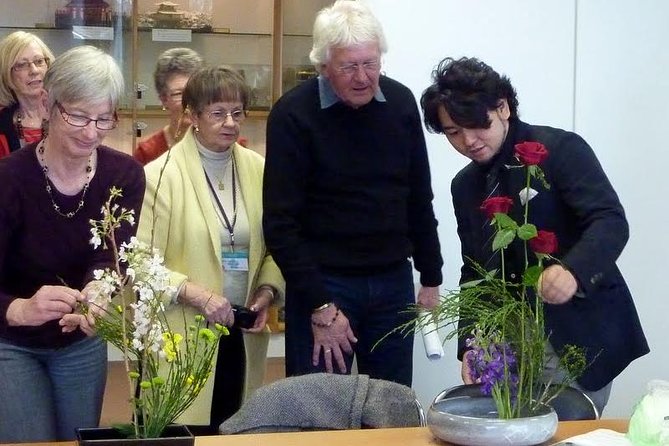
After the opening explanation, you create your own work. The instructor shows you how to apply the basic ideas to the flowers in front of you. You decide how to place the main line, where to add supporting material, and how to leave space around the arrangement.
This is where the lesson becomes personal. Everyone may begin with similar flowers, yet the final result can look different because of small changes in height, direction, and spacing.
The instructor then examines your arrangement and gives advice. The feedback is practical. You may be shown how to improve an angle, adjust a branch, or change the relationship between the main flower and the supporting stems.
Several classes have been led by Naohiro Kasuya, whose approach is described as friendly, patient, and clear. Mrs. Shimakawa has also taught the class, taking time to explain the process carefully and encouraging beginners. English ability can vary by instructor, but one instructor specifically apologized for her English even though the lesson was understood without trouble.
The tone appears supportive rather than rigid. You are learning an art with rules, but the instructor helps you use those rules rather than making you feel tested. That is especially helpful if you are not confident with crafts.


Why the photography time matters
Once your arrangement is finished, you have time to photograph it. This is more useful than it may sound. Flowers change quickly, and the piece may not look the same once you leave the school.
Photographs also give you a record of the principles you learned. Later, you can compare the picture with arrangements you make at home. It is a simple way to remember the line, spacing, and overall shape.
The photos provide a pleasant souvenir without adding another object to your luggage. You do not need to ship a large craft or carry a fragile arrangement across Japan. The skill and the images are the lasting parts of the experience.
Ask before moving the arrangement if you want a particular photograph. The lesson includes the opportunity to take pictures, but the available time remains limited by the total 70-minute session.
What you receive for $67.28
At $67.28 per person, this is not the cheapest short activity in Tokyo. The price needs to be judged against what is included. You receive instruction, flowers, equipment, a vase, a personal arrangement, and feedback from an experienced ikebana teacher.
The small-group limit also adds value. A class of up to 10 people is more personal than a large demonstration. If the group is small on your date, you may have generous access to the instructor’s attention.
The lesson is also efficient. In just over an hour, you get an introduction to the art, a guided practice session, an individual critique, and time for photographs. That fits well into a Tokyo itinerary when you want a focused activity rather than a full-day commitment.
The price makes less sense if you only want a quick photo opportunity or a simple souvenir craft. It makes more sense if you want to understand why ikebana looks the way it does and plan to use the ideas again. The class is especially useful for someone who already enjoys flowers, design, Japanese culture, or quiet creative work.
The instructor can also be sent to any hotel in Tokyo, according to the supplied details. Ask about this option before booking, since a hotel-based lesson may involve separate arrangements or fees. Large groups are charged a venue rental fee separately.
Who will enjoy this experience most
This class is designed for people aged 6 and older. Children aged 12 and younger must be accompanied by a parent. The activity can work well for a family, though younger children may need help handling the equipment and following the slower pace of the lesson.
It suits solo visitors, couples, and small groups. One person described having the class alone, while other sessions included several students. The maximum group size is 10.
You do not need prior experience. The teaching starts with basic principles and moves into practice. At the same time, the class is not only for complete beginners. Someone with previous flower-arranging experience can still gain a better understanding of Japanese form and movement.
I would recommend it to anyone who wants a break from Tokyo’s major sights. The experience is calm, focused, and connected to a Japanese tradition. It also works well as a birthday activity or a thoughtful gift for someone who enjoys flowers.
It may be less suitable if you want a lively, social class with many activities packed into the hour. Ikebana asks you to slow down and pay attention to small visual changes.
Practical details that affect your decision
Confirmation is sent within 48 hours of booking, subject to availability. The activity is booked an average of 16 days ahead, so reserving early is sensible if your Tokyo dates are fixed.
A mobile ticket is provided, which keeps the entry process simple. The experience is near public transportation, and most people can participate.
The activity is non-refundable and cannot be changed for any reason. That is the biggest booking risk. Do not reserve it until your schedule is firm.
You are responsible for accidents or injuries during the experience. Keep your valuables with you, since the school does not accept responsibility for items left behind or lost.
The class ends back at the meeting point. That gives you a clear finish and avoids the problem of being dropped in an unfamiliar part of Tokyo.
How it fits into a Tokyo itinerary
The 70-minute length makes this easy to pair with other plans. You could schedule it between sightseeing blocks, though you should allow extra time for transportation and finding the address.
Since the start and finish are both in Nakano, you can stay in the area afterward instead of rushing across Tokyo. The exact nearby attractions and restaurants are not part of the activity, so plan those separately.
You can also use the class as a quieter counterpoint to busy city days. After temples, shopping streets, and train stations, an hour spent studying flowers and empty space offers a change of pace.
If you become interested in ikebana, ask the instructor about local exhibitions. One class led to information about an ikebana show the following day, giving the participant a chance to see the art in a larger setting. Availability of such suggestions will depend on the calendar, but the school can be a useful starting point for learning what else is taking place.
Should you book this ikebana experience?
Book it if you want more than a quick cultural demonstration. You will learn the ideas behind ikebana, work with seasonal flowers, make your own arrangement, and receive personal advice from an instructor such as Naohiro Kasuya or Mrs. Shimakawa.
The price is fair for a supplied-materials lesson with expert teaching and a small group, though the session is short for anyone hoping to develop serious skill. The non-refundable policy means you should book only after your schedule is settled.
For a first encounter with Japanese flower arranging, this is a strong choice. You leave with photographs, a better eye for shape and space, and a practical method you can try with flowers at home.
FAQ
Where does the ikebana class take place?
The class takes place at 一葉式いけ花本部, located at 4-chōme-20-5 Nakano, Nakano City, Tokyo 164-0001, Japan.
How long does the experience last?
The activity lasts approximately 1 hour and 10 minutes.
Is the class suitable for beginners?
Yes. The instructor teaches the basics and adjusts the lesson to your level, so no previous ikebana experience is required.
What age can participate?
The program is designed for people aged 6 and older. Children aged 12 and younger must be accompanied by a parent.
Are flowers and equipment included?
Yes. Flowers, a vase, and the equipment needed for the lesson are provided.
How many people can join the class?
The activity has a maximum of 10 participants.
Can I cancel or change my booking?
No. The experience is non-refundable and cannot be changed for any reason.
More tours in Tokyo we've reviewed




Tokyo, compared.
 ★ 5.0Mt Fuji and Hakone 1-Day Bus Tour Return by Bullet TrainFrom $163
 ★ 5.01-Day Tokyo Bus TourFrom $129
 ★ 4.6Tokyo: teamLab Planets TOKYO Digital Art Museum Entry TicketFrom $251 day
 ★ 4.0Mt Fuji & Hakone Cruise, Drum Show Bullet Train 1 Day from TokyoFrom $149
 ★ 5.0Tokyo: Shinjuku Food Tour (13 Dishes at 4 Local Eateries)From $86
 ★ 4.4Tokyo Mt Fuji 5th St & Hakone Cruise Bus Tour w/Bullet TrainFrom $15410 hours