Reviewed · SELF-GUIDED TOURS
LA Little Tokyo to Olvera St Smartphone (App/GPS) Walking Tour
Little Tokyo to Olvera Street is a short walk with a surprisingly broad story: Japanese American history, Los Angeles City Hall, the city’s birthplace, and a Mexican marketplace all fit into one route. The GPS-guided app gives you the background without tying you to a group or a fixed speaking schedule.
In This Article
- Key points to know before you go
- A compact walk through three sides of Los Angeles
- Starting at the Chiune Sugihara statue
- Japanese Village Plaza and the fire tower
- Fugetsu-Do, a stop with a food connection
- Los Angeles City Hall from the outside and above
- El Pueblo and the place where Los Angeles began
- Olvera Street and the finish at Cielito Lindo
- What $7.50 really gets you
- How the app compares with a person-led walk
- Timing, access, and who should book
- Should you book the Little Tokyo to Olvera Street walk?
- FAQ
- How long does the walking tour take?
- Where does the tour begin?
- Where does the tour end?
- Is food included in the price?
- Is this a guided group tour?
- What language is available?
- Can I cancel for a full refund?
I like the freedom to stop for mochi, photos, or a closer look at an old building. I also like the low price, just $7.50, and the way the narration points out small places you could easily miss. The main drawback is that this is not a live guided walk, so you must manage your phone, GPS, battery, and directions yourself.
Key points to know before you go
- The route crosses several cultures and eras: Little Tokyo, Japanese Village Plaza, City Hall, El Pueblo, and Olvera Street all appear in one compact outing.
- The app can be paused: You can stop to eat, shop, take photos, or explore without holding up a group.
- The tour ends at Cielito Lindo: Food is not included, but you finish near a well-known taquito stand on Olvera Street.
- The starting point is specific: Meet at the Chiune Sugihara statue at 192 South Central Avenue.
- Expect a self-guided experience: The app supplies narration and directions, but no person accompanies you.
- Allow about 60 to 75 minutes: Add extra time if you plan to sample food or spend time inside the stops.
A compact walk through three sides of Los Angeles
This tour works because the route links places that can feel separate on a city map. You begin near Little Tokyo and finish at Olvera Street, passing through civic Los Angeles and El Pueblo along the way.
The route is not built around admission-heavy attractions. You see public streets, plazas, historic buildings, and outdoor sites, while the phone narration explains what you are looking at. That keeps the base cost low, but it also means the experience depends on your interest in walking and listening.
The app is location-aware. As you move, it directs you to the next point and plays the relevant information. One useful feature is the ability to pause the tour. You can linger at a bakery, stop for a snack, or take photos without feeling that a guide is waiting for you.
That flexibility is especially helpful for mixed-interest groups. One person can focus on the historical story, while another takes photos or checks out food stalls. You can also return to a point if you missed something.
The trade-off is simple: you do not get a live person to answer questions or adjust the route. You also need to follow the GPS carefully. One experience with the app noted that the directions were mostly clear, but that some instructions around the DoubleTree area were less easy to follow. If you get turned around, the same account found that it was possible to get back on track within a few minutes, but you should still watch the map.
Other walking tours we've reviewed in Los Angeles
Starting at the Chiune Sugihara statue
The official starting point is the statue of Chiune Sugihara at 192 South Central Avenue, Los Angeles. This gives you a precise place to begin rather than a vague instruction to meet somewhere in Little Tokyo.
From there, the app introduces the Japanese presence in Los Angeles and points you toward sites in Little Tokyo. The opening section sets up the larger purpose of the walk: you are not simply moving between restaurants and shopping streets. You are following the story of communities that shaped downtown Los Angeles.
Little Tokyo is a good place to begin because it rewards slow looking. Streets, signs, plazas, and small businesses carry pieces of the neighborhood’s identity. The walk gives you a framework for noticing those details instead of passing through with only a few photographs.
The Little Tokyo section takes about 15 minutes. That is enough for a focused introduction, but not enough for a full neighborhood visit. If you want to browse shops or eat along the way, use the pause function and plan on extending the outing.
Japanese Village Plaza and the fire tower
Japanese Village Plaza receives its own stop, with about five minutes of narration. You will see the plaza, learn about its role in Little Tokyo, and hear about the fire tower.
This is the kind of stop that can be easy to overlook without context. A plaza may look like a pleasant public space, while the app helps explain why it matters and what to notice. The fire tower adds a clear visual marker and gives the narration something concrete to point toward.
The short timing also tells you how to use this tour. It is designed as a series of concise stories rather than long lectures. You can listen, look around, and continue. If the plaza catches your attention, pause the narration rather than treating five minutes as a strict limit.
Fugetsu-Do, a stop with a food connection
Fugetsu-Do Bakery Shop is another five-minute stop. The narration covers the bakery’s story and identifies it as a good place to eat.
Food stops help keep a history walk grounded. You are not only hearing about a community in the abstract. You are seeing a business connected to the neighborhood and getting a practical reason to slow down.
Food is not included in the tour price. That is worth remembering when you compare the $7.50 cost with a conventional guided walk. The app covers the historical route, while any mochi, bakery items, drinks, or other snacks are extra.
The ability to pause matters here. You can listen to the explanation, decide if you want to buy something, and continue on your own schedule. For many people, that is more useful than being given a rushed stop with no time to order.
Los Angeles City Hall from the outside and above
The City Hall stop lasts about 10 minutes. You learn why the building was constructed and have a chance to see a view from the observation deck.
The wording matters: you get a chance to see the view, not a guarantee of a scheduled private visit or a reserved entry. The supplied details do not promise admission arrangements, so treat the observation deck as an opportunity connected to the stop rather than the main reason to book.
City Hall changes the tone of the walk. After the neighborhood-focused stops in Little Tokyo, you shift to the machinery and symbolism of city government. The app explains the story behind the building, helping you connect the architecture to the growth of Los Angeles.
This is also a good point to take stock of the route. You have moved from Japanese American history to the civic center and will soon reach the oldest part of the city. The tour’s strength is this succession of distinct subjects within a short distance.

El Pueblo and the place where Los Angeles began
The El Pueblo de Los Ángeles Historical Monument stop takes about 10 minutes. Here, the app explains the site where Los Angeles began, the story behind the city’s name, and the historic park.
This stop gives the walk its broadest city context. Little Tokyo and Olvera Street are not isolated attractions. They sit within a much older story about the founding and naming of Los Angeles.
Expect an outdoor historical stop rather than a formal museum visit. You can look around the park while listening, and you may want to pause if you find a building or public space worth examining more closely. The app’s short narration keeps the pace moving, but you control how long you stay.
The route also includes a stop outside the Chinese American Museum. The supplied details identify the subjects covered there: the Chinese riot, the murders, and the history of Chinese people in Los Angeles. Since the timing is not specified, allow some flexibility if you want to spend more time looking at the area.
This section broadens the tour beyond the communities named in the main route. It shows that downtown Los Angeles carries several difficult and important stories close together. The app format lets you take that material at your own pace, which can be useful when a subject deserves a quiet pause.
Olvera Street and the finish at Cielito Lindo
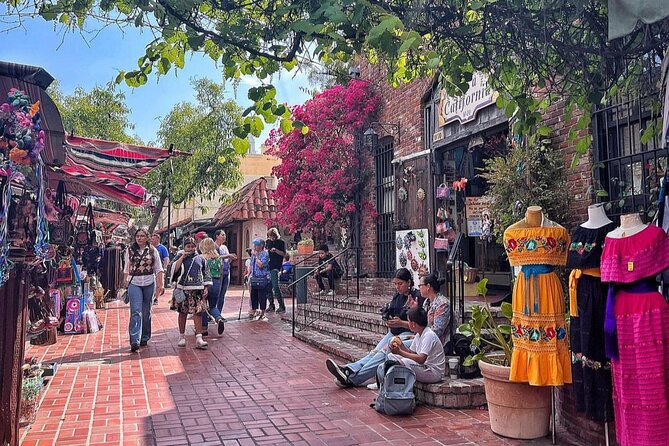
The walk ends on Olvera Street, also known as Calle Olvera. The street was originally called Wine Street. In 1877, it was extended and renamed for Judge Augustín Olvera, the first elected county judge in Los Angeles.
In 1930, local merchants adapted the street into the Mexican marketplace you see today. The result is a festive pedestrian setting with shops, food, and a strong sense of place. The app explains how the street developed, so you get more than a quick stroll through colorful storefronts.
The final stop is Cielito Lindo, a historic taquito stand at E 23 Olvera Street. You hear how it began and how the food is made. The tour does not include food, but ending here gives you an obvious chance to order something after the narration finishes.
Cielito Lindo is open daily from noon until 11:30 p.m., according to the supplied schedule. That makes the endpoint practical for a daytime or evening walk, though you should still check current conditions before setting out because business hours can change.
The ending works well as a reward for the route. You finish with a specific food tradition rather than simply stopping at an anonymous street corner. If you are hungry, the taquitos can turn the last five minutes into a meal stop. If you are not, Olvera Street itself gives you time to walk around.
What $7.50 really gets you
At $7.50 per person, this is inexpensive for a self-guided city walk that covers several notable districts and civic sites. The value comes from the narration, route planning, and historical framing, not from included food, admissions, or personal service.
You can think of it as a low-cost introduction to downtown Los Angeles. It does not replace a full day in Little Tokyo, a museum visit, or a detailed architectural tour. It does give you a practical first look and helps you decide where to return later.
The price is also favorable for families or pairs with different interests. Everyone can move at the same speed, and nobody has to pay for a full private guide. At the same time, you should budget separately for food at Fugetsu-Do or Cielito Lindo, plus any entrance costs if you choose to visit a site beyond the narrated outdoor stops.
The experience is private in the sense that only your group takes part. It is not a private guide service. You share the streets with other people, but the app does not place you in a scheduled group.
How the app compares with a person-led walk
The best feature is control. You can pause when a shop catches your eye, stop for a snack, replay your position by checking the directions, and move on when you are ready.
The narration is also strong enough to keep different interests together. A history-minded person can listen closely, while someone more interested in photos can use the same pauses to explore. One particularly useful detail is the mention of less obvious places in Little Tokyo, including the mochi bakery and the Edo garden.
The limitations are typical of phone tours. GPS triggers can be imperfect, and the narration may stop when you are not exactly where the app expects you to be. One user specifically wished there were a way to listen to the rest of a segment without being stopped by the GPS location.
You should also be comfortable walking while checking directions. Keep your phone charged, use headphones only if you can remain aware of your surroundings, and pause the app when crossing streets or entering a shop. The tour is easy to customize, but that freedom comes with a little responsibility.
One person also expressed concern about walking to Chinatown and Koreatown on foot. Those areas are not listed as the core stops of this route, so do not assume this tour provides a full walking connection through every downtown district. Follow the route given by the app and avoid adding unrelated walks if you are not comfortable with the surroundings.
Timing, access, and who should book
The stated duration is about one hour to one hour and 15 minutes. That estimate fits a steady walk with short stops, but food, shopping, photos, and museum time will make it longer.
The tour is offered in English and uses a mobile ticket. You need a smartphone capable of running the walking tour app and receiving location information. No guide, food, water, or admission ticket is included.
Service animals are allowed, and the activity is near public transportation. Most people can take part, but the information provided does not promise a fully step-free route or detailed accessibility measurements. If you need exact information about surfaces, distances, or restroom access, confirm those points before booking.
I would recommend this for first-time visitors who want a quick introduction to central Los Angeles, families who need flexibility, couples who like to mix history with food, and independent walkers who do not want to follow a flag or headset through a group.
I would be less likely to choose it if you want live conversation, detailed answers to questions, or a carefully managed group walk. It also may not suit you if phone navigation makes you uneasy or if you prefer to put your device away while sightseeing.
Booking tends to happen well ahead of time, with an average booking point of about 37 days in advance. That does not mean you must plan that early, but it suggests that putting it on your schedule ahead of a Los Angeles trip is sensible. Free cancellation is available until 24 hours before the start time. Within 24 hours, the booking is nonrefundable, and late changes are not accepted.
Should you book the Little Tokyo to Olvera Street walk?
Book it if you want a low-cost, flexible introduction to several important downtown districts and are happy to guide yourself with a phone. The route packs Japanese American history, City Hall, the Chinese American Museum area, El Pueblo, and Olvera Street into a manageable outing.
The strongest reason to choose it is the pause function. You can treat the walk as a framework, not a race. Stop at Fugetsu-Do, browse Japanese Village Plaza, take photos, or finish with taquitos at Cielito Lindo.
Skip it if you need a live guide or a fully predictable GPS experience. For everyone else, $7.50 buys a useful first orientation, a clear route, and enough local detail to turn a downtown walk into something more meaningful than a string of snapshots.
FAQ
How long does the walking tour take?
The estimated duration is one hour to one hour and 15 minutes. You can take longer if you pause for food, shopping, photos, or extra time at the stops.
Where does the tour begin?
It begins at the Chiune Sugihara statue at 192 South Central Avenue, Los Angeles, California 90012.
Where does the tour end?
It ends at Cielito Lindo at E 23 Olvera Street, Los Angeles, California 90012.
Is food included in the price?
No. Food, water, entrance fees, and people are not included. The route discusses Fugetsu-Do Bakery Shop and ends at Cielito Lindo, where you can buy food separately.
Is this a guided group tour?
No. It is a location-aware smartphone app walking tour. Only your group participates, and no person accompanies you.
What language is available?
The tour is offered in English.
Can I cancel for a full refund?
Yes, if you cancel at least 24 hours before the experience start time. Cancellations or changes made within 24 hours are not accepted for a refund.
More Walking Tours in Los Angeles
More tours in Los Angeles we've reviewed
Self-Guided Tours, compared.
 ★ 3.8Tokyo: Open Top Panoramic Sightseeing Bus with Audio GuideFrom $111h 10m
 ★ 4.0Tokyo: 60min Panoramic Open Top Bus Tour with Audio GuideFrom $141 hour
 ★ 3.7Akihabara: Self-Guided Tour with a special brochureFrom $61 day
 ★ 3.5Tokyo Self-Guided Audio TourFrom $9
 ★ 4.6Hakone: Self Guided Trip to Mt. Fuji // Made by Local GuidesFrom $31 day
 ★ 4.8Tokyo: Sumo Keiko Training Tour with Audio Guide & PhotoFrom $8540 - 90 minutes