Reviewed · MT FUJI DAY TRIPS
3 Day Japan Highlights Tour: Tokyo, Mt.Fuji, Nara, Kyoto, Osaka
The clever part of this 3-day Japan tour is its route. Instead of spending all your time in Tokyo and Kyoto, you cross much of central Japan by road, with stops at Kamakura, Hakone, Mt. Fuji, Nara, Kyoto, and Osaka. You get countryside views and major sights without arranging several separate day trips.
In This Article
- Key points at a glance
- What this three-day route really gives you
- Day 1: Kamakura temples, Enoshima, and Hakone’s volcanic sights
- Hakone’s ropeway and Lake Ashi cruise
- Day 2: Mt. Fuji villages, lava caves, and Nagoya at night
- Lava tubes and a short forest walk
- Nagoya after dark
- Day 3: Nara deer, Kyoto temples, and Osaka’s Dotonbori
- Arashiyama and Fushimi Inari in a single afternoon
- Price, inclusions, and the real value
- Who should book this tour
- Should you book the 3 Day Japan Highlights Tour?
- FAQ
- Where does the tour start?
- Where does the tour end?
- What is included in the price?
- Are meals included?
- How large is the group?
- What is the cancellation policy?
I like the small maximum group of 23 and the chance to adjust the day around your interests. I also like the mix of famous sights and local stops, from black eggs at Owakudani to a tea ceremony in Kyoto. The main drawback is the pace: this is a very full tour, and some stops are brief.
Key points at a glance

- Kamakura opens the trip with two major temples, the Great Buddha and Hasedera, plus time on Enoshima Island.
- Hakone combines a ropeway, volcanic steam vents, and a Lake Ashi cruise in one compact sightseeing day.
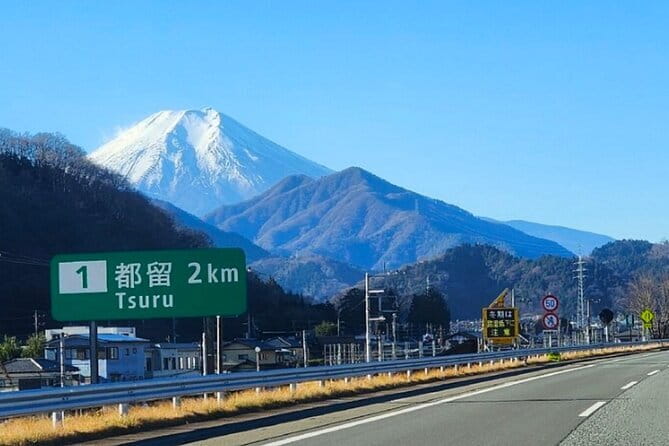
- Mt. Fuji views depend on the weather, but the route includes several good viewing points and traditional villages.
- Nara and Kyoto receive serious attention on Day 3, including Todaiji, Kiyomizu-dera, Arashiyama, and Fushimi Inari.
- Guide Matt can tailor parts of the route, which helps if you care more about temples, scenery, food, or local customs.
- The $1,310.55 price includes transport, two breakfasts, WiFi, road costs, parking, and 3-star accommodation, but not lunch, dinner, or most entry fees.
What this three-day route really gives you

This is not a relaxed temple holiday. It is a fast-moving introduction to a large stretch of Japan, beginning at Narita or Tokyo and finishing somewhere different along the route toward Osaka. You spend a great deal of time in an air-conditioned vehicle, but that time serves a purpose: the tour links places that are awkward to combine by train in such a short visit.
The road route also gives you something a standard Tokyo, Kyoto, and Osaka package often misses. You see the coastal side of Kanagawa, the mountain resorts of Hakone, the farming and craft areas around Mt. Fuji, and Nagoya’s Sakae district after dark.
The group is capped at 23 people. That is not a private tour, but it is small enough for a guide to keep the day moving and respond to individual interests. Matt is the named guide associated with the experience, and the strongest praise centers on his flexibility and help with Japanese culture.
You should still expect early starts, frequent boarding and unloading, and little spare time. If you want to sit for an hour at each temple, this route will feel rushed. If you want to see a lot of Japan on a first visit, the pace is its main advantage.
If you're still narrowing it down, here are other tours in Narita we've reviewed.



Day 1: Kamakura temples, Enoshima, and Hakone’s volcanic sights
The first day begins with Kamakura’s Great Buddha at Kotoku-in. The bronze statue is about 11 meters high and dates from 1252, when Kamakura served as Japan’s capital. You have roughly 30 minutes here, enough to see the statue and grounds, but not enough for a long, unhurried visit.
The entry ticket is not included, so keep some Japanese yen available. The short stop works well as an introduction to Japanese Buddhist art, though serious history fans may want more time than the schedule allows.
Next comes Hasedera, a temple known for a 9-meter wooden statue of the goddess of mercy. The gardens and sea views give this stop a different feel from the Great Buddha. You can also go underground in the temple, adding a small sense of discovery to the visit.
I would use the 40 minutes here for the gardens and view first. If you spend too long in the underground section, you may miss the best outdoor parts.
Enoshima Island follows, with about an hour to explore. The island has a shrine complex, sea caves, a public bath, surfing nearby, and seafood restaurants. Lunch is not included, so this is one of the clearest chances to choose your own meal.
An hour is enough for a taste, not a full exploration. You may find the island’s steps and walking routes more demanding than the rest of the morning, but the seaside setting breaks up the temple visits nicely.
Hakone’s ropeway and Lake Ashi cruise
The afternoon shifts from the coast to Hakone. The Hakone Ropeway provides a high view over the mountain area, and the schedule includes a relaxing foot bath before boarding the gondola down the mountain. The listed ropeway admission is 2,000 yen and is not included.
This is one of the day’s most enjoyable transport segments because the ride itself is part of the sightseeing. Clear weather can bring views toward Mt. Fuji, though clouds often decide how much you see.
At Owakudani, or Hell Valley, you make a short stop beside sulphur steam vents rising from the crater area. The stop lasts about 15 minutes. You can try a kuro-tamago, a black egg boiled in the sulphur springs, but the schedule is too short for a long walk.
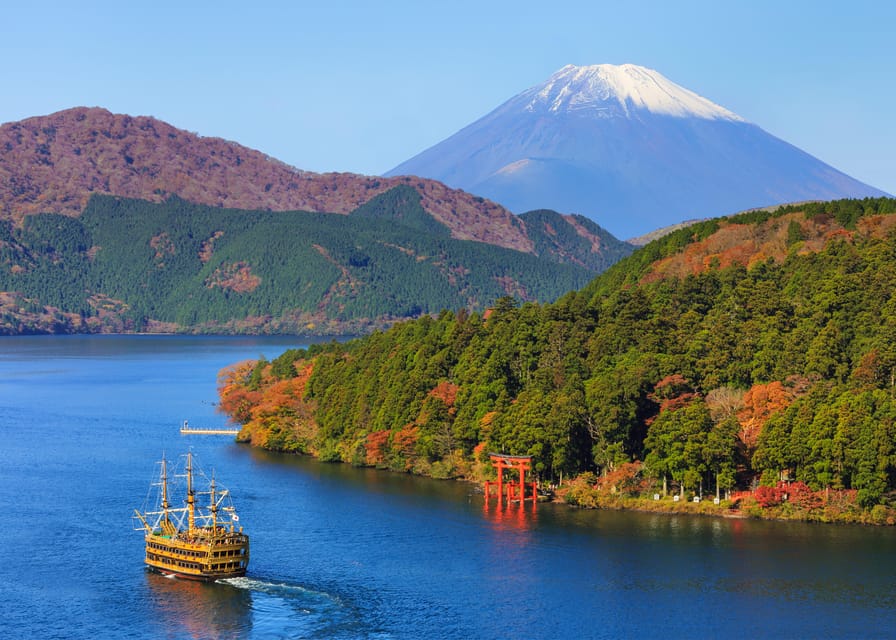
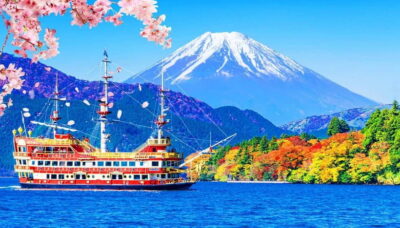
The Lake Ashi portion is more generous. You board the Hakone Pirate Ship at Togendai Port for about an hour on the crater lake. Admission is listed at 1,700 yen and is extra. On a clear day, this is one of the best chances to see Mt. Fuji from the water.
The final Hakone stop is Hakone Shrine, founded in 757. Its forest of large cedar trees gives the shrine a quiet, old-road atmosphere, while the torii gate on Lake Ashi is the famous photo point. You have about 30 minutes, so you will need to choose between the forest complex and the lakeside gate.
The drive along the Lake Ashinoko Skyline then takes you toward the Fuji area. The route includes views of the Pacific, Lake Ashi, and Mt. Fuji when conditions cooperate. Japanese wildlife, including deer and raccoon dogs, may appear from the roadside, but sightings are not guaranteed.
Day 2: Mt. Fuji villages, lava caves, and Nagoya at night
Day 2 is built around Mt. Fuji, with several viewing points rather than one single mountain excursion. The first stop includes local specialties and views of tea plantations. It is a short 20-minute introduction to the agricultural side of the region.
Oshino Hakkai gives you more time. This pretty village has eight clear ponds, shops, and regional foods. The water and traditional buildings make it a pleasant place to slow down, although one hour still limits how much you can explore.
Kitaguchi Hongu Fuji Sengen Shrine sits in a cedar forest at the foot of Mt. Fuji. It dates to around 100 and was traditionally the starting point for climbing the mountain. The shrine offers cultural context that a photo stop cannot provide, and the 30-minute visit is enough to see the main approach and grounds.
At Oishi Park, you get about 20 minutes for a view across Lake Kawaguchi toward Mt. Fuji. This is a weather-dependent stop. The mountain can be partly or fully hidden, so I would treat the lake and park as worthwhile even if the famous cone does not appear.
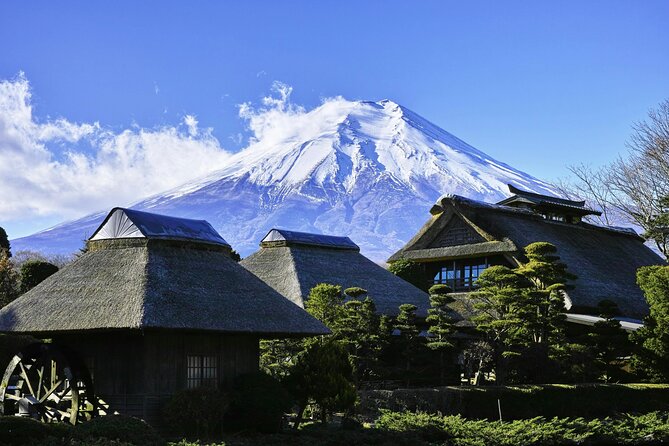
Saiko Iyashi no Sato Nenba is one of the more distinctive stops. The traditional village has thatched-roof houses, views toward Mt. Fuji, and the option to dress in a kimono or samurai armor. Admission is 500 yen extra.
This stop adds a hands-on cultural element to a day otherwise filled with scenery. If you enjoy photographs and traditional dress, plan to use the full hour. If you prefer quiet village views, you can simply walk through the buildings and countryside.
Lava tubes and a short forest walk
Fugaku Wind Cave is a lava tube at Mt. Fuji’s base. Inside, the temperature stays cold enough for natural ice to remain for much of the year. Admission is 300 yen extra, and the visit lasts around 30 minutes.
The cave is a compact stop, but it gives you a physical sense of Mt. Fuji’s volcanic past. Wear shoes suitable for uneven surfaces, since the provided schedule does not promise a long visit or extensive walking assistance.
The Aokigahara Forest stop is only about 10 minutes. This is a quick walk in one of Japan’s most famous forests, not a long forest outing. The name carries a heavy reputation, but the tour presents it as a brief nature stop at the mountain’s base.
Shiraito Falls provides a stronger finish to the afternoon. A short walk leads to two waterfalls, with local snacks available nearby. You have about 40 minutes, enough to enjoy the water and take photographs without turning the stop into a long hike.



Nagoya after dark
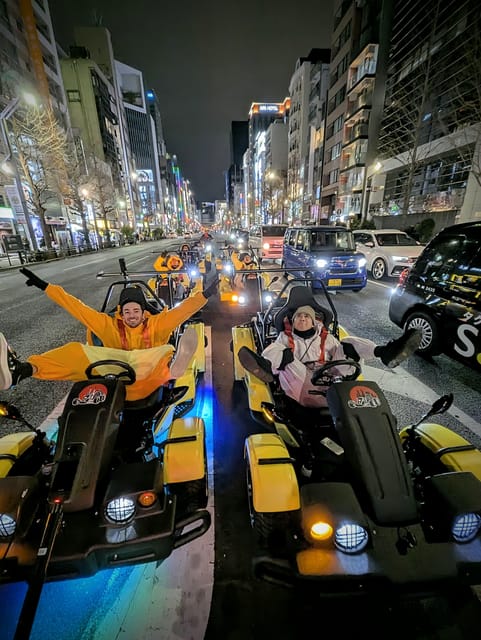
The day ends in Nagoya, where you spend about an hour in the Sakae district. This area is known for colorful shops and restaurants, so it is a useful chance to choose your own dinner. Meals are not included in the tour price.
One hour is short for Nagoya, and this is not a full city tour. Think of it as an evening stop that breaks up the long transfer between Mt. Fuji and the Kansai region. If you want to sample local food, ask the guide for help choosing among the restaurants.
Day 3: Nara deer, Kyoto temples, and Osaka’s Dotonbori

Day 3 packs three major destinations into one day. It begins at Nara Park, where you take a guided walk among the deer. You have about two hours, making this the most generous stop of the trip.
The deer are famous for approaching people, and some can be very eager around food. Follow the guide’s instructions and keep a close eye on maps, tickets, and snacks. The park itself gives you room to walk, but the deer are the main attraction here.
Todaiji Temple follows. Founded in 738, it houses one of the world’s largest bronze Buddha statues inside a huge wooden building. Admission is 800 yen and extra. You have around an hour, enough to see the main hall and several large sculptures and artworks.
Todaiji is one of the places where the short schedule still works reasonably well. The scale of the building makes an immediate impression, even if you do not have time to study every detail.
In Kyoto, Kiyomizu-dera is the first major stop. This World Heritage temple is reached by routes intended to avoid the heaviest crowds, and traditional shops line the approach. Admission is 500 yen extra, with about an hour at the temple.
The old shops are part of the experience, but they also make the approach busy. Keep the meeting time in mind, since it is easy to spend your entire visit browsing food and craft stalls.
Entoku-in offers a quieter contrast. It was the family home and garden of Nene, the wife of Toyotomi Hideyoshi, and was built in 1605. The stop lasts around 40 minutes. A short tea ceremony is available for an additional 1,300 yen.
This is a good optional extra if you want a small, traditional cultural activity rather than another large temple. Since the ceremony costs extra and time is limited, decide in advance if it matters to you.
Arashiyama and Fushimi Inari in a single afternoon
Arashiyama’s famous bamboo forest receives about an hour. The grove is photogenic, but its reputation means it can feel crowded, especially at popular times. The tour offers a less crowded bamboo grove at Kotoku-in as a substitute if the schedule is tight.
That flexibility is useful. You will not get a long, solitary walk through the bamboo, but you can still see the setting and combine it with Kyoto’s western temple district.
Fushimi Inari-taisha is the final Kyoto sight. More than 10,000 orange torii gates form a path up the mountain, and the main structure dates to 1499. The shrine began as a place connected with rice and agriculture, while today the torii-lined route is its signature view.
You have around 40 minutes, which is enough to walk through the first section of gates. It is not enough to climb the entire mountain trail. Stay near the lower route if you want to return to the vehicle on time.
The tour ends in Osaka’s Dotonbori entertainment district. You have an hour to explore the back alleys, signs, and restaurants. This is another self-directed food stop, since dinner is not included.
Dotonbori is a fitting finish because it feels very different from Nara’s park and Kyoto’s temples. You can use the hour for a meal, a short walk, or both, but not an extended Osaka night out.
Price, inclusions, and the real value

The listed cost is $1,310.55 per person. That is a substantial price for three days, but the comparison is not simply three days of sightseeing. The fee covers an air-conditioned vehicle, WiFi onboard, parking, road tolls, two breakfasts, and 3-star accommodation.
It also pays for a guide, route planning, and the ability to connect remote or awkwardly linked sights without handling several train changes and luggage transfers yourself. For a first visit, that convenience can be worth a lot.
You should budget extra for admission fees. The stated costs include 2,000 yen for the Hakone Ropeway, 1,700 yen for the pirate ship, 500 yen for Saiko Iyashi no Sato Nenba, 300 yen for Fugaku Wind Cave, 800 yen for Todaiji, 500 yen for Kiyomizu-dera, and possibly 1,300 yen for the tea ceremony.
Lunch and dinner are also extra. Enoshima, Nagoya, and Dotonbori provide natural places to buy meals, but the price of food is not part of the package.
I see the best value here for someone who would otherwise book several private transfers or day trips. If you are comfortable using Japan’s trains and want to spend several days in each city, a self-guided trip may cost less and feel calmer. If you have only a few days and want to cover a broad route, the included transport and planning do real work.
Who should book this tour

I would recommend it to a first-time visitor who wants a broad introduction to central Japan and does not mind moving quickly. It also suits families and mixed-age groups because the route can be tailored and most travelers can participate, according to the provided activity information.
The tour is a good match if you value:
- Seeing Mt. Fuji from several locations instead of relying on one viewpoint
- Mixing shrines and temples with food stops, villages, caves, and city nightlife
- Having an English-speaking guide explain cultural details
- Avoiding the work of arranging transport between Tokyo, Hakone, Mt. Fuji, Nara, Kyoto, and Osaka
- Adding extra time in Tokyo or continuing later toward Hiroshima or back to Tokyo through the Japan Alps
I would hesitate if your priority is slow photography, long temple visits, or independent evenings. The schedule often gives you 20 to 60 minutes at a place, and the final day in particular is packed.
The activity is offered with pickup and mobile ticketing, and service animals are allowed. Confirmation is normally provided at booking, subject to availability for bookings made within one day of departure. Cancellation gives a full refund up to six full days before the start, 50 percent from two to six days before, and no refund within two days.
Should you book the 3 Day Japan Highlights Tour?

Book it if you want maximum geographic coverage with minimum planning. The route gives you Kamakura’s Buddhist monuments, Hakone’s volcanic scenery, Mt. Fuji’s villages and lakes, Nara’s deer and Todaiji, Kyoto’s best-known temples, and Osaka nightlife in a single sweep.
Do not book it expecting a restful holiday. You will spend long hours on the road and make several short visits, with extra costs for many admissions and all lunches and dinners.
For the right person, the tour’s greatest strength is its range. The flexibility associated with guide Matt is another strong reason to consider it, especially if you tell him early that temples, food, scenery, or local customs matter most to you. I would choose this trip for a first visit with limited time, then return later for slower days in Kyoto, Tokyo, or the Japanese Alps.
FAQ

Where does the tour start?
The listed starting point is Narita Airport Terminal 2 and 3 Station in Narita, Japan. Pickup is also offered from a hotel or port of entry in Tokyo or Narita.
Where does the tour end?
The activity ends at a different location from the starting point. The route finishes with time in Osaka’s Dotonbori district, but the supplied details do not specify the exact final drop-off point.
What is included in the price?
The price includes WiFi onboard, an air-conditioned vehicle, parking fees, road tolls, 3-star accommodation, and two breakfasts.
Are meals included?
Two breakfasts are included. Lunch and dinner are not included, so you should budget for meals at stops such as Enoshima, Nagoya, and Dotonbori.
How large is the group?
The group can have a maximum of 23 travelers.
What is the cancellation policy?
You receive a full refund when you cancel at least six full days before the start time. Cancellation two to six days before receives a 50 percent refund, while cancellation less than two full days before receives no refund.
More tours in Narita we've reviewed



Mt Fuji Day Trips, compared.
 ★ 5.0Mt Fuji and Hakone 1-Day Bus Tour Return by Bullet TrainFrom $163
 ★ 4.0Mt Fuji & Hakone Cruise, Drum Show Bullet Train 1 Day from TokyoFrom $149
 ★ 4.4Tokyo Mt Fuji 5th St & Hakone Cruise Bus Tour w/Bullet TrainFrom $15410 hours
 ★ 4.5From Tokyo: Mount Fuji Full-Day Sightseeing TripFrom $6810 hours
 ★ 4.7Tokyo: Mt. Fuji Tour, Hakone Ropeway, Owakudani, Lake AshiFrom $5410 hours
 ★ 4.4Tokyo:Mt.Fuji,Kawaguchiko Oishi Park,Arakurayama Sengen ParkFrom $5410 hours